
Cambridge English works differently from every other exam in this series, and the difference is worth understanding before you book. You do not pass or fail a level. You sit an exam aimed at a level and get placed on a single shared scale — and that scale can hand you a certificate one level above or one level below the exam you walked in to take.
It is also the only major English qualification here whose certificate does not expire. IELTS, TOEFL and PTE scores are generally treated as valid for two years. A Cambridge certificate is yours permanently.
One scale, three overlapping exams
Since 2015 all Cambridge English exams report on the Cambridge English Scale. You get a score for each skill — Reading, Writing, Listening, Speaking, and Use of English where it is tested — an overall score averaged from those, a grade, and a CEFR level.
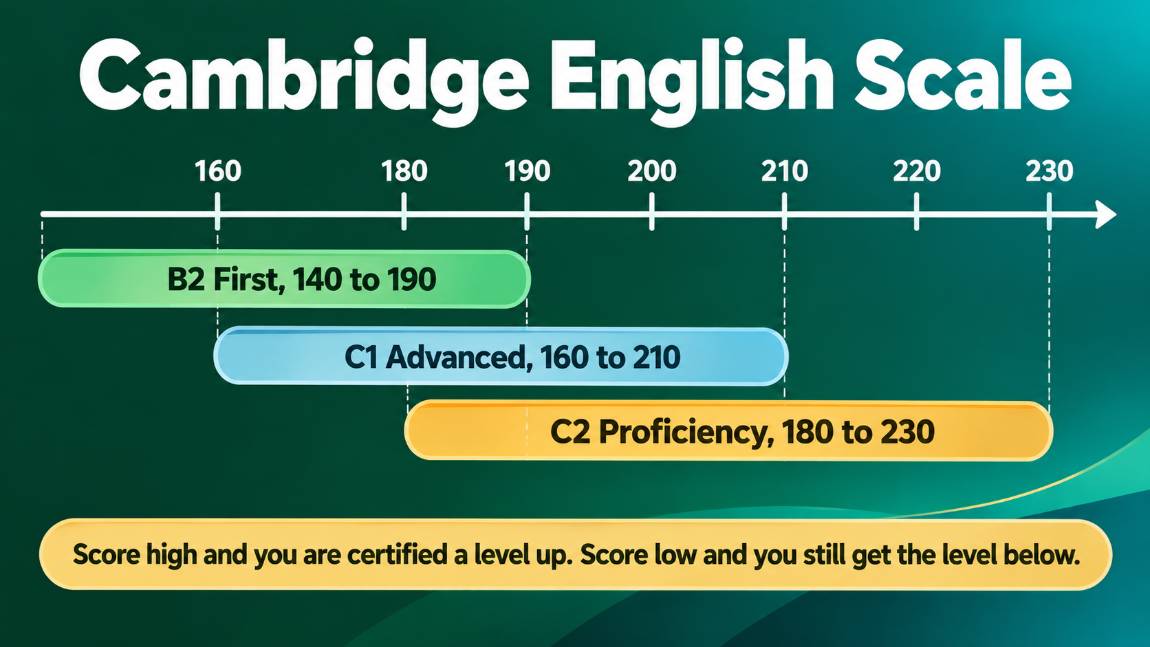
The bars overlap deliberately. The same score means the same ability whichever exam produced it, which is what makes the overlap safe.
What each grade actually gets you
B2 First reports from 140 to 190:
| Grade | Score | Certificate awarded |
|---|---|---|
| A | 180–190 | C1 |
| B | 173–179 | B2 |
| C | 160–172 | B2 |
| Level B1 | 140–159 | B1 |
Below 140 — between 122 and 139 — you receive a Statement of Results and no certificate.
C1 Advanced reports from 160 to 210:
| Grade | Score | Certificate awarded |
|---|---|---|
| A | 200–210 | C2 |
| B | 193–199 | C1 |
| C | 180–192 | C1 |
| Level B2 | 160–179 | B2 |
C2 Proficiency reports from 180 to 230. A score of 200 or above earns the C2 certificate; 180 to 199 earns a C1 certificate instead; below 180 produces a score report only.
The practical reading of those tables: sitting one level up is less risky than it feels. A candidate who takes C1 Advanced and underperforms does not walk away empty-handed — at 160 to 179 they still earn a B2 certificate, which is exactly what passing B2 First would have given them. The real cost of aiming high is the exam fee and the preparation time, not the result.
The reverse also holds, and it is the more common mistake. Sitting comfortably below your level caps what you can be awarded. A genuine C1 candidate who books B2 First can score 190, the very top of the scale, and still only be certified at C1 — never C2.
Which exam to book
Book B2 First if you need to demonstrate upper-intermediate English for a job, a visa or a university foundation course, or if you are not yet confident in extended academic writing.
Book C1 Advanced if you are applying to an English-medium university or a professional role. It is the Cambridge exam most universities name, and its scale reaches C2 if you perform well.
Book C2 Proficiency only if you genuinely work at near-native level. It is 236 minutes long — reading and use of English 90 minutes, writing 90, listening 40, speaking 16 in pairs — and the fallback at 180 to 199 is a C1 certificate you could have earned more cheaply.
How this compares with IELTS and TOEFL
| Cambridge | IELTS | TOEFL | |
|---|---|---|---|
| Result | Scale score, grade and CEFR level | Band 1–9 | Band 1.0–6.0 since January 2026 |
| Expires | No | Typically treated as 2 years | Typically treated as 2 years |
| Level sat | You choose an exam aimed at a level | One test for all levels | One test for all levels |
| Can you be certified elsewhere? | Yes, one level up or down | Not applicable | Not applicable |
| Speaking | Face to face, in pairs | Face to face | Recorded, 8 minutes |
The paired speaking test is the Cambridge feature candidates most often underestimate. You are assessed partly on interaction — asking your partner questions, responding, building on what they said. A flawless monologue delivered at someone is not what the criteria reward.
Preparing without guessing
Cambridge publishes sample papers and answer keys for every exam on its own site, along with the assessment criteria for Writing and Speaking. As with IELTS, the comprehension papers mark themselves and the productive skills do not — read the criteria before you write, not after.
Three things worth building into practice:
Use of English is its own skill. It sits inside the Reading paper at B2 First and C1 Advanced and tests control of form — word formation, key word transformations, collocation. It is the section that most separates candidates who have learned English through exposure from those who have studied it, and it is highly trainable.
Rehearse speaking with a partner, not a mirror. The interaction marks are real and you cannot practise them alone.
Sit the whole paper timed. C2 Proficiency in particular is close to four hours.
Where to go next
If you are choosing between English qualifications rather than Cambridge levels, our comparisons of IELTS, TOEFL, PTE and Duolingo and English test score requirements by country are the places to start — and note the lifetime validity point above, because it changes the maths if you expect to need proof of English more than once.
For what official practice material each board actually provides, we have written the same guide across the board: IELTS, TOEFL, PTE Academic, TOPIK, JLPT, DELF, DELE and the Goethe-Zertifikat.
Frequently asked questions
Do Cambridge English certificates expire?
No. Unlike IELTS, TOEFL and PTE scores, which are generally treated as valid for two years, a Cambridge certificate does not expire. Individual institutions may still prefer a recent one.
Can I get a C1 certificate from B2 First?
Yes. A grade A at B2 First, meaning a score of 180 to 190, is certified at CEFR level C1.
What happens if I fail C1 Advanced?
If you score 160 to 179 you are awarded a B2 certificate rather than nothing. Below 160 you receive a score report only.
Which Cambridge exam do universities want?
Usually C1 Advanced. Check the specific requirement, since some accept B2 First at grade A and some ask for C2 Proficiency.
Is it better to sit a higher exam and risk it?
Often, yes. The scales overlap, so underperforming on a higher exam usually still earns the certificate below it. The cost is the fee and the preparation, not a wasted attempt.
What is Use of English?
A section testing control of grammar and vocabulary through word formation, transformations and gap tasks. It sits within the Reading paper at B2 First and C1 Advanced and is one of the most trainable parts of the exam.