
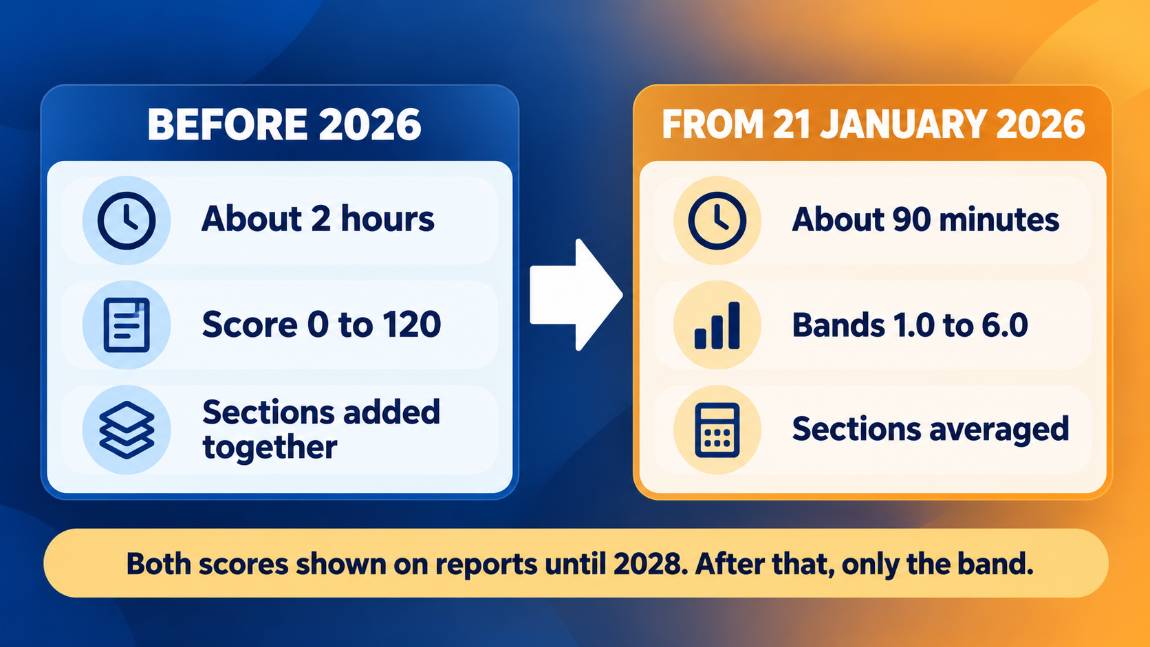
On 21 January 2026 the TOEFL iBT changed more than it has in twenty years. The test is now about 90 minutes instead of roughly two hours, Reading and Listening adapt to your performance as you go, and — the change that matters most — the 0–120 total score has been replaced by a band from 1.0 to 6.0, averaged across the four sections rather than added up.
If you are reading advice written before that date, and most TOEFL advice online still is, it is describing a test that no longer exists.
What the test looks like now
Twelve tasks across four sections, taken in a fixed order: Reading, then Listening, then Writing, then Speaking.
| Section | Time | Task types |
|---|---|---|
| Reading | up to 30 min | Complete the Words; Read in Daily Life; Read an Academic Passage |
| Listening | up to 29 min | Listen and Choose a Response; Listen to a Conversation; Listen to an Announcement; Listen to an Academic Talk |
| Writing | 23 min | Build a Sentence; Write an Email; Write for an Academic Discussion |
| Speaking | 8 min | Listen and Repeat; Take an Interview |
| Total | about 90 min | 12 tasks |
Two things in that table deserve more attention than they usually get.
Speaking has collapsed to eight minutes. It is now two task types: repeating seven short sentences against a visual cue, and an interview of three or four questions with no preparation time and 45 seconds per answer. The old independent and integrated speaking tasks, with their 15 or 20 seconds to think, are gone. If you prepared for TOEFL speaking by learning to build a structured answer during the prep window, that skill no longer has a window to live in.
Reading and Listening are adaptive. Question difficulty shifts with your performance, which means two candidates sit measurably different tests. It also means the total time varies — roughly 83 to 89 minutes of testing depending on how you are routed — and that you cannot flag and return across stages the way you could before.
Writing, by contrast, grew: from 16 minutes to 23, and it now includes short constructed tasks alongside the academic discussion post.
The scoring change, and why it matters more than the format
Each section is scored from 1.0 to 6.0 in half-point steps, and the overall score is the average of the four, not the sum. The bands are aligned to CEFR levels.
This is not a cosmetic relabelling. Under the old system a very strong Reading score could carry a weak Speaking score, because 30 points is 30 points wherever they come from. Under an average, every section pulls with equal weight and a single weak section drags the whole band down in a way that is much harder to compensate for. A candidate at 5.5, 5.5, 5.5 and 3.5 averages 5.0 — and no amount of extra Reading strength fixes that.
Both scores appear on reports through 2028. After that, only the band. In the meantime you will meet institutions quoting requirements in the old currency, and the rough correspondence is the thing to know: B2, the most commonly required level, sits at roughly 72–93 on the old 0–120 scale.
If you hold an older score, it remains valid for its usual two years and reports issued during the transition show both scales. The practical risk is not your score being rejected; it is quoting the wrong scale to an institution, or an institution quoting the wrong scale to you. Ask which they mean.
Official practice material
ETS's own portal is TOEFL TestReady, which you sign into with a free ETS account. The split between free and paid is clear:
| Free | Paid |
|---|---|
| One full-length practice test with automated scoring and feedback on all four sections, including personalised comments on Speaking and Writing | Section Tests and Section Practice |
| A rotating daily activity from one section | Focused Practice |
| A study plan generated from a five-question survey | TOEFL Practice Online (TPO) |
| Sample items from each skill section | The Official Guide and the Official TOEFL iBT Tests volumes |
That one free full-length test with automated Speaking and Writing feedback is the single most valuable free item in this whole series. IELTS gives you free questions but no marking of the productive skills. ETS gives you one properly scored run, free, including the two sections you cannot mark yourself. Do not spend it carelessly — sit it timed, early, before you have studied to the test.
A caution on everything else: because the format changed in January 2026, a great deal of third-party TOEFL practice still drills the old tasks. Any material offering 20-second speaking preparation time, or scoring you out of 120, was built for the previous test.
How this changes preparation
Speaking is now about fluency under no preparation. With 45 seconds per interview question and no thinking time, rehearsed templates do not fit. What helps is volume of unprepared speaking — answering questions aloud, immediately, on ordinary topics — rather than memorised frames.
Your weakest section decides your band. Under an average, the efficient move is always to lift the lowest section. Work out which one that is from the free scored test, not from instinct.
Practise adaptively-paced reading. You cannot bank time by rushing an easy passage and returning later. Steady accuracy beats speed.
Check the scale in every requirement you read. Until 2028, "TOEFL 90" and "TOEFL 4.5" may be the same requirement written two ways, and they may not.
Where to go next
If you are still choosing a test, our comparisons of IELTS, TOEFL, PTE and Duolingo and IELTS versus PTE versus TOEFL set out the trade-offs, and English test score requirements by country covers what institutions actually ask for.
We have written this guide for the other major boards too, and the contrast in how much they give away is instructive: IELTS, PTE Academic, TOPIK, JLPT, DELF, DELE and the Goethe-Zertifikat.
For how long the underlying English takes to build, rather than how to sit the test, the FSI language difficulty ranking is the honest baseline.
Frequently asked questions
When did the TOEFL change?
21 January 2026. Anyone testing on or after that date takes the new format.
Is the TOEFL still scored out of 120?
Not as its primary scale. Each section now gets a band from 1.0 to 6.0 and the overall score is their average. Score reports show both the band and the old 0–120 total through 2028; after that, only the band.
How long is the new TOEFL?
About 90 minutes of testing — roughly 83 to 89 depending on adaptive routing — against roughly two hours before. ETS advises allowing about two hours for the whole appointment.
Is my old TOEFL score still valid?
Yes, for its normal validity period. The risk during the transition is mismatched scales, not rejection — confirm with the institution which scale their requirement refers to.
Is there a free official TOEFL practice test?
Yes. TOEFL TestReady includes one full-length practice test with automated scoring and feedback on all four sections, including Speaking and Writing. It is the most generous free item any major board offers.
How much speaking preparation time do I get?
None in the interview task. You get 45 seconds to answer each of three or four questions, with no thinking time beforehand.