
There are no official JLPT past papers. Not one. Unlike the TOPIK, which publishes a complete paper free every year, the Japan Foundation and JEES have never released a used JLPT exam — and the collections circulating online under titles like "JLPT past papers 1991 to 2023" are not official releases, whatever the file names suggest.
What does exist is better than most people realise, and it is free. The official site publishes two complete sets of sample questions for every level from N5 to N1, with listening audio, answer keys, listening scripts and blank answer sheets. On top of that sit two paid workbooks built from real post-2010 test material. That is the entire legitimate supply, and this guide covers how to get the most out of it.
What officially exists
| Material | What it is | Cost |
|---|---|---|
| 2018 sample questions | Sample items for N1–N5, in the current test format | Free on jlpt.jp |
| 2012 sample questions | An earlier set for N1–N5, same format | Free on jlpt.jp |
| 2009 new-test sample questions | Published when the N1–N5 structure replaced the old levels 1–4 | Free on jlpt.jp |
| Official Practice Workbook (2012) | All levels, described by the test's own publishers as having almost as many questions as a real test | Paid, from Bonjinsha |
| Official Practice Workbook Vol. 2 (2018) | All levels, questions drawn from tests since the 2010 revision | Paid, from Bonjinsha |
The free sample sets are more substantial than the word "sample" suggests. For each level you get separate PDFs by test section — N1 and N2 split Vocabulary, Grammar and Reading into three files, while N3 to N5 combine Grammar and Reading — plus MP3 listening audio, the answer keys, the full listening scripts, and a blank answer sheet. There is also a set of explanatory materials aimed at teachers, which is worth reading even if you are studying alone, because it explains what each question type is designed to measure.
One limitation to know about: the site notes copyright restrictions on some third-party material, which particularly affects certain N1 and N2 reading passages and all of the listening audio. Download it for your own use and leave it there.
The two paid workbooks are the closest thing to a past paper that exists. Volume 2 in particular is built from questions used in actual tests after the 2010 revision, which is as near as the official supply gets to the real thing. If you are serious about N2 or N1, they are worth the money, because the free samples alone will not fill the gap.
Where to find them
Go to jlpt.jp, switch to the English site if you need it, and open the samples index. Everything free is on that one page, organised by year of release and then by level. The workbooks are sold by Bonjinsha rather than by JLPT itself, so they are a separate purchase.
Be sceptical of everything else. Sites offering decades of "past papers" are hosting scans of uncertain provenance, often mixing pre-2010 papers from the old four-level test — which used a different structure, different scoring and a different syllabus — with newer material. Practising on a 1998 Level 2 paper tells you very little about N2 today.
How the scoring works, and why it matters for practice
This is the part that changes how you should use the material, because the JLPT does not pass you on your total alone.
| Level | Scoring sections | Pass mark | Sectional minimum |
|---|---|---|---|
| N1 | Language Knowledge /60, Reading /60, Listening /60 | 100 / 180 | 19 in each section |
| N2 | Language Knowledge /60, Reading /60, Listening /60 | 90 / 180 | 19 in each section |
| N3 | Language Knowledge /60, Reading /60, Listening /60 | 95 / 180 | 19 in each section |
| N4 | Language Knowledge and Reading /120, Listening /60 | 90 / 180 | 38 and 19 |
| N5 | Language Knowledge and Reading /120, Listening /60 | 80 / 180 | 38 and 19 |
You must clear both the overall mark and every sectional minimum. Fall below 19 in one section and you fail regardless of your total — a candidate scoring 140 on N1 with 18 in listening does not pass. Miss a section entirely and you fail with no section scores reported at all.
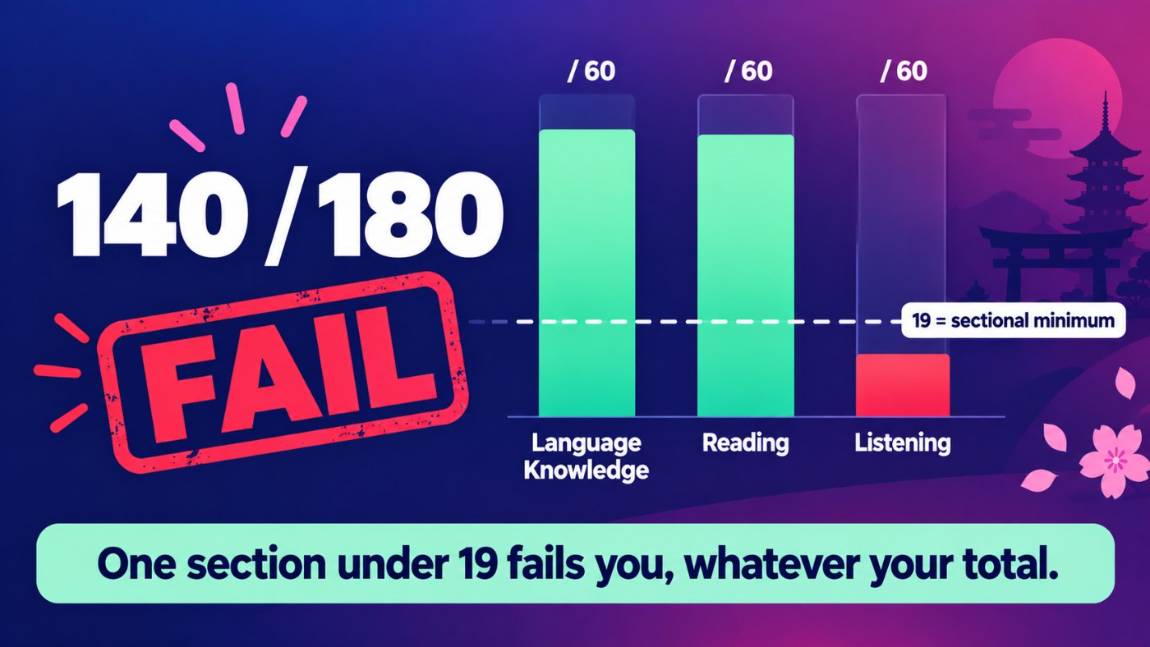
Two things follow. First, N3's pass mark is higher than N2's — 95 against 90 — which looks like a misprint and is not. The marks are set against different difficulty curves, so they are not comparable across levels. Second, the sectional minimum makes your weakest skill the only one that matters once you are near the line. Most self-study learners are strong on vocabulary and grammar and weak on listening, which is precisely the shape the sectional rule is designed to catch.
A further wrinkle: the JLPT uses scaled scoring rather than raw marks, so the number of questions you got right does not convert directly into a section score. When you mark a free sample set, treat the proportion correct as a rough guide to whether you are near the threshold, not as a predicted score.
Using the supply well
There is not much of it, so do not waste it.
Sit one full set cold, timed, before you study anything. The sample sets are the closest free approximation of the real paper, and their value as a baseline is spent the moment you have looked at the answers. Take the baseline first.
Keep the other set for the month before your exam. Two timed sets separated by real study give you a trend. Two sets taken in the same week give you nothing.
Play the listening audio once. The listening section is where the sectional minimum bites hardest and where replaying a track does the most damage to the measurement.
Read the teacher materials. Knowing that a particular grammar question type is testing your ability to order a scrambled sentence, rather than to recognise a form, changes how you approach it. That information is sitting in a document most candidates never open.
Then move to the workbooks. When the free samples run out — and they will, quickly — the two official workbooks are the only remaining material built from real test questions.
When the papers say you are not ready
Practice material measures; it does not teach, and the JLPT is a long road. The FSI language difficulty ranking places Japanese in Category IV, the hardest tier for English speakers, at roughly 2,200 class hours to professional working proficiency. A sample set that goes badly in month six is a reading of month six.
Where the sets tend to expose gaps: our guides to the wa and ga particles and to the writing systems cover the two areas that most often cost reading marks, and the 100 most common kanji list is the fastest route to lifting reading speed at N5 and N4.
For the levels themselves, see JLPT levels explained and the JLPT to CEFR score guide. For structured plans, the N5 three-month plan and the N5 to N4 in four months plan. And for practice beyond the official supply, JLPT mock test apps covers what the app ecosystem offers.
If you are curious how other exam boards handle this, the contrast is stark: TOPIK releases one complete paper every year for free, and the Goethe-Institut gives away three or four per level.
Frequently asked questions
Are there official JLPT past papers?
No. The Japan Foundation and JEES have never released a used JLPT exam. The official supply is two free sample-question sets per level and two paid practice workbooks.
What about the "JLPT past papers 1991 to 2023" collections online?
Those are not official releases. They typically mix scans of uncertain provenance, and much of the older material comes from the pre-2010 four-level test, which had a different structure and syllabus. A 1998 Level 2 paper tells you little about N2 today.
Are the official sample questions free?
Yes. The PDFs, listening MP3s, answer keys, listening scripts and answer sheets are all free from jlpt.jp for N1 through N5, in both the 2012 and 2018 sets.
Are the official practice workbooks worth buying?
For N2 and N1, yes. Volume 2 is built from questions used in real tests after the 2010 revision, which is the closest the official supply comes to a past paper, and the free samples alone are not enough at those levels.
Why is the N3 pass mark higher than N2's?
N3 requires 95 out of 180 and N2 requires 90, because the marks are set against each level's own difficulty curve. The numbers are not comparable across levels.
Can I pass with a high total but a weak section?
No. You need the overall pass mark and at least 19 in each scored section, or 38 for the combined Language Knowledge and Reading section at N4 and N5. One section below the minimum fails you whatever your total.