
Three months to pass the JLPT N5 is tight but absolutely doable — if you use your time wisely. The N5 is the entry-level Japanese proficiency test, designed for people who've mastered basic Japanese. It tests hiragana, katakana, about 100 kanji, 800 vocabulary words, and fundamental grammar patterns.
This isn't a vague "study Japanese for three months" guide. It's a week-by-week plan with specific targets, resources, and milestones so you know exactly where you should be at every point.
What JLPT N5 Actually Tests
Before diving into the plan, let's be clear about what you're preparing for. The N5 exam has three sections: Language Knowledge (Vocabulary), Language Knowledge (Grammar) and Reading, and Listening. The total test time is about 90 minutes.
You need to score at least 80 out of 180 overall, with a minimum of 19 points in each section. That means you can't completely ignore any section — even if your listening is strong, bombing the vocabulary section will fail you.
The vocabulary section tests roughly 800 words and 100 kanji. Grammar covers about 75 sentence patterns. Reading involves short passages using N5-level vocabulary and grammar. Listening uses slow, clear speech about everyday topics.
Before You Start: Week 0 Preparation
Spend a day or two before your three months begin getting these foundations in place: download Anki (free flashcard app) and install an N5 vocabulary deck, bookmark the Tae Kim grammar guide (free online), get a copy of Genki I textbook (or use free alternatives), and set up a daily study time — consistency matters more than duration.
You'll need to commit to approximately 1-2 hours per day, 6 days a week. One day off per week prevents burnout. If you can do more, great, but 1-2 hours daily is the minimum for this timeline.
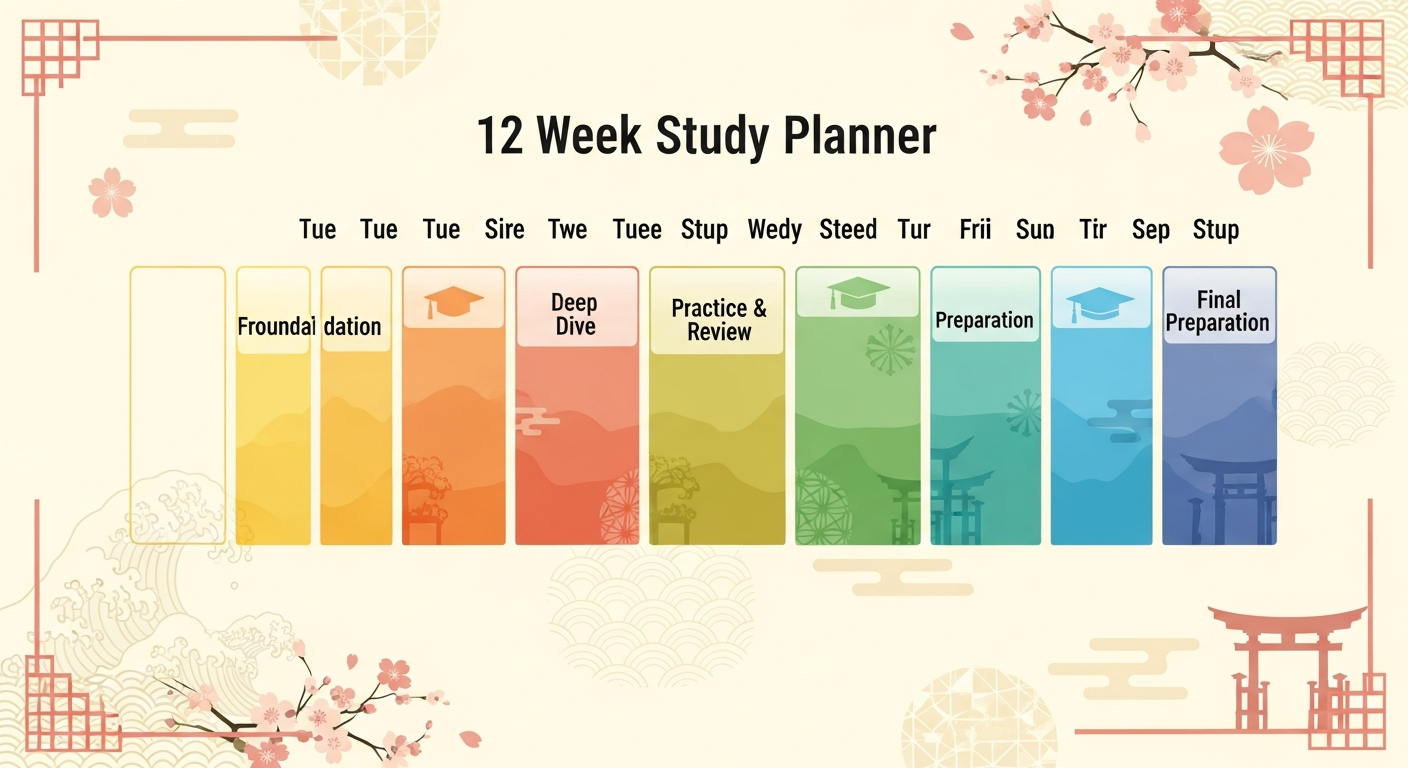
Month 1: Foundations (Weeks 1-4)
Week 1-2: Hiragana and Katakana
This is non-negotiable and must come first. Every minute you spend before mastering these writing systems is wasted.
Hiragana (Week 1): Learn all 46 basic characters plus dakuten variations (ga, gi, gu, etc.) and combination characters (kya, kyu, kyo, etc.). Use the "write it ten times" method: for each character, write it, say it aloud, write it again. Aim to learn 10-15 characters per day.
By the end of week 1, you should be able to read any hiragana word slowly but correctly. Speed comes later.
Katakana (Week 2): Same approach, same number of characters. Katakana is harder to retain because you'll see it less frequently in beginner materials. Use it actively — practice writing foreign words you know in katakana (koohii for coffee, terebi for television, etc.).
Daily routine weeks 1-2: 30 minutes writing practice, 15 minutes Anki reviews, 15 minutes reading practice (children's materials or simple Japanese texts).
Week 3-4: First Kanji and Vocabulary Push
Start learning your first 30 kanji alongside the 200 most common N5 vocabulary words. Don't try to learn kanji in isolation — learn them through vocabulary.
Focus on the most useful kanji first: numbers (一 through 十), time-related kanji (日, 月, 年, 時, 分), person/people (人, 子, 男, 女), and basic verbs in kanji form (見る, 食べる, 行く, 来る).
Daily routine weeks 3-4: 20 minutes new kanji/vocabulary, 20 minutes Anki reviews, 20 minutes Genki I Chapter 1-2 grammar, 15 minutes listening practice (NHK World Easy Japanese or JapanesePod101 beginner episodes).
Month 1 milestone: You can read hiragana and katakana fluently, know 30 kanji and 200 vocabulary words, and can form basic self-introduction sentences.
Month 2: Building Grammar and Expanding Vocabulary (Weeks 5-8)
Week 5-6: Core Grammar Patterns
This is where Genki I (Chapters 3-6) or Tae Kim's guide becomes your primary resource. Focus on these essential grammar patterns: particle usage (は, が, を, に, で, へ, と, も, から, まで), verb conjugation (present, past, negative forms for both polite and casual), adjective types (い-adjectives and な-adjectives with conjugations), and basic sentence structures (XはYです, existence verbs いる/ある).
Don't just read grammar explanations — practice each pattern by creating your own sentences. Write 5-10 example sentences for every grammar point you study.
Daily routine weeks 5-6: 30 minutes grammar study, 20 minutes Anki vocabulary/kanji reviews (you should be doing 50-100 reviews daily now), 15 minutes reading practice (Genki I exercises), 15 minutes listening (increase to intermediate beginner content).
Week 7-8: Vocabulary Expansion and Reading
Push your vocabulary to 500+ words. At this point, Anki is doing heavy lifting — you should be adding 10-15 new words daily while reviewing older cards. Focus on topic clusters: family members, food and drink, daily activities, weather, shopping, directions, and time expressions.
Start doing N5 reading practice with short passages. Websites like Tadoku (free graded readers) offer Level 0 and Level 1 stories perfect for this stage.
Month 2 milestone: You know 60+ kanji and 500+ vocabulary words. You can understand and produce simple sentences using the core grammar patterns. You can read very short passages with dictionary help.

Month 3: Test Preparation and Practice (Weeks 9-12)
Week 9-10: Complete Grammar and Fill Vocabulary Gaps
Finish the remaining N5 grammar patterns: te-form (very important for the exam), request forms (ください), desire expressions (たい), and comparison patterns. Continue pushing vocabulary toward 700-800 words.
Start doing full N5 practice tests. Use official JLPT practice materials (available from the Japan Foundation) or websites like JLPT Sensei and Japanesetest4you. After each practice test, analyze your mistakes — are they vocabulary, grammar, or listening errors?
Daily routine weeks 9-10: 20 minutes grammar review, 20 minutes Anki reviews, 30 minutes practice test sections (rotate between vocabulary, grammar/reading, and listening), 15 minutes targeted weak area practice.
Week 11: Full Practice Tests
Do at least two complete timed practice tests this week. Simulate real test conditions: set a timer, don't use a dictionary, and do all sections in one sitting.
After each practice test, spend time reviewing every single wrong answer. Understand why the correct answer is correct, not just that you got it wrong. This review process is where the biggest learning happens in the final weeks.
Target score on practice tests: 120+ out of 180. If you're consistently scoring above 120, you're well-positioned to pass. If you're between 80-120, focus your remaining time on your weakest section.
Week 12: Final Review and Test Strategy
Don't learn new material this week. Focus entirely on review and strategy: review your most-missed Anki cards, re-read grammar points you've struggled with, do one final practice test, and plan your test day logistics.
Test day strategy: For the vocabulary section, if you don't know a word, eliminate obviously wrong answers and guess — there's no penalty for wrong answers. For grammar and reading, read the question first, then find the answer in the passage. For listening, listen for keywords rather than trying to understand every word.
Essential Resources
Free: Tae Kim's Guide to Japanese Grammar, Anki flashcard app with N5 decks, NHK World Easy Japanese, JLPT Sensei website, Tadoku free graded readers.
Paid (recommended): Genki I textbook (the gold standard for structured learning), official JLPT N5 practice test workbook, WaniKani (for systematic kanji learning, though optional for N5).
Apps: Anki (flashcards, essential), Bunpo (grammar practice), HelloTalk (conversation practice with native speakers).
Common Mistakes to Avoid
Spending too long on hiragana/katakana. Two weeks maximum. Some guides suggest a month — that's too long for a three-month timeline. Get them to "readable" in two weeks and let daily exposure build speed.
Ignoring listening practice. Many self-studiers underestimate the listening section because they focus on reading. Listen to Japanese every day, even if it's just 15 minutes of easy content.
Trying to learn too many kanji. N5 only requires about 100 kanji. Don't get drawn into learning 500+ kanji before the test — that time is better spent on vocabulary and grammar.
Not doing practice tests. Practice tests reveal gaps that studying alone can't find. The format, timing, and question styles of the JLPT are specific — you need to be comfortable with them before test day.
Is Three Months Realistic?
Yes, for most people, three months of consistent daily study (1-2 hours) is sufficient for JLPT N5. The key word is "consistent." Three months of sporadic study with long gaps won't work. If you follow this plan and stay on track with the weekly milestones, you should be well-prepared on test day.
For a broader overview of all JLPT levels and what they require, check out our complete JLPT Levels Explained guide.