
The Goethe-Institut gives away more practice material than almost any other exam board, and most candidates use a fraction of it. Every level from A1 to C2 has at least one free Modellsatz — a complete model exam with audio — and most levels add one or more Übungssätze on top. A1 alone has three full papers. B1 has four, because the adult and teenage versions are separate exams with separate material.
All of it is free, all of it is on goethe.de, and none of it requires an account.
Modellsatz and Übungssatz: what the two words mean
This is the distinction that decides how you should use them, and the Goethe-Institut never explains it on the download page.
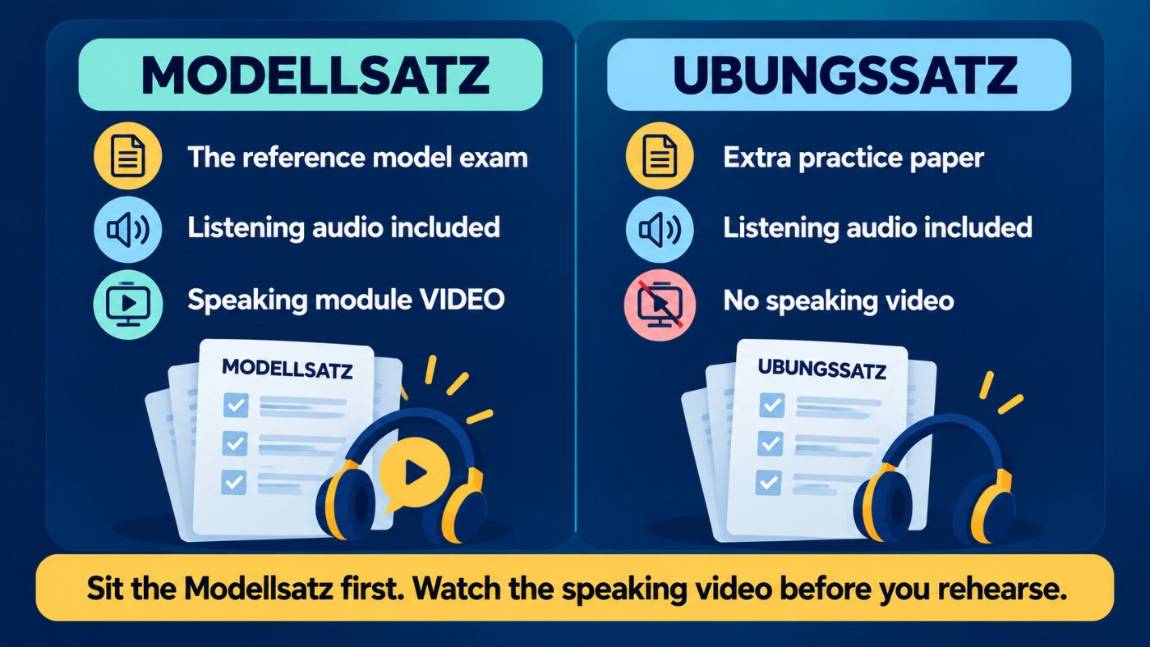
A Modellsatz is the reference paper. It is the one the Institut points to as "this is what the exam looks like", and for several levels it is the only set that includes a video of the speaking module — an examiner and candidates running the real thing. That video is the single most useful item in the whole library, because the speaking test is the part you cannot rehearse from a PDF.
An Übungssatz is an additional practice paper. Same format, different content, listening audio included, but no speaking video. Where a level has two or three of them, they are numbered.
The practical consequence: sit the Modellsatz first, watch the speaking video before you attempt the speaking section yourself, and keep the Übungssätze for later rehearsals.
What is actually available
The library differs by level, so the list below is the shape rather than a promise — check your own level's page before planning around it.
| Level | What you get |
|---|---|
| A1 (Start Deutsch 1) | Modellsatz with listening audio and a speaking video, plus Übungssatz 01 and Übungssatz 02 |
| B1 | Separate Erwachsene (adult) and Jugendliche (teenage) sets — a Modellsatz and an Übungssatz for each, so four complete papers |
| Other levels | At minimum a Modellsatz with audio; most add one or more Übungssätze |
Several levels also offer a barrierefreier Modellsatz — an accessible model test you work through online in the browser rather than downloading. It is built for candidates using screen readers, but it is useful to anyone who would rather practise on screen.
To find your level's page, go to goethe.de, open the page for your exam, and look for Übungsmaterialien. Each entry lists the PDF with its file size and the audio separately, usually as MP4 or MP3.
Adults and teenagers are not the same exam
At B1, the Goethe-Institut runs two versions — Erwachsene and Jugendliche — and they are genuinely different papers, not the same paper with a different cover. The teenage version is built around school, family, friendships and part-time work; the adult version around employment, housing, services and public life.
Both certify B1. Both are equally valid. But practising on the wrong one hands you vocabulary you will not be asked for and leaves you unprepared for the topics you will. Check which version you are registered for before you download anything.
B1 and B2 are modular, and the practice material does not say so
The Goethe-Zertifikat B1 and B2 are modular exams: Lesen, Hören, Schreiben and Sprechen are four separate modules, each passed or failed independently, and you can retake a single failed module rather than the whole exam.
This changes how a practice paper should be read. A full Modellsatz looks like one long ordeal, and candidates sit it as one. But if you are retaking only Schreiben, the other three sections of that PDF are noise — and if you are sitting all four for the first time, knowing that a weak module can be repeated on its own should change where you spend your last two weeks. Spend them on the module nearest the pass line, not on the one you enjoy most.
Each module is scored out of 100 and needs 60 to pass.
Using the papers so the practice transfers
Sit the collective sections in one block, timed. Lesen, Hören and Schreiben run back to back on the day. Practising them on three separate evenings tells you whether you know the German; practising them together tells you whether you can still produce it in the third hour, which is the thing that actually fails people.
Play the listening audio the number of times the paper specifies, then stop. The Goethe listening module plays some texts once and some twice, and it is marked on the assumption that you obeyed that. Replaying a track until you catch it converts a measurement into a vocabulary exercise.
Watch the speaking video before you rehearse speaking. Candidates consistently misjudge the register and the length of their turns. Ten minutes of watching the real thing fixes more than an hour of guessing.
Mark writing against the criteria, not your instinct. German letter conventions — greeting, closing, the Sie or du decision and holding it consistently — carry marks of their own. Dropping them costs points that have nothing to do with how good your German is.
Do not re-sit a paper you have already marked. Once you know the answers you are testing recall, and the score it gives you is flattering and useless.
Where to go when the papers run out
Three or four papers per level sounds like plenty and is gone faster than you expect. Past papers measure; they do not teach. When the gap they expose is grammar, our guides to German cases and der, die, das and German word order cover the two areas that cost the most marks in written production, and the common beginner mistakes guide covers what examiners see most often.
If you are still choosing which German exam to sit, start with which German certificate to choose or the DSH, TestDaF, Goethe and telc comparison. For the Austrian alternative, see the ÖSD Zertifikat guide; for the integration exam, the DTZ format and scoring guide.
And for the question underneath all of it: the FSI language difficulty ranking puts German in Category II at roughly 900 class hours to professional working proficiency. B1 sits well below that. A Modellsatz that goes badly in month four is not a verdict on your ability. It is a reading of month four.
Frequently asked questions
Are Goethe practice papers free?
Yes. Every Modellsatz and Übungssatz on goethe.de is a free download, with the listening audio, and no account is required. Sites charging for them are reselling public files.
What is the difference between a Modellsatz and an Übungssatz?
The Modellsatz is the reference model exam and, for several levels, the only set that includes a video of the speaking module. Übungssätze are additional practice papers in the same format, with listening audio but no speaking video.
How many practice papers are there per level?
It varies. A1 has three — a Modellsatz and two Übungssätze. B1 has four, because the adult and teenage versions each get a Modellsatz and an Übungssatz. Most other levels have at least a Modellsatz plus one Übungssatz.
Do the practice papers come with answers?
The downloads include the answer keys for the comprehension sections and the assessment criteria for writing and speaking. They do not include model essays or worked explanations.
Should I use the Erwachsene or the Jugendliche version?
Whichever you are registered for. They certify the same level and are equally valid, but the topics differ — school and friendships for the teenage version, work and public life for the adult one.
What score do I need to pass?
Each module is marked out of 100 and requires 60 to pass. At B1 and B2 the modules are independent, so you can pass three and retake only the fourth.