
Short answer: the Deutsch-Test für Zuwanderer (DTZ) certifies either A2 or B1 — nothing in between and nothing above. And there is one rule that decides most outcomes: you are awarded B1 overall only if you reach B1 in Sprechen and in at least one written component. Speaking is not one skill among four. It is the one you cannot pass without.
This guide covers the exam's structure, exactly how it is scored, and what that B1 rule means for how you should prepare.
What the DTZ is
The DTZ is the closing language exam of the German Integrationskurs, built specifically for migrants in Germany. It is tied to the B1 learning goal set in the Residence Act for the course's language component, and it is administered in all federal states under uniform standards at centres authorised by the Federal Office for Migration and Refugees (BAMF).
You do not have to attend a course to sit it. Anyone aged 16 or over with Latin-script literacy can take the DTZ to obtain a language certificate.
It is a scaled test, which is the detail most guides skip. It assesses two CEFR levels — A2 and B1 — and reports your result at one of them for each skill group. There are no A2+ or B1+ sublevels. You cannot score C1 on it, and you cannot fail it in the ordinary sense: candidates who do not reach B1 still leave with a documented A2 result.
The exam structure
Written part — about 100 minutes
| Section | Time | What it contains |
|---|---|---|
| Hören (listening) | 25 minutes | 20 tasks across four spoken texts: phone messages, announcements, radio information, conversations and opinion statements |
| Lesen (reading) | 45 minutes | 25 tasks across five texts: catalogues and directories, advertisements, press and formal notices, information brochures, and a formal letter |
| Schreiben (writing) | 30 minutes | One task: writing a short message in formal register |
Listening and reading answers are marked on an answer sheet. Note how practical the text types are — directories, adverts, official notices, a formal letter. This is a test of German for living in Germany, not an academic exam.
Oral part — paired, about 10 minutes per candidate
The speaking exam is taken with another candidate and has five parts: introducing yourself, answering follow-up questions, giving information, comparing and narrating and reporting, and finally negotiating something together with your partner.
Three of those five are interaction tasks. You are not delivering a monologue — you are being assessed on responding to another person, including a stranger whose German may be weaker or stronger than yours.
How scoring actually works
This is where the DTZ differs from most exams, and where preparation goes wrong.
Hören and Lesen are combined into a single result out of 45. At least 20 correct gives A2. At least 33 correct gives B1. They are not scored separately, so strength in reading can offset weakness in listening and vice versa.
Schreiben and Sprechen are scored separately, each by two examiners against defined criteria. If most criteria are marked at B1 by both examiners, that skill is certified at B1. Otherwise it is A2.
The rule that decides your result
You receive B1 overall if you reach B1 in Sprechen and B1 in at least one written component — either the combined Hören/Lesen result or Schreiben.
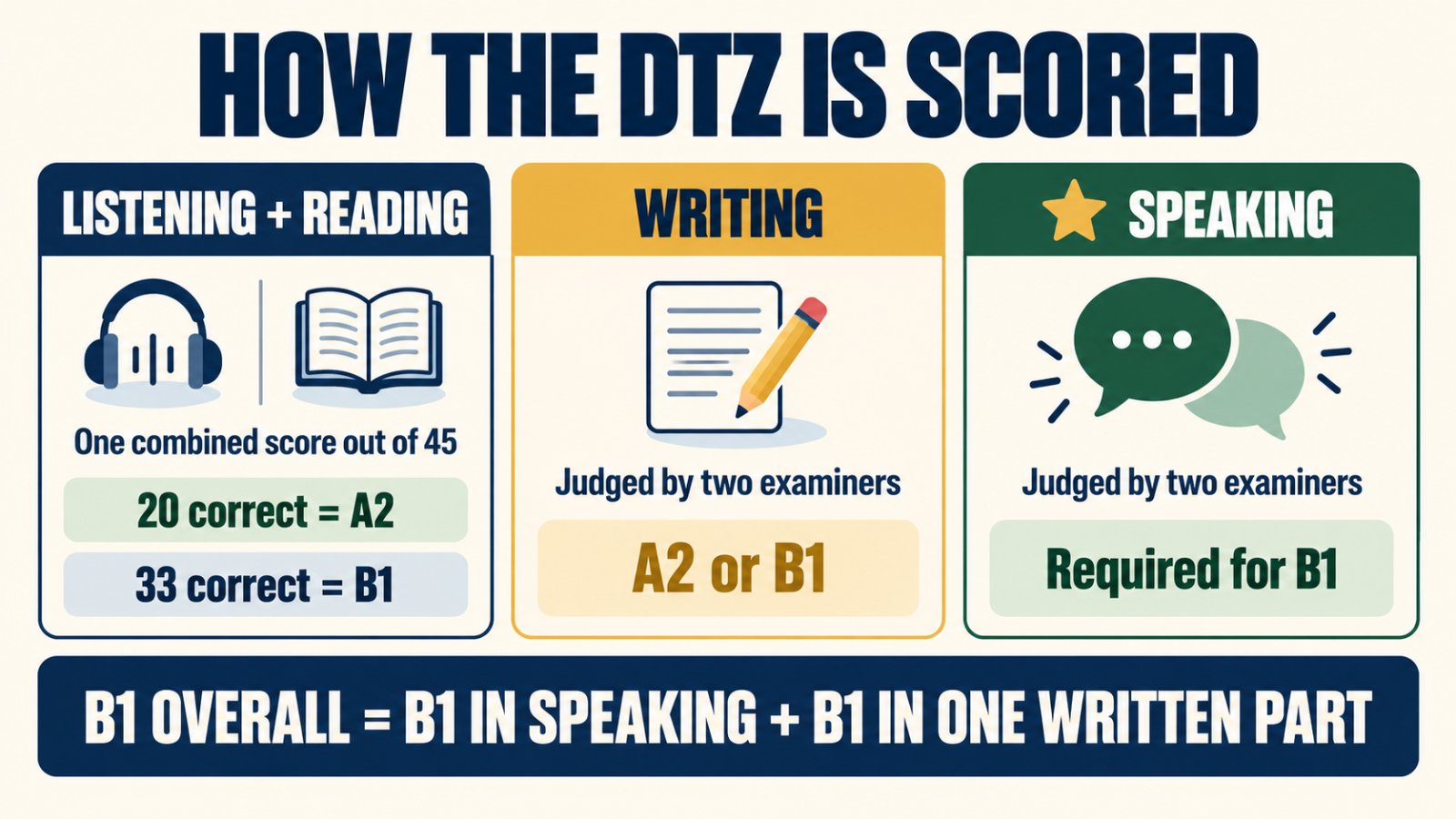
Read that again, because the implication is sharp. B1 in reading, listening and writing but A2 in speaking does not produce a B1 result. Speaking is mandatory. Everything else offers you two routes, of which you need one.
This inverts the usual preparation strategy. Many candidates drill reading and listening because they are practisable alone and feel measurable, and leave speaking until last because it requires a partner and is uncomfortable. On the DTZ that is precisely backwards.
What you receive
Every candidate gets a score sheet showing all parts of the exam. Candidates who are successful also receive a certificate stating the level reached in each skill group.
Because the certificate reports per skill, it is honest about where you are rather than reducing you to a single grade — which also means an employer or authority reading it can see that your speaking is B1 and your writing A2, or the reverse.
How to prepare for it
Start with speaking, not finish with it. Given the B1 rule, the speaking exam deserves the largest share of your preparation, not the smallest. Find a practice partner early. The paired format means you must be comfortable with unpredictable input from another learner.
Practise the negotiation task specifically. Part 3 asks two candidates to agree on something together. It is the least like ordinary classroom practice and the most like real life — planning an event, dividing a task, settling on a time. Rehearse the language of suggesting, agreeing, objecting politely and proposing alternatives.
Treat Hören and Lesen as one target. Since they are combined out of 45 with a B1 threshold of 33, work out which of the two you score better in and push it further, rather than spreading effort evenly.
Learn the formal register for writing. The writing task is a short message in formal German — the forms of address, the conventional openings and closings, the indirect phrasing. This is highly learnable and worth drilling, because it is a single task with a predictable shape.
Frequently asked questions
Can you fail the DTZ?
Not in the usual sense. The test certifies A2 or B1, so a candidate who does not reach B1 is certified at A2 rather than failing outright. Whether an A2 result is sufficient depends entirely on what you need the certificate for.
What score do I need for B1?
In the combined Hören and Lesen result, at least 33 correct out of 45 gives B1, and at least 20 gives A2. Schreiben and Sprechen are judged against criteria by two examiners rather than by a raw score. Overall B1 requires B1 in Sprechen plus B1 in at least one written component.
Do I have to take an Integrationskurs first?
No. The DTZ is the course's closing exam, but anyone aged 16 or over with Latin-script literacy can take it independently to obtain a certificate.
Is the speaking exam really taken with a partner?
Yes. It is a paired exam of about ten minutes per candidate, and three of its five parts are interaction tasks, including a final task where the two of you must negotiate something together.
Can I get a result above B1?
No. The DTZ scales only between A2 and B1. If you need to certify a higher level, you need a different exam — the Goethe-Zertifikat, telc or ÖSD ranges all extend to C2.
What is the DTZ used for?
It is the standard evidence of German from the Integrationskurs, and the B1 level it certifies is commonly referenced in German residence and naturalisation requirements. Those requirements are set in law and change, and they vary by the status you are applying for — confirm the current rule and the accepted evidence with the relevant German authority rather than relying on any guide.
Where to go next
If you are working toward A2 before attempting the DTZ, our Goethe-Zertifikat A2 guide covers the level below. If you need to certify German above B1, choosing the right German certificate compares the options, and the ÖSD range covers the Austrian equivalents. For the longer path, the German proficiency roadmap maps A1 to C2.