
Official IELTS practice material is free, abundant, and built from real past-paper questions — which makes IELTS the opposite of almost every other exam in this series. The British Council publishes full mock tests for all four skills, in both Academic and General Training, with answer keys. You do not need to buy anything to practise.
What you cannot get free is marking. Listening and Reading mark themselves against a key. Writing and Speaking are judged by a human examiner against band descriptors, and no answer key exists for them. That gap — not a shortage of questions — is the real constraint on IELTS preparation, and it is where your money should go if you spend any.
What is officially free
| Material | Where | What you get |
|---|---|---|
| Free practice and mock tests | British Council preparation site | Listening, Reading, Writing Task 1 and 2, and Speaking, using real past-paper questions, with answer keys |
| General Training versions | Same | Separate Reading and Writing papers; Listening and Speaking are identical to Academic |
| Sample test questions | ielts.org | Academic, General Training and UKVI Life Skills sample questions and answers |
| Computer familiarisation test | British Council | A run-through of the computer-delivered interface, which is not the same experience as paper |
| IELTS Ready | British Council | A preparation platform with a free tier, including some scored practice |
Two details are worth pulling out. Listening and Speaking are the same test for Academic and General Training — only Reading and Writing differ — so you can practise half the exam from either set. And the computer familiarisation test matters more than it sounds: on computer-delivered IELTS the Listening section gives you far less transfer time than the paper version, and candidates who have only practised on paper lose marks to the interface rather than to their English.
Marking yourself: Listening and Reading
Both papers have 40 questions and convert to a band score. The approximate conversions:
| Raw score | Listening | Academic Reading | General Training Reading |
|---|---|---|---|
| 39–40 | 9.0 | 9.0 | 8.5–9.0 |
| 37–38 | 8.5 | 8.5 | 8.0 |
| 35–36 | 8.0 | 8.0 | 7.0–7.5 |
| 32–34 | 7.5 | 7.5 (33–34) | 6.5 |
| 30–31 | 7.0 | 7.0 (30–32) | 6.0 |
| 26–29 | 6.5 | 6.5 (27–29) | 5.5 |
| 23–25 | 6.0 | 6.0 (23–26) | — |
| 18–22 | 5.5 | 5.5 (19–22) | — |
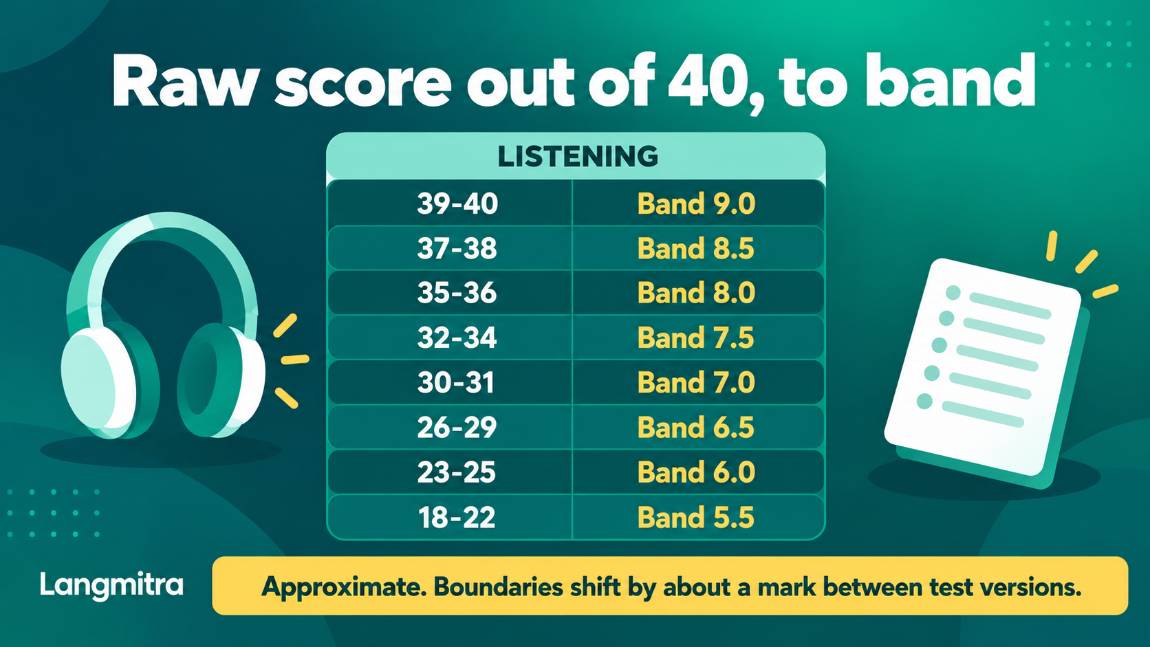
Treat these as approximate. Boundaries move by roughly a mark between test versions, which is deliberate — the conversion is adjusted so that a given band means the same thing whichever paper you sat. If a practice test puts you on the edge of a band, you are on the edge, not safely inside it.
General Training Reading is marked harder. The texts are easier, so more correct answers are needed for the same band: 30 out of 40 is around Band 6.0 on General Training and Band 7.0 on Academic. Candidates who switch between practice sets without noticing this misread their progress badly.
How the overall band is calculated
Average the four skill bands, then round to the nearest half band. Two rules govern the awkward cases: an average ending in .25 rounds up to the next half band, and one ending in .75 rounds up to the next whole band. So 6.25 becomes 6.5 and 6.75 becomes 7.0.
There is no pass mark. An institution sets the band it wants, and many also set a minimum in each skill — which is the requirement that catches people. An overall 7.0 built on a 6.0 in Writing fails a requirement of "7.0 overall with no band below 6.5", and Writing is the most common skill to fall short on.
The part you cannot mark yourself
Writing and Speaking are half your overall band and neither has an answer key. This is the genuine bottleneck, and there is no free fix for it.
What you can do without paying:
Read the public band descriptors before you write anything. They are published, and they are specific: Task Achievement, Coherence and Cohesion, Lexical Resource, and Grammatical Range and Accuracy are scored separately and averaged. Many candidates lose marks on Coherence and Cohesion — paragraphing and signposting — while working on vocabulary, because vocabulary is the one that feels like progress.
Check the mechanical things yourself. Did you hit the word count? Did you answer every part of the question? Task 2 asking "to what extent do you agree" and getting a balanced discussion with no position is a Task Achievement penalty that no amount of good English recovers.
Record your speaking and listen back. You will hear the hesitations, the repeated discourse markers and the two-word answers to Part 3 questions. Speaking is the skill where self-assessment works best, because the problems are audible.
What you should consider paying for: one round of examiner feedback on a Writing task, from a scored tier or a qualified teacher. One accurate read of where your writing actually sits is worth more than ten more untimed practice essays, because without it you are rehearsing your own blind spots.
How IELTS compares
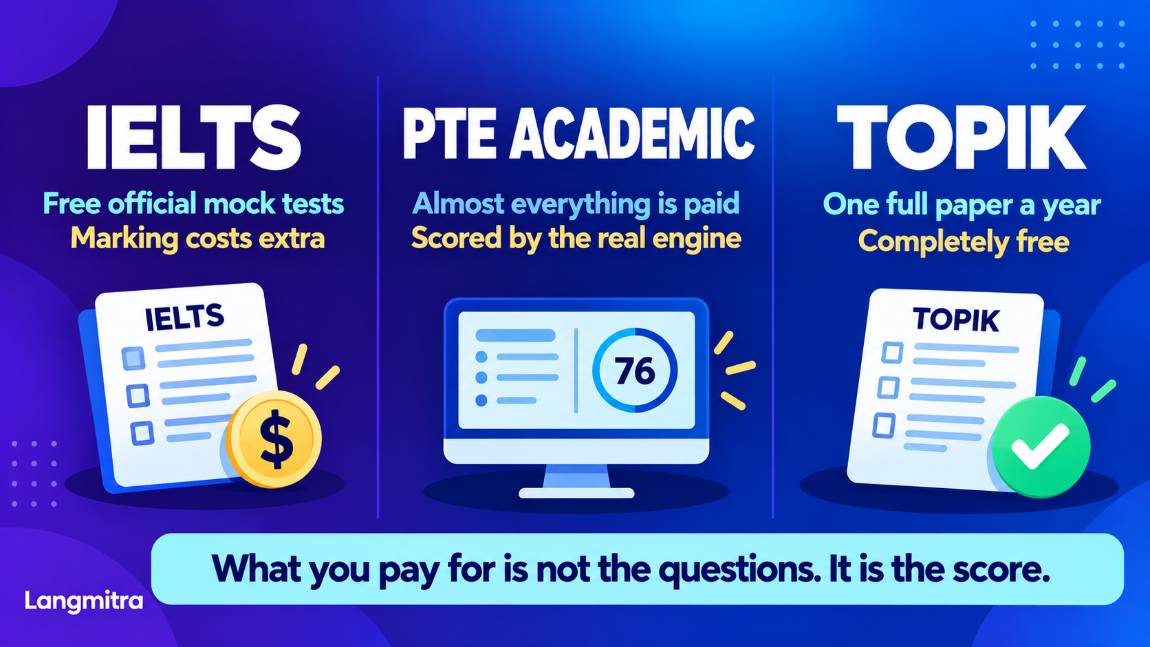
The contrast with the other boards is sharp, and it tells you where to put your effort.
Using the free material well
Sit the three written papers in one block. Listening, Reading and Writing run back to back with no breaks — roughly two hours and forty minutes of continuous work. Splitting them across evenings measures your English; sitting them together measures whether you still have it in the third hour.
Play the Listening audio once. It is played once in the real test. Replaying it turns a measurement into a vocabulary exercise.
Practise the transfer time honestly. On paper you get ten minutes at the end to transfer answers; on computer you get far less. Practise whichever you are sitting.
Do not re-sit a paper you have marked. You are testing recall at that point, and the score flatters you.
Where to go when the practice runs out
Practice tests measure; they do not teach. Our IELTS Band 7 preparation plan covers the structured route, IELTS speaking preparation covers the part you can rehearse alone, and the Writing Task 2 templates guide covers the half of the exam with no answer key.
If you have not settled on IELTS yet, see IELTS vs TOEFL vs PTE vs Duolingo, and for the practical question of what score you actually need, English test score requirements by country.
We have written this guide for the other major boards too: PTE Academic, TOPIK, JLPT, DELF, DELE and the Goethe-Zertifikat.
Frequently asked questions
Are official IELTS practice tests free?
Yes. The British Council publishes free mock tests built from real past-paper questions, covering all four skills in both Academic and General Training, with answer keys. ielts.org hosts official sample questions as well.
How many questions do I need for Band 7 in Listening?
Approximately 30 out of 40. Academic Reading needs roughly the same; General Training Reading needs more. These boundaries shift by a mark or so between versions.
Why is General Training Reading marked harder?
Because the texts are easier. The conversion is adjusted so that a given band represents the same ability on both papers, which means more correct answers are needed on General Training.
How is the overall band calculated?
Average the four skills and round to the nearest half band. An average ending in .25 rounds up to the next half band; .75 rounds up to the next whole band.
Can I get my practice Writing marked for free?
Not reliably. The band descriptors are public and you can check the mechanical criteria yourself, but accurate marking of Writing and Speaking requires a trained examiner. One paid round of feedback is usually worth more than many more unmarked attempts.
Is computer-delivered IELTS the same test?
Same questions and same scoring, different interface — and notably less transfer time in Listening. Practise in the format you are booked for.