
There is a category of mistake that nobody will ever correct you on. Your grammar gets fixed by teachers, apps and well-meaning friends. Your pronunciation gets commented on. But when you say something that is grammatically flawless and socially wrong, what happens is quieter and worse: the listener adjusts their opinion of you, and says nothing.
Linguists have a name for this. In 1983 Jenny Thomas pointed out that pragmatic failure is more damaging than grammatical error, because a grammar mistake makes you look like a learner while a pragmatic mistake makes you look rude. One is forgiven automatically. The other is remembered.
The mistake nobody flags
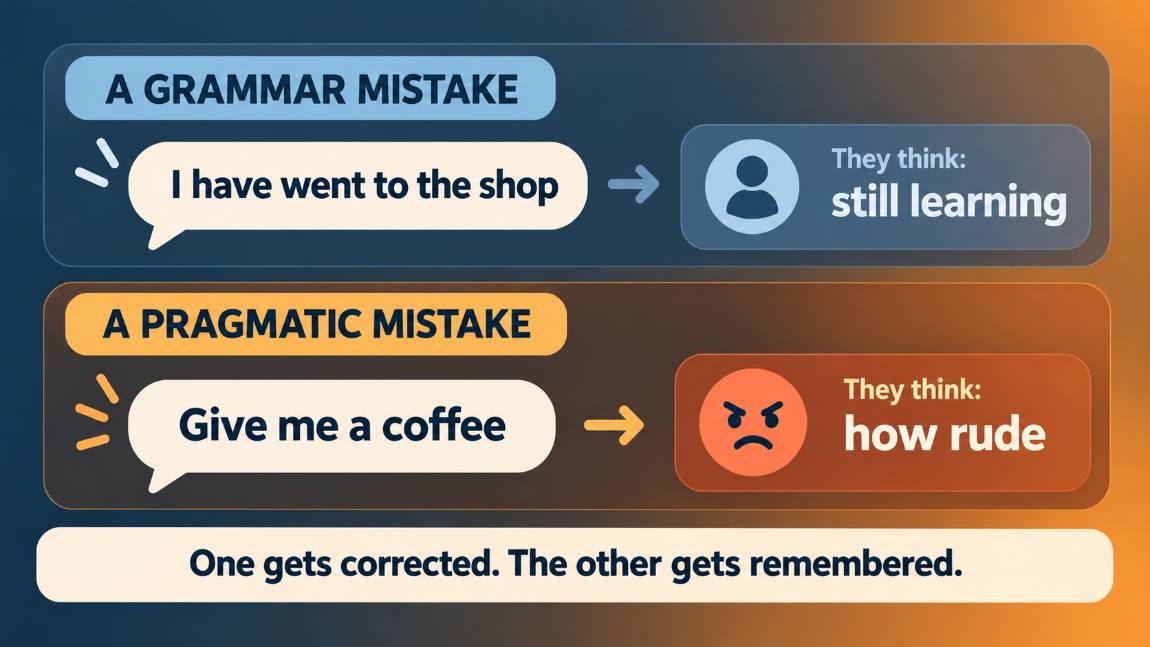
The mechanism is called pragmatic transfer: you carry the social rules of your first language into your second. Often it is harmless or even helpful. Sometimes it lands badly, and the examples in the research literature are strikingly ordinary:
Chinese learners of English responding to thank you with it's my duty — a direct translation of a natural Chinese phrase, which in English suggests you helped out of obligation rather than willingness. Or answering thanks, that's a great help with never mind, following the Chinese méi guānxi, where English expects you're welcome.
Japanese learners saying I'm sorry on receiving a gift. In Japanese, expressing gratitude through a form of apology is normal and gracious. In English the listener hears an apology and asks what for.
Spanish learners answering an invitation with a bare well, leaving the host genuinely unsure whether they are coming.
And in the other direction: non-native speakers taking we should get lunch sometime literally, then concluding their American colleagues were insincere when no lunch materialised.
None of these people made a grammatical error. All of them were misread.
Why fluent speakers are more exposed, not less
The intuitive assumption is that pragmatic skill arrives with proficiency. The research says otherwise: strong grammatical competence does not guarantee pragmatic competence. Grammar is necessary but not sufficient.
Worse, the gap widens in perception. At A2, every oddity is attributed to your level. Nobody takes offence at a beginner's blunt request, because the blunt request is obviously a limitation rather than an attitude. At C1, with fluent delivery and accurate structures, the same bluntness reads as a choice. The better your language, the more your pragmatic errors get attributed to your personality.
There is also evidence that learners notice their own grammatical errors far more readily than their pragmatic ones — so the thing doing the damage is precisely the thing you are least likely to spot.
The four areas that cause the most trouble
Directness in requests. Languages differ enormously in how much softening a request needs. English piles it on — would you mind, I was wondering if, when you get a chance. Other languages consider that much hedging evasive or insincere. Research found Japanese learners of English used far fewer indirect hints than native speakers and did not improve with time, which makes perfectly reasonable requests land as abrupt.
The formality dial. Most European languages have the T/V distinction — tu and vous, du and Sie, tú and usted. The grammar is trivial to learn and the social rule is not, because it is about relationship rather than register, and it shifts by country, generation and industry. German tends to hold Sie far longer than French holds vous; Latin American usted behaves differently from peninsular Spanish. Korean and Japanese replace the binary choice with a multi-level system where the verb ending encodes the relationship in every single sentence — our guide to Korean honorifics and speech levels covers that case in depth.
Refusals. Saying no is the speech act learners find hardest and the one most likely to offend, because every language wraps refusals in culturally specific padding. Learners' refusals are consistently less mitigated than native speakers', which reads as curt.
Thanks, apologies and compliments. Small, frequent, formulaic — which is exactly why a mismatch is noticed. These are also the easiest to fix, because the correct forms are short and finite.
How to actually learn this
Collect formulas, not rules. Pragmatics is more idiom than system. Instead of trying to derive the right level of politeness, notice and bank the exact phrases people use: how your colleague opens an email, how a shopkeeper closes a transaction, what someone says when they decline. Twenty stock phrases will carry you further than any explanation.
Watch unscripted interaction between native speakers. Not dialogue written for learners, which is sanitised, and not people talking to you, which is adjusted. Observing how they speak to each other is where the real norms are visible.
Ask directly, because nobody volunteers it. "Was that too direct?" and "how would you have said that?" are among the highest-value questions a learner can ask, and almost nobody asks them. People will answer honestly if asked and will never raise it unprompted.
Over-formalise at first. When in doubt, be more formal than you think necessary. Being slightly stiff reads as respectful. Being accidentally familiar reads as presumptuous, and the second error costs much more than the first.
Treat it as information, not judgement. Finding out that your natural style reads as brusque in another language says nothing about you as a person. It says the two languages distribute politeness differently.
Why this matters more than another grammar point
If you are at B2 and wondering where to put your effort, this is an unusually good answer. The grammatical difference between B2 and C1 is largely invisible to ordinary listeners. The pragmatic difference is not — it determines whether people enjoy talking to you, which in turn determines how much practice you get.
It is also the area least likely to be taught. Courses teach the T/V forms and not when to switch. They teach would you mind and not which situations demand it.
For the related question of whether people can understand you at all, see what actually makes you hard to understand — accent and politeness are separate problems and are routinely confused. And if the barrier is finding anyone to observe in the first place, practising speaking with no partner covers what you can build alone, though pragmatics is the one area where other people are genuinely required.
Frequently asked questions
What is pragmatic transfer?
Applying the social and conversational norms of your first language when speaking your second. It is harmless when the norms align and causes misreadings when they do not.
Why do people think I am rude when my grammar is fine?
Because grammatical and pragmatic competence are separate. Fluent, accurate speech makes listeners attribute social missteps to your personality rather than your language level.
Which mistakes cause the most offence?
Requests that are not softened enough for the language, refusals without the expected padding, getting the formality level wrong, and mismatched responses to thanks and apologies.
How do I learn the formal and informal distinction?
Learn the forms from a grammar, then learn the usage by observation — when people switch, who initiates it, and what happens around age and workplace boundaries. The rule varies by country and generation, so one explanation will not transfer across languages.
Should I be more formal or less when unsure?
More. Excess formality reads as respectful and is easily dialled back. Excess familiarity reads as presumptuous and is harder to recover from.
Does pragmatic competence improve on its own?
Not reliably. Research finds that some pragmatic gaps persist even as grammar improves, partly because learners notice their grammatical errors far more easily than their pragmatic ones.