
The standard advice for improving your speaking is to find a conversation partner. It is good advice and it is useless to a great many people — those in a time zone with no overlap, those who cannot afford a tutor, those who are too self-conscious to start, and those who simply do not have forty spare minutes to arrange and attend a call.
Here is the more useful observation: speaking is several separate skills, and only one of them actually requires another person. The rest you can train alone, today, with a phone.
What speaking is actually made of
When you cannot get a sentence out, one of four things has gone wrong:
Retrieval. You know the word. You cannot produce it inside the half-second a conversation allows. This is a speed problem, not a knowledge problem, and it is entirely trainable alone.
Assembly. You can produce the words but not arrange them — the grammar you can explain in writing deserts you in real time. Also trainable alone.
Articulation. Your mouth has not made these sounds enough times to make them without thinking. Very trainable alone.
Interaction. Responding to something unpredictable, repairing a misunderstanding, handling an interruption. This is the part that needs a person.
Three out of four. Most learners who say they "can't practise speaking" are blocked on three things they could fix without anyone, and treating the whole skill as unavailable because one quarter of it is.
A fifteen-minute routine
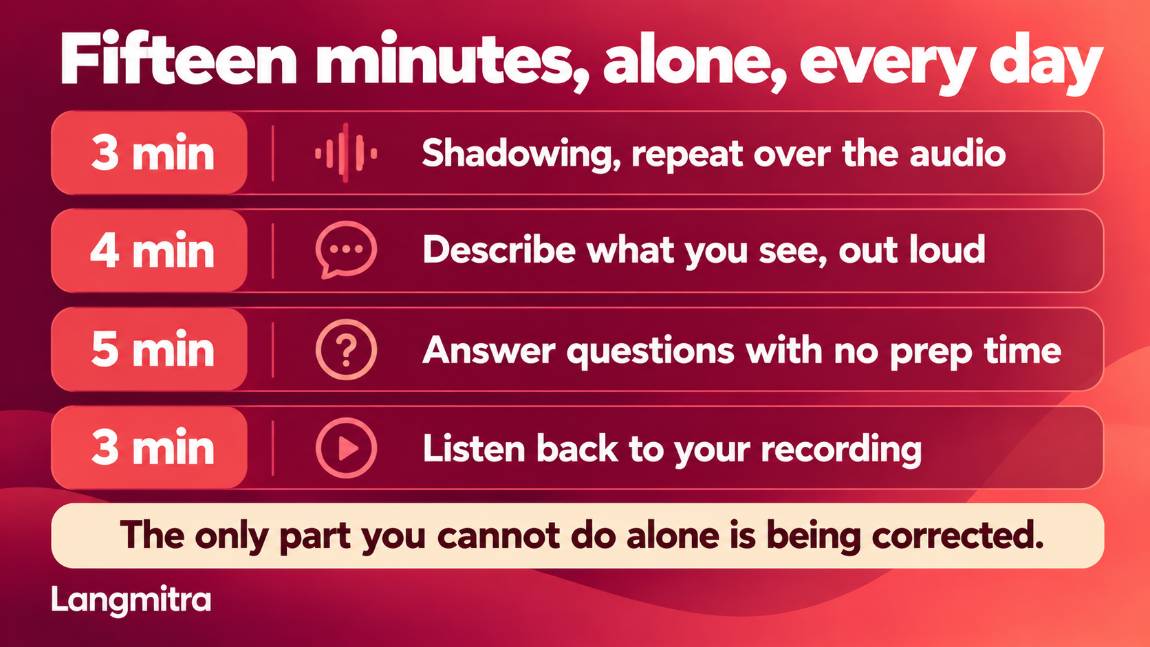
Shadowing, three minutes. Play audio and speak along a beat behind, copying rhythm and intonation rather than translating. This trains articulation and, as a side effect, listening — our shadowing guide covers the technique in full.
Describe what you see, four minutes. Narrate your surroundings, a photo, what you did this morning. Out loud, in full sentences, without stopping to look anything up. When you hit a word you do not have, talk around it — that circumlocution is itself the skill that keeps real conversations alive.
Answer questions with no preparation, five minutes. Find a list of questions, hit record, and answer each one immediately. No thinking time. This is the retrieval drill, and it is the most uncomfortable and most valuable part of the routine. Discomfort is the point: you are training production under time pressure, which is the only condition that matters.
Listen back, three minutes. Most people skip this and it is where half the value sits. You will hear things you cannot hear while speaking: the hesitations, the one filler word you overuse, the tense you keep getting wrong, the sentences you abandon halfway. You do not need a teacher to notice most of your own errors — you need a recording.
Fifteen minutes daily beats ninety minutes weekly, because retrieval speed responds to frequency rather than duration.
Making it harder as you improve
Set a timer and do not stop. Two minutes of continuous speech with no pauses is a different exercise from two minutes with thinking breaks. Fluency means not stopping, so practise not stopping.
Speak about things you have no vocabulary for. Comfortable topics rehearse what you already have. Pick something slightly out of range and let yourself struggle.
Re-record the same task a week later. Same question, same two minutes, then compare the two recordings. This is the clearest evidence of progress you will get, and during the intermediate plateau it may be the only evidence you get.
Narrate in your head during dead time. Commutes, washing up, walking. It is weaker than speaking aloud because articulation is missing, but it trains retrieval and assembly, and it converts time you were not using at all.
The one part you cannot fake
You cannot correct what you do not know is wrong. A recording reveals hesitation and inconsistency; it does not reveal that a structure you use confidently is unnatural, or that a word you are proud of is wrong for the register. That requires another person — and, crucially, not very much of one.
A single tutor session a month, used as a correction session rather than a conversation class, will catch what thirty days of solo practice could not. Turn up with specific questions and a recording, rather than treating it as an hour of chat. Language exchange works the same way if you set the expectation: our guide to language exchange apps covers where to find partners.
Between those sessions, the solo work is not a substitute for speaking practice. It is speaking practice. The tutor is the proofreader.
What not to bother with
Do not wait until you feel ready. The readiness never arrives on its own; it is produced by the practice you are postponing.
Do not memorise scripts for conversations. Rehearsed monologues collapse the moment someone asks something unexpected, and they train the wrong skill — assembly from scratch is the thing you need.
Do not confuse input with output. Another hour of listening is more comfortable than ten minutes of talking to yourself, and it will not make you able to speak. Most intermediate learners are heavily input-weighted precisely because input is easier.
If you are preparing for an exam with a speaking component, the solo work transfers directly — see our guides to IELTS speaking and, for the recorded-response format that rewards exactly this kind of practice, PTE Academic and the new TOEFL, which now gives you no preparation time at all before speaking.
Frequently asked questions
Can you really improve speaking without a partner?
Largely, yes. Retrieval speed, sentence assembly and articulation are three quarters of the skill and all are trainable alone. Only interaction — handling the unpredictable — needs another person.
How long should I practise each day?
Fifteen focused minutes daily beats a long weekly session. Retrieval speed responds to frequency more than duration.
Is talking to yourself actually effective?
Yes, provided it is out loud, timed, and recorded. Thinking in the language trains retrieval but skips articulation, which is a real part of the problem.
Why record myself if it is uncomfortable?
Because you cannot hear your own hesitations, filler words and abandoned sentences while you are producing them. The recording catches most of your errors without a teacher present.
How often do I need a real person?
Less often than you think. A monthly correction session, used deliberately with specific questions and a recording, catches the errors solo practice cannot reveal.
Will AI conversation practice work?
For retrieval and assembly under time pressure, it works well and it removes the self-consciousness barrier. For natural register and the specific ways your output sounds off to a native speaker, a human is still better.