
Somewhere around B1, most learners stop feeling like they are improving. The beginner phase was exhilarating — every week brought something you could not do before. Then it stops. You can hold a conversation, you can follow a film with subtitles, and six months later you can still hold a conversation and still need the subtitles. It feels like you have hit a ceiling.
You almost certainly have not. The plateau is mostly an arithmetic illusion, and once you see the arithmetic it stops being demoralising.
Why progress goes invisible
At the beginning, every hour you study moves a number you can feel. Learn your first 1,000 word families and you can suddenly understand roughly 80 percent of ordinary text — from nothing. That is a transformation you notice daily.
Now look at what the next stretch buys. Going from 2,000 to 3,000 word families takes you from about 90 percent coverage to about 95 percent. Going from 3,000 to 9,000 — six thousand more families — takes you from 95 percent to 98 percent.
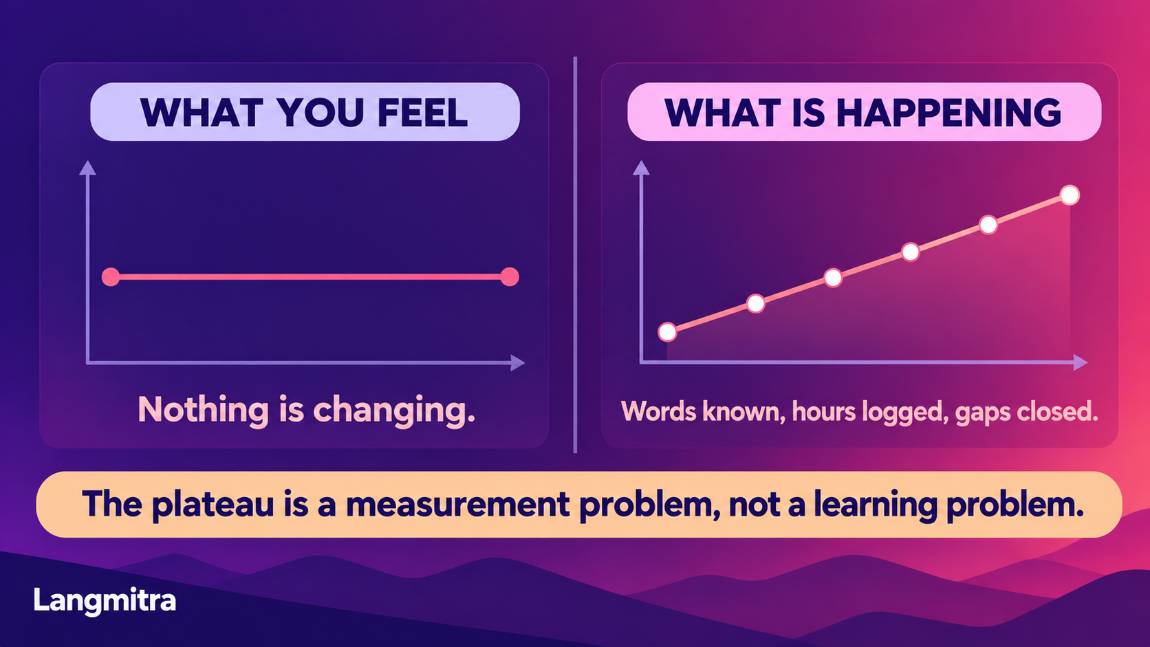
Three percentage points for six thousand words. You are learning at the same rate you always were, possibly faster. The return per unit of effort has collapsed, because the words left to learn are rare by definition. That is the plateau. It is not a wall you have hit; it is a curve flattening.
The same pattern shows up in hours. The FSI difficulty ranking puts a Category I language at roughly 600 to 750 class hours to professional working proficiency. B1 sits somewhere near a third of that. So the moment the plateau starts is, roughly, the moment you discover that two thirds of the work is still ahead — and that the remaining two thirds produce far less visible change than the first third did.
The three things actually happening at B1
One: your feedback loop broke. As a beginner, every interaction produced evidence — a sentence you could finally form, a word you finally recognised. At B1 you are good enough to get through most situations using what you already have. Nothing forces you to notice a gap, so you stop collecting evidence of progress even though progress continues.
Two: you stopped being stretched. B1 is the level at which you can comfortably avoid difficulty. You can talk around the word you do not know. You can pick the media you already understand. Comfortable input maintains a level; it does not raise one. A great deal of apparent plateau is simply three hundred hours of revision disguised as study.
Three: the remaining gaps are specific, not general. Beginners are uniformly bad at everything, so general study works. At B1 your profile is jagged — perhaps solid reading, weak listening at natural speed, decent vocabulary but shaky connectives, fluent on familiar topics and lost on unfamiliar ones. General study spreads effort evenly across a problem that is not evenly distributed, so most of it lands where you were already fine.
What actually breaks the plateau
Change what you measure. Stop asking "do I feel more fluent?", which is unanswerable, and start tracking something countable: word families known, hours of unassisted listening, pages read without a dictionary, minutes spoken without switching to English. These keep rising while the feeling stays flat, and seeing them rise is what gets people through.
Make the input genuinely hard again. If you understand 95 percent of what you are reading or listening to, it is maintenance. Deliberately choose material where you miss closer to one word in ten — then the mid-frequency vocabulary you are missing finally starts appearing.
Diagnose instead of studying generally. Find out which skill is actually lagging. A timed practice paper from any of the exam boards will do it, even if you never intend to sit the exam; our guides to IELTS, DELF, TOPIK and the Goethe-Zertifikat cover what free material exists. The result is a profile, and a profile tells you where to aim.
Produce more than you consume for a while. Most intermediate learners are heavily input-weighted because input is easier. Speaking and writing expose gaps that reading politely hides — you cannot talk around a missing structure when you have to produce one.
Give yourself a deadline with a number on it. An exam date is the crudest and most effective plateau-breaker available, not because the certificate matters but because it converts a vague ambition into a measurable target with a date attached.
Narrow the domain. General proficiency is the most expensive thing to buy. Competence in one area — your job, one hobby, one kind of text — is far cheaper and often what you actually needed.
What not to do
Do not switch languages. The plateau is not a sign of a bad fit. It arrives in every language at roughly the same point, and starting again resets you to the part of the curve that feels good while discarding the hours you have banked.
Do not switch methods every few weeks. Method-hopping feels like action and produces the same revision in new packaging. Almost any method applied consistently with genuinely difficult material beats the best method applied for a fortnight.
Do not read the plateau as a verdict on talent. The curve flattens for everyone. People who get past B2 are not the ones who found it easy; they are the ones who kept going while it felt pointless.
The honest timeline
If you are at B1 in a Category I language, you have perhaps 200 to 250 hours in, and B2 is a few hundred more. In a Category IV language — Chinese, Japanese, Korean, Arabic — the same transition is measured in years, not months. The FSI figures and our realistic timelines guide set out what that looks like.
Knowing that in advance is most of the cure. The plateau breaks people mainly because they expected the beginner curve to continue, and interpreted an entirely normal flattening as personal failure.
For the underlying numbers, see how many words you actually need. For method, our guides to spaced repetition, shadowing and how to learn a language cover the practices that hold up at this stage.
Frequently asked questions
Why does language learning stall at intermediate level?
Because the returns flatten. Each additional thousand words buys far less comprehension than the last, so you continue improving at the same rate while the visible change shrinks dramatically.
How long does the intermediate plateau last?
As long as you keep measuring progress by feel. It ends when you either start tracking countable things or raise the difficulty of your input enough to be stretched again — commonly a few months, sometimes much longer.
Is the plateau real or psychological?
Both. The flattening of the coverage curve is real and measurable. The sense of having stopped is psychological, caused by applying a beginner's expectations to an intermediate's curve.
Should I take an exam to break the plateau?
It often works, less for the certificate than for the deadline and the diagnostic. A timed practice paper alone will show you which skill is lagging, and you need not sit the exam at all.
Will switching languages help?
No. The plateau recurs at the same point in any language, and switching discards the hours you have already invested.
How do I know I am still improving?
Track something countable: word families known, minutes of unassisted listening, pages read without a dictionary. These keep rising through the plateau, which is the evidence the feeling cannot give you.