
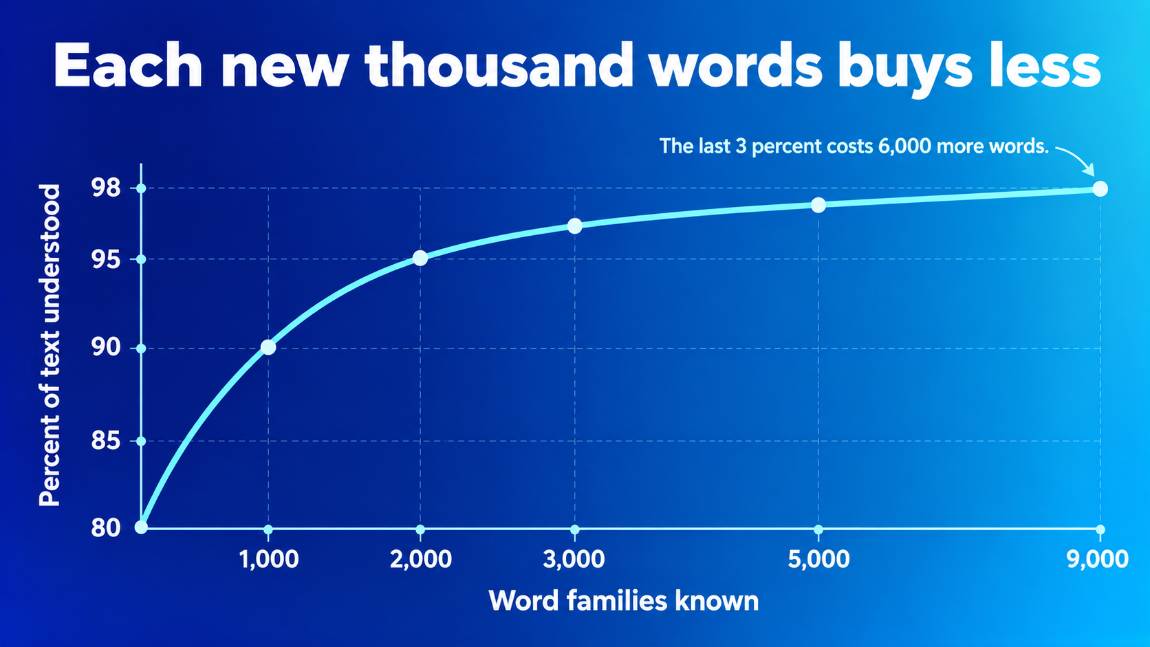
About 2,000 word families will carry you through 90 to 95 percent of ordinary conversation and 80 to 85 percent of everyday written text. That is the number worth chasing first, and most learners can reach it inside a year.
The uncomfortable part is what comes after. To read an unfamiliar text without constantly guessing — the 98 percent coverage that researchers associate with unassisted comprehension — you need roughly 8,000 to 9,000 word families. For spoken language it is about 6,000 to 7,000. So the last three percentage points cost you four times more vocabulary than the first ninety-five.
What the numbers actually say
| Vocabulary known | Roughly covers |
|---|---|
| 1,000 word families | About 80 percent of written text |
| 2,000 word families | 90–95 percent of colloquial speech; 80–85 percent of common written text |
| 3,000 word families | About 95 percent of spoken discourse |
| 6,000–7,000 word families | About 98 percent of spoken text |
| 8,000–9,000 word families | About 98 percent of written text |
Two terms are doing heavy lifting here and are worth getting straight.
A word family, not a word. Teach, teaches, teaching, taught, teacher is one family, not five. Counts given in word families are therefore much smaller than counts given in individual words — which is why you will see "3,000" and "5,000" quoted for the same level of spoken coverage by different sources. They are measuring different things. Always check the unit before comparing two figures.
Coverage is not comprehension. Ninety-five percent coverage sounds close to complete. It means one unknown word in every twenty — roughly one per line of text. That is enough to follow a conversation and badly insufficient to read a contract. The jump from 95 to 98 percent, one unknown word in fifty, is where reading stops being work.
What the exams expect
Exam boards set vocabulary targets, and they make the scale concrete:
| Level | HSK (Chinese) | JLPT (Japanese) |
|---|---|---|
| Beginner | HSK 1: 300 | N5: about 800 |
| Elementary | HSK 2: 500 | N4: about 1,500 |
| Lower intermediate | HSK 3: 1,000 | N3: about 3,000 |
| Intermediate | HSK 4: 2,000 | N2: about 6,000 |
| Advanced | HSK 5: 3,600 | N1: about 10,000 |
| Upper advanced | HSK 6: 5,400 | — |
Notice how far apart two "equivalent" exams can sit. JLPT N1 asks for roughly twice the vocabulary of HSK 6. That is not because Japanese is twice as hard as Chinese; it is because the boards count differently and pitch their top levels differently. Treat cross-exam vocabulary comparisons with suspicion.
On CEFR: you will find tables all over the internet giving vocabulary sizes for A1 through C2 — typically around 500 at A1 rising to 15,000 or more at C2. The CEFR itself specifies no such numbers. It describes what you can do, not how many words you know. Those tables are useful rules of thumb assembled by teachers and publishers, and they should not be quoted as official.
What this means for how you study
Front-load frequency. The first 2,000 word families are not just the first 2,000 words — they are the ones that recur constantly. A frequency list for your language is the single highest-return study resource at the beginning, and the gap between studying the right 2,000 words and a random 2,000 is enormous.
Stop drilling lists around 3,000. Past that point frequency lists give you diminishing returns, because the remaining words are rare by definition. Each additional thousand buys perhaps one percentage point of coverage. Reading and listening at volume start to beat flashcards, because they expose you to exactly the mid-frequency words you lack, in context, in proportion to how often they actually occur.
Narrow your domain if you have a deadline. General coverage is expensive; domain coverage is cheap. A nurse who needs German for work does not need 9,000 general word families — they need 2,000 general ones plus a few hundred clinical terms. Technical vocabulary is small, predictable and learnable in weeks.
Count recognition and production separately. You will recognise far more than you can produce, and that is normal rather than a failure. Reading targets need recognition; speaking targets need a much smaller set you can retrieve under pressure.
Expect the plateau. When your coverage curve flattens, progress stops feeling like progress long before it stops being progress. That experience has its own article: the intermediate plateau.
How long it takes
Vocabulary is only one input, but it maps onto time. The FSI language difficulty ranking puts a Category I language such as Spanish or French at roughly 600 to 750 class hours to professional working proficiency, and Category IV languages — Arabic, Chinese, Japanese, Korean — at around 2,200. The vocabulary targets above are a large part of why that gap exists: in a language that shares no cognates with English, every one of those 9,000 families is learned from scratch.
For method rather than quantity, our guides to spaced repetition and how to learn a language cover getting words to stick, and how many languages you can learn at once covers what happens when you divide this budget across two.
If you are learning towards a specific exam, our guides to HSK and JLPT levels set out what each level expects beyond the word counts.
Frequently asked questions
How many words do I need to be conversational?
About 2,000 word families covers 90 to 95 percent of colloquial speech. That is enough to hold ordinary conversations, with occasional gaps.
How many words do I need to be fluent?
"Fluent" has no agreed threshold, but for reading unfamiliar material without assistance, research points to 8,000 to 9,000 word families, and 6,000 to 7,000 for listening.
What is a word family?
A base word plus its inflections and common derivations — teach, teaches, taught, teaching, teacher counts as one. Figures quoted in individual words are considerably larger than the same knowledge quoted in families.
Is 95 percent coverage enough?
For following the gist, usually. It means one unknown word in twenty, which is roughly one per line. For comfortable unassisted reading, 98 percent is the figure researchers point to.
Do official CEFR vocabulary sizes exist?
No. The CEFR describes functional ability, not vocabulary counts. The A1-to-C2 word-count tables circulating online are informal estimates, useful as rough guides but not official.
Should I use frequency lists?
Yes, intensively, up to about the first 2,000 to 3,000 families. After that, wide reading and listening deliver mid-frequency vocabulary more efficiently than lists, because rare words are better learned in context than in isolation.