
No. If you book an HSK Level 1 to 6 exam today, you are almost certainly sitting HSK 2.0 — the six-level test that has been running for years. The nine-level HSK 3.0 standard is real, official and published, but it has not replaced the regular exams, and no date for that switch has been announced.
A lot of guidance online says "everything changes in July 2026". That reading confuses the date the syllabus took effect with a date the exams changed, and acting on it can mean preparing for the wrong test.
What has actually happened, in order
| When | What |
|---|---|
| November 2025 | The new HSK standard is published (发布) — the nine-level framework becomes official as a document |
| 31 January 2026 | A limited HSK 3.0 pilot runs for Levels 1–6 at selected centres worldwide, producing real score reports |
| July 2026 | The syllabus is marked for implementation (实施) — it becomes the operative reference for teachers and test writers |
| Now | Regular Level 1–6 sittings still use HSK 2.0. No launch date announced for the switch |
The word doing the damage is implementation. The July date applies to the syllabus as the authority that curriculum and test design must follow. It is not a date on which every candidate started sitting a new paper. The official notice accompanying the pilot said plainly that regular 2026 test dates continue to use HSK 2.0 until a formal launch is announced.
The trap: both versions use the same level numbers. "HSK 4" under 2.0 and "HSK 4" under 3.0 are not the same exam, and nothing in the name tells you which you booked. Confirm with your test centre rather than inferring from the level.
The nine levels, and what they actually are
HSK 3.0 organises Chinese into three stages across nine levels. The vocabulary targets are cumulative:
| Level | Cumulative vocabulary |
|---|---|
| 1 | 300 |
| 2 | 500 |
| 3 | 1,000 |
| 4 | 2,000 |
| 5 | 3,600 |
| 6 | 5,400 |
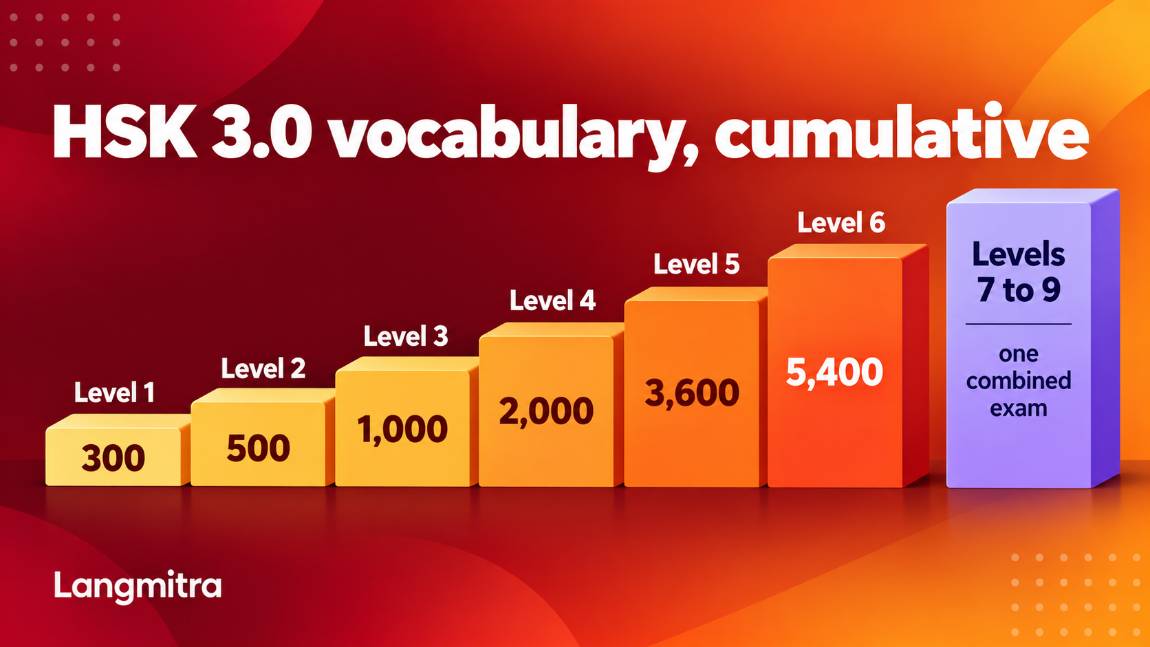
Levels 7 to 9 share an advanced band above that, and this is the part most summaries get wrong: Levels 7–9 are not three exams. They are one. You sit a single integrated advanced test and the result comes back as below Level 7, Level 7, Level 8 or Level 9. It is internet-based, runs to 98 questions over about 210 minutes, and covers listening, reading, writing, translation and speaking.
That translation component is worth pausing on. No other major proficiency exam in this series tests translation. It signals what the advanced band is for — professional and academic work with Chinese rather than general communication.
Levels 7–9 already exist and already run, with sittings in May and November. So the honest picture is split: the advanced band of HSK 3.0 is live, while the levels most learners actually take are not.
The jump that changes how you plan
Look at the vocabulary column again. Level 3 to Level 4 doubles your words, 1,000 to 2,000. Level 4 to Level 5 adds 1,600 more. Level 5 to Level 6 adds another 1,800.
Under the old six-level standard the upper levels were widely criticised for being too easy relative to their CEFR claims — HSK 6 did not represent anything like C2. The 3.0 framework addresses that by raising the targets and extending the ladder upward, which is why the advanced band exists at all. If you have been told that HSK 6 is "near-native", that was never quite true and is less true under the new standard.
Practical consequence: if you hold or are working towards HSK 5 or 6 under 2.0, expect the same number to mean more under 3.0 whenever the switch lands. That is an argument for sitting sooner rather than waiting, if you need the certificate for an application.
What to do right now
Before booking, ask your test centre which version your sitting uses. Not the level — the version. This is the single action that protects you, and it takes one email.
Prepare for HSK 2.0 for Levels 1–6 unless your centre confirms otherwise in writing. Preparing for an announced-but-unlaunched format is the expensive mistake here.
If you are aiming at the advanced band, prepare for 3.0 — Levels 7–9 are live and are 3.0 by definition.
Build vocabulary against the 3.0 targets regardless. The word lists are the most stable part of the new standard, and nothing about learning 2,000 words for Level 4 is wasted if the exam you sit asks for fewer.
Watch for the announcement rather than the rumour. A formal launch will be announced by the test authority. Until then, dates circulating on prep sites are inference, not policy — including the July date that so many of them present as fact.
Where to start with Chinese
If you are earlier in the journey than any of this, our beginner's roadmap for Mandarin Chinese covers the first year, and Japanese versus Chinese covers the choice between them if you have not committed yet.
For a realistic sense of the time involved, the FSI language difficulty ranking places Mandarin in Category IV, the hardest tier for English speakers, at roughly 2,200 class hours to professional working proficiency. Against that scale, the gap between HSK 4 and HSK 6 is years rather than months, and a framework that stretches the ladder upward is arguably more honest than one that compressed it.
For how other exam boards handle their practice material and reforms, see our guides to TOPIK, JLPT and the TOEFL's own 2026 overhaul.
Frequently asked questions
Is HSK 3.0 in effect?
Not for regular Levels 1–6, which still use HSK 2.0 with no announced switch date. The Levels 7–9 advanced exam is live and is HSK 3.0.
What changed in July 2026?
The syllabus reached its implementation date, meaning it became the operative reference for curriculum and test design. It was not a date on which regular exams changed format.
How many levels does HSK have now?
Nine on paper, in three stages. In practice Levels 1–6 run as separate exams and Levels 7–9 run as a single combined test reported as below Level 7, Level 7, Level 8 or Level 9.
How much vocabulary does each level need?
Cumulatively under 3.0: 300 at Level 1, 500 at Level 2, 1,000 at Level 3, 2,000 at Level 4, 3,600 at Level 5 and 5,400 at Level 6, with a shared band above for Levels 7–9.
Should I wait for HSK 3.0 or take HSK 2.0 now?
If you need a certificate for an application, take what is available now. No launch date has been announced, and the same level number is likely to demand more under 3.0, not less.
How do I know which version I am sitting?
Ask your test centre directly. Both standards use identical level numbers, so the name of the exam will not tell you.