
Most learners who worry about pronunciation are worrying about the wrong thing. They want to lose their accent. What they actually want is to be understood without effort — and researchers have spent thirty years establishing that these are not the same goal, do not require the same work, and do not even correlate as closely as everyone assumes.
You can have a strong accent and be perfectly easy to understand. You can also have a mild accent and be exhausting to listen to. Which of those you are depends on a surprisingly small number of features, and they are probably not the ones you have been practising.
Three things people lump together as pronunciation
In 1995 Munro and Derwing separated out three constructs that everyday language runs together, and the distinction is the single most useful idea in this field.
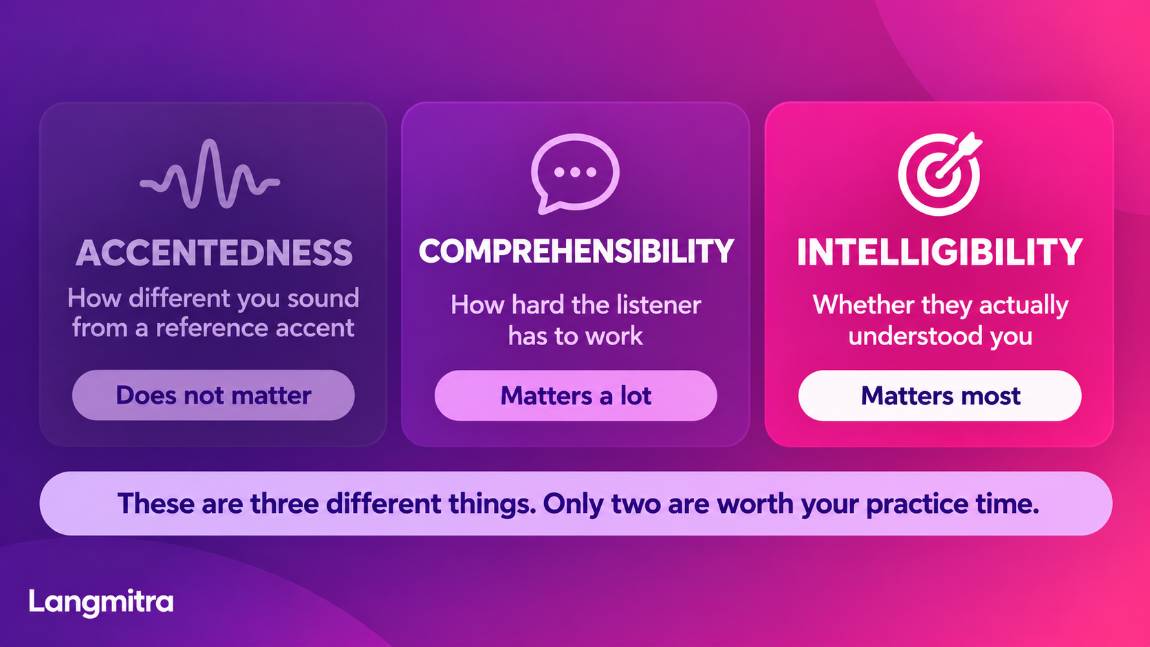
Accentedness is how far your speech differs from some reference accent. Listeners are extremely sensitive to it — in one study they could identify speech as non-native even when the content was masked and played backwards.
Comprehensibility is how much effort the listener has to spend. This is the one that determines whether people enjoy talking to you.
Intelligibility is whether they actually understood the words. This is the one that determines whether communication happened at all.
The crucial finding is that these come apart. A heavily accented speaker can be entirely intelligible and easy to follow. Speakers of different native dialects of the same language understand each other fine despite obvious differences. Accent is noticed; it is not necessarily a barrier.
The two principles, and why one of them wastes your time
John Levis named the two positions underlying pronunciation teaching.
The nativeness principle says work on anything that marks you as non-native, whether or not it affects understanding. This is the instinct most learners arrive with, and it is the one that produces years of frustration. Levis's assessment is blunt: trying to become nativelike is almost never an appropriate goal for a second-language learner.
The intelligibility principle says work on the features most likely to stop listeners understanding, or to force them to work hard. Everything else is cosmetic.
This is not lowered expectations dressed up as kindness. Adult learners very rarely achieve a native accent regardless of effort, while intelligibility and comprehensibility are reliably trainable. One of those goals is achievable with the time you have. The other mostly consumes it.
Not all sounds matter equally
The concept that makes this practical is functional load — how much work a sound contrast does in distinguishing actual words.
The English /l/–/r/ contrast carries a heavy load: lead and read, light and right, collect and correct. Confuse those and you generate real ambiguity constantly.
The /f/–/θ/ contrast carries a light one. Fought and thought is close to the only pair anyone cites, and context resolves it instantly. A learner who says fink for think is noticeably accented and almost never misunderstood.
Munro and Derwing found in 2006 that high functional load errors damaged comprehensibility considerably more than low functional load errors — and that accumulating low-load errors did not even raise accentedness ratings much. The implication is direct: find out which contrasts in your target language carry heavy loads, and spend your time there. The notorious "hard sound" that embarrasses you may be costing you nothing.
What actually makes you hard to follow
Beyond high-load sound contrasts, the features that reliably damage comprehensibility are mostly not individual sounds at all:
Word stress. Putting the stress on the wrong syllable does more damage in English than mispronouncing the vowels, because listeners use stress patterns to locate words in the stream. PHOtograph and phoTOgraphy are recognisable; put the stress somewhere neither belongs and the word effectively disappears.
Rhythm and timing. Languages differ in whether they time by syllable or by stress. Importing the wrong rhythm makes every individual sound correct and the whole utterance hard to parse.
Intonation and phrasing. Where you pause and how your pitch moves tells the listener which words group together. Get it wrong and they have to reassemble your sentence themselves.
Speed. Not yours — theirs. Speaking slightly more slowly than feels natural costs you nothing and buys the listener a lot.
This is why shadowing works so well as a technique: it trains rhythm, stress and phrasing simultaneously, which is exactly the cluster that matters. Our guide to shadowing covers the method.
A practical order of work
First, find your high-load errors. Record yourself, or better, ask a patient speaker to tell you which words they actually had to guess at. Not which words sounded foreign — which words they had to guess at. Those two lists are different and only one is worth acting on.
Second, fix word stress. It is learnable, it is rule-governed in many languages, and it pays back faster than anything else.
Third, work on rhythm through imitation rather than explanation. You cannot reason your way into a rhythm; you copy it.
Fourth, and only if you want to, chase the cosmetic stuff. Wanting to sound more native is a legitimate personal goal. It is just not a communication goal, and it should not be the thing standing between you and speaking.
The part nobody says out loud
A great deal of accent anxiety is not really about being understood. It is about being judged — and the research is clear that listeners do form judgements based on accent, which is a problem with listeners rather than with speakers.
What the intelligibility evidence offers is a way to separate the two. You can work on the features that genuinely affect communication, reach the point where people follow you effortlessly, and still sound like someone who learned the language as an adult. That is not a failure state. It is what success looks like for almost everyone.
If the problem is the other direction — you cannot understand them — that is a different skill with a different fix, covered in why you can read a language but not hear it. And if you have nobody to practise with, the solo speaking routine covers how to train articulation alone.
Frequently asked questions
Can adults lose their accent completely?
Very rarely, regardless of effort. This is why researchers argue that intelligibility rather than nativeness should be the goal — one is achievable, the other usually is not.
Does a strong accent mean people cannot understand me?
No. Accentedness, comprehensibility and intelligibility are separate. Plenty of heavily accented speakers are completely easy to follow, and the research treats accent and understanding as distinct.
Which pronunciation mistakes actually matter?
Those involving high functional load contrasts, such as /l/ and /r/ in English, plus word stress, rhythm and phrasing. Low functional load errors like /f/ for /θ/ are noticeable and rarely cause misunderstanding.
What is functional load?
A measure of how much work a sound contrast does in distinguishing real words. High-load contrasts separate many word pairs; low-load contrasts separate very few.
Should I work on individual sounds or on rhythm?
Rhythm, stress and phrasing usually give the bigger return, because listeners use them to find word boundaries. Individual sounds matter where the functional load is high.
Is it worth paying for accent reduction coaching?
It can be, if it targets intelligibility. Be wary of anything promising a native accent — that outcome is rare, and the money is better spent on the features that affect whether people understand you.