
You can read a newspaper in your target language. You can follow written dialogue without effort. Then someone says one sentence out loud and you catch three words out of eleven. It feels like a different language, and in a mechanical sense it is.
Reading and listening are not the same skill wearing different clothes. Written text hands you word boundaries for free. Speech does not. Everything that makes listening hard follows from that one fact.
Speech has no spaces
Look at this sentence. Your eyes are being handed a gift on every line: a blank space telling you exactly where one word ends and the next begins. You never had to learn to find those boundaries, because a typesetter found them for you.
Speech arrives as a continuous acoustic stream. There is no reliable silence between words — pauses in natural speech fall at clause boundaries and hesitations, not between every word. Your brain has to cut the stream into words using nothing but its knowledge of which words exist and which are likely next.
In your native language this is so automatic you cannot switch it off; you hear words, not sound. In a new language the machinery is not built yet. You are not failing to hear. You are hearing perfectly and failing to segment.
Words change shape when spoken
The second problem compounds the first. The word you learned is not the word you will hear.
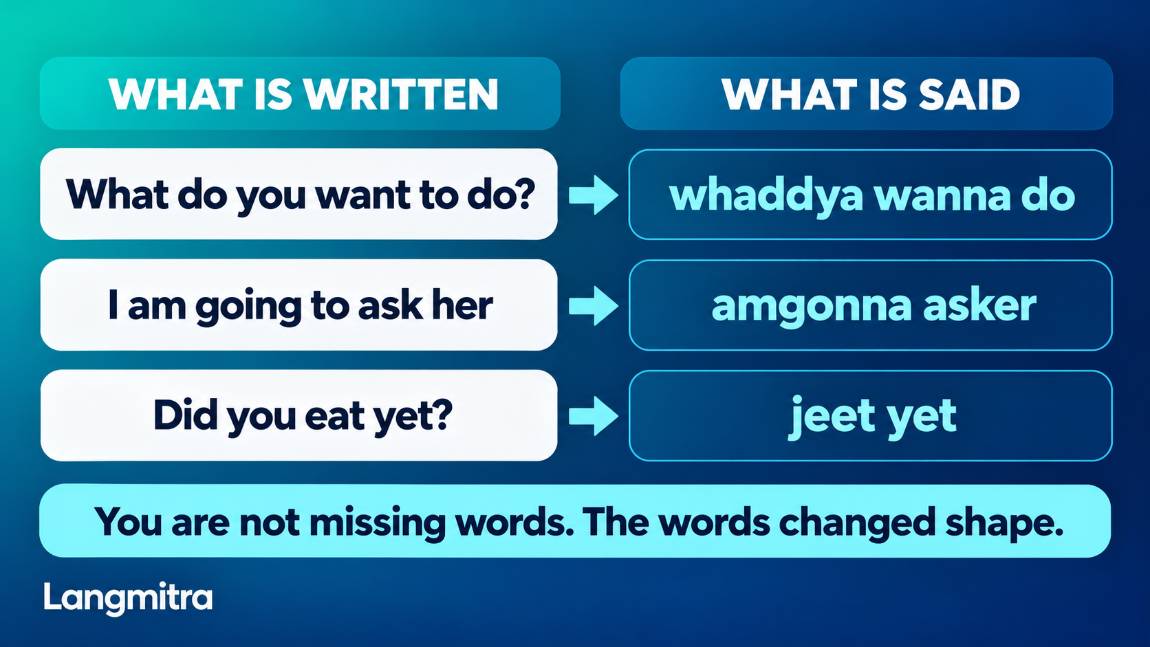
What happens to the written forms above is not sloppiness or slang. It is the normal phonology of connected speech, and every language does its own version:
Reduction. Unstressed function words collapse towards a neutral vowel. English to, of, for, can, and become barely more than a grunt in running speech. A learner listening for the clear to they were taught will not find it.
Assimilation. Sounds take on features of their neighbours. Did you becomes didja; ten pounds drifts towards tem pounds.
Elision. Sounds simply disappear. The t in next day is rarely pronounced; the d in grandmother goes the same way.
Linking. Words run into each other. French liaison is the famous case, but Spanish resyllabification does the same thing — los otros arrives as something closer to lo-so-tros, with the boundary in the wrong place entirely.
This is why a transcript feels like a trick. You read it afterwards and every word is one you knew. You did know them. You knew their citation forms, and you were handed their running forms.
Why they speak too fast is the wrong diagnosis
It is the universal complaint, and it is mostly misdiagnosed.
A 2019 study in Science Advances by Coupé, Oh, Dediu and Pellegrino measured 17 languages and found something striking. Syllable rates varied widely — Spanish and Japanese are spoken with many more syllables per second than Vietnamese or Mandarin — but information density moved in the opposite direction, from about 5 to 8 bits per syllable. Multiply the two together and every language in the study landed at roughly the same place: about 39 bits per second. The authors suggest this may reflect a limit on how fast human brains process language. The finding has been debated since, as striking results usually are, but the core observation holds up well.
What that means for you is encouraging. Spanish does not actually deliver meaning faster than English. It delivers the same meaning in more, lighter syllables. Your problem is not that the speaker is outrunning your comprehension — it is that you are still processing syllable by syllable while they are processing in chunks. Speed is a symptom of unautomated segmentation, not the cause of it.
Slowing audio down helps you decode an individual sentence and does very little to build the skill, because it removes the exact thing you need to get used to.
What actually builds listening
Listen to the same short passage many times rather than new passages once. This is the single biggest change most learners can make. The first pass you catch fragments, the fourth you catch structure, the eighth you hear words you would have sworn were not there. Repetition on one minute of audio trains segmentation; one pass over thirty minutes mostly trains frustration.
Use the transcript second, never first. Listen until you stop improving, then read, then listen again. That final listen — where you hear the thing you previously could not — is where the learning happens. Reading first converts the exercise into reading practice.
Shadow. Repeating over the top of audio forces you to produce the reductions and linkings yourself, and producing them is the fastest way to start perceiving them. Our guide to the shadowing method covers the technique properly.
Learn the reductions explicitly. Most courses teach citation forms and leave connected speech to chance. Ten minutes spent learning that your target language routinely does this to that pays back immediately, because you stop listening for a form that will never arrive.
Accept unscripted audio early. News broadcasts are read aloud from a script by trained speakers and are much easier than two friends talking. Podcasts and unscripted conversation are harder and are where the real thing lives — which, conveniently, is the format we built Langmitra around.
Keep the volume up. Listening is the skill that responds most to raw hours, and least to clever study. Our guide to how to learn a language makes the broader case.
When it clicks
Listening improves in steps rather than smoothly, and the steps arrive without warning — a day when a podcast you have struggled with for months is simply comprehensible. That discontinuity is why listening feels so demoralising in the meantime: the underlying progress is continuous and invisible, which is the same measurement problem described in our piece on the intermediate plateau.
If vocabulary is the bottleneck rather than segmentation — and at the beginning it usually is — the figures in how many words you actually need are the place to start: roughly 6,000 to 7,000 word families for 98 percent coverage of speech.
Frequently asked questions
Why can I read a language but not understand it spoken?
Because written text marks word boundaries with spaces and speech does not. You have to segment a continuous stream yourself, and the words arrive in reduced, linked forms rather than the citation forms you learned.
Do native speakers really speak faster in some languages?
In syllables per second, yes. In information delivered per second, the 2019 Coupé et al. study found 17 languages all landing near 39 bits per second. Faster-sounding languages carry less meaning per syllable.
Should I slow down audio to practise?
Sparingly. It helps you decode a specific sentence but removes the thing you need to adapt to. Repeating the same passage at full speed builds the skill faster.
Should I read the transcript while listening?
Not on the first pass. Listen until you stop improving, then read, then listen again. Reading first turns a listening exercise into a reading exercise.
How long until listening clicks?
It tends to arrive in steps rather than gradually, and it responds mostly to accumulated hours. Months of daily listening, not weeks, and the improvement is largely invisible until it is not.
Is it better to listen to news or conversation?
News is read from a script by trained speakers and is considerably easier. Unscripted conversation is harder and is what you actually need, so move towards it sooner than feels comfortable.