
Most learners read material that is too hard for them, feel bad about how slowly it goes, and conclude they need to try harder. The fix is almost always the opposite: read something easier, read much more of it, and stop looking things up.
There is a widely repeated rule that you need to know 95 percent of the words in a text to follow it, or 98 percent to read it comfortably. The research behind those numbers is more interesting than the rule suggests, and it changes what you should actually do.
There is no threshold
Schmitt, Jiang and Grabe tested 661 learners across eight countries on how much of a text they knew and how much they understood. They were looking for the threshold everyone cites. They did not find one.
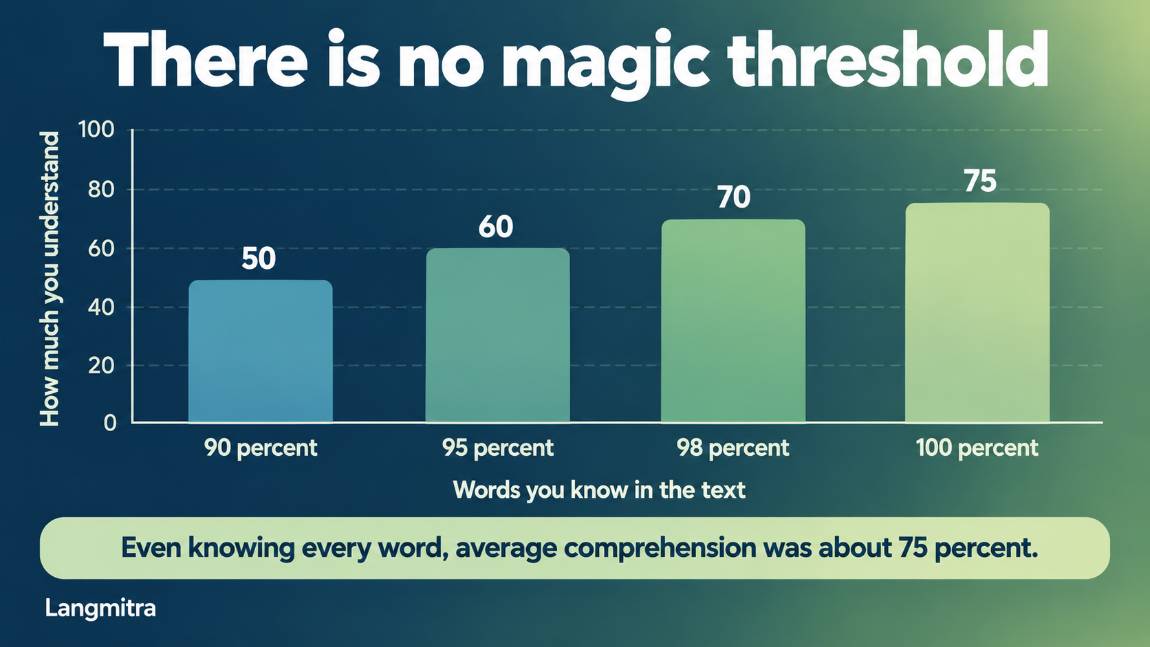
Comprehension rose steadily from around 50 percent when readers knew 90 percent of the words, to about 75 percent when they knew essentially all of them. No cliff, no magic line — a straight trade.
Two things follow, and they point in opposite directions.
The optimistic one: there is no minimum you must clear before reading is worth doing. At 90 percent coverage you are still understanding half of what you read, and reading at that level still teaches you things. You do not need permission to start.
The sobering one: even at 100 percent coverage, average comprehension was only about 75 percent. Vocabulary is necessary and nowhere near sufficient. Knowing every word in a sentence does not mean you have understood the paragraph, which is why "I know all these words but I don't get it" is a normal experience rather than a personal failing.
The authors still conclude that 98 percent is the sensible target for academic reading — which lines up with needing 8,000 to 9,000 word families, the figure in our guide to how many words you actually need.
Two kinds of reading, and most people only do one
Intensive reading is what school taught you: a short, difficult text, every unknown word looked up, nothing left unresolved. It is genuinely useful for picking apart grammar and for exam preparation.
Extensive reading is the other mode: long, easy texts read quickly for meaning, with almost nothing looked up. This is the one most learners skip, and it is the one that builds reading speed, consolidates half-known vocabulary, and makes grammar feel automatic rather than remembered.
They do different jobs. Intensive reading adds knowledge; extensive reading converts knowledge into fluency. A learner who only reads intensively accumulates a large vocabulary they cannot access at speed — which is one route into the intermediate plateau.
Setting the dial
For extensive reading, aim for material where you meet roughly one unknown word per two or three lines — somewhere near that 98 percent mark. If you are stopping more often than that, the text is too hard for this purpose, however much you want to be reading it.
Signs the dial is set wrong:
You are reading with a dictionary open. That is intensive reading. It is fine, but do not mistake it for the other thing, and do not do only it.
You reach the end of a page and could not say what happened. All your capacity went on decoding, leaving none for meaning.
It feels like work every single time. Extensive reading should be close to pleasant. If it never is, the level is wrong.
You have been on the same book for two months. Volume is the active ingredient. A book you abandon teaches less than three easy books you finish.
Where to find material that is actually easy enough
Graded readers are the obvious answer and the most under-used resource in language learning. They are written to controlled vocabulary levels, they are properly plotted, and most learners skip them out of embarrassment about reading simplified books. That embarrassment is expensive.
Children's and young adult fiction works, with a caveat: books for young children often use rare animal names, invented words and unusual registers, which makes them harder than their reading age suggests. Books aimed at ten- to fourteen-year-olds are usually the better bet.
Translations of books you already know remove the plot burden entirely, so all your attention goes to the language.
News written for learners. Many broadcasters publish simplified news; it is current, free and pitched correctly.
Re-reading. Reading the same easy book twice is not a waste. The second pass is where fluency is built, because nothing is being decoded.
How to actually do it
Do not look words up. Not most of them. If a word keeps recurring and blocks meaning, look it up; otherwise keep going. Interrupting to look up the fourth word on every page destroys the reading speed you are trying to build, and recurring words get learned from context anyway.
Read for time, not pages. Twenty minutes is a more useful unit than a chapter, because it keeps the pace honest.
Abandon books freely. Finishing something you dislike is a virtue in reading your own language and a liability here, because it kills volume.
Keep a hard text on the side if you want one. One difficult article a week, read intensively with a dictionary, alongside daily easy reading. Both modes, deliberately separated.
Let it feed the other skills. Reading is the cheapest way to meet mid-frequency vocabulary in context, which is exactly the vocabulary that listening and speaking need and that frequency lists stop supplying around 3,000 words.
Frequently asked questions
What percentage of words do I need to know to read a text?
There is no sharp threshold. Comprehension rises steadily with coverage — roughly 50 percent understanding at 90 percent coverage, about 75 percent when you know nearly every word. For comfortable reading, 98 percent is the usual target.
Should I look up every word I do not know?
For extensive reading, no. Look up only words that keep recurring and block meaning. Constant lookups destroy reading speed, which is the thing extensive reading is for.
What is the difference between intensive and extensive reading?
Intensive reading is short, hard texts studied closely. Extensive reading is long, easy texts read quickly for meaning. They do different jobs, and most learners do only the first.
Are graded readers worth it?
Yes, and they are badly under-used. They are written to controlled vocabulary levels, which is precisely what makes high-volume reading possible at lower levels.
Why do I understand every word but not the paragraph?
Because vocabulary is not sufficient for comprehension. In the research, readers who knew essentially all the words still averaged only around 75 percent comprehension.
How much should I read?
Volume matters more than difficulty. Twenty minutes daily of material you can follow easily will do more than an hour a week of something you have to fight.