
If you have been looking for free TestDaF model tests and coming up short, there is a reason, and it is not you. TestDaF is one of the few major German exams that does not publish its model tests openly. The Goethe-Institut gives away three or four complete papers per level to anyone who visits the site. TestDaF puts its two free model tests behind registration, in the participant portal, where only people who have already booked a sitting can reach them.
That single fact reorganises how you should prepare, and almost no guide states it plainly. What follows is what is actually free and public, what sits behind the registration wall, what you have to pay for, and the scoring rule that decides whether any of it was enough.
What is free and public
More than you would think, though none of it is a complete paper.
Sample tasks with audio and solutions. The official site publishes Beispielaufgaben covering the task types of the digital TestDaF, with audio and video files, transcripts and answers. This is the closest thing to free official material, and because it includes the transcripts it is more useful for self-study than a bare practice paper would be. You can read what you failed to hear.
Video tutorials, section by section. There are short official tutorials explaining how each task type works and what format the answer has to take: seven for reading, seven for listening, two for writing and seven for speaking. Seven tutorials for speaking is not padding. The digital speaking section is a sequence of distinct task types performed to a computer, and candidates who have never seen the format lose marks to the format rather than to their German.
The paper-based model tests. The paper-based TestDaF still exists alongside the digital one, and its complete model tests are downloadable from the official site, split by section with the listening audio. The format is not identical to the digital test, so treat these as practice in handling academic German under time pressure rather than as a rehearsal of the exam you will sit.
What sits behind registration
Two full model tests, in the participant portal. These are the real thing and they are free, but only once you are a registered candidate. If you are still deciding whether to book, you cannot see them.
The practical consequence is a sequencing decision. Register earlier than feels comfortable, because registration is what unlocks your only two complete official practice papers, and two papers used properly need to be spread across your preparation rather than crammed into the final fortnight.
What costs money
Deutsch-Uni Online runs guided and self-study courses at B2 and C1 built on the original test format, including a model test. The Klett materials, including the digital TestDaF preparation title and the Kompass B2 series, contain model tasks and an online simulation.
These are worth considering precisely because the free supply is thin. With Goethe or TOPIK, a candidate can prepare entirely on free official papers. With TestDaF, you have sample tasks plus two portal tests, and that runs out.
The scoring rule that decides everything
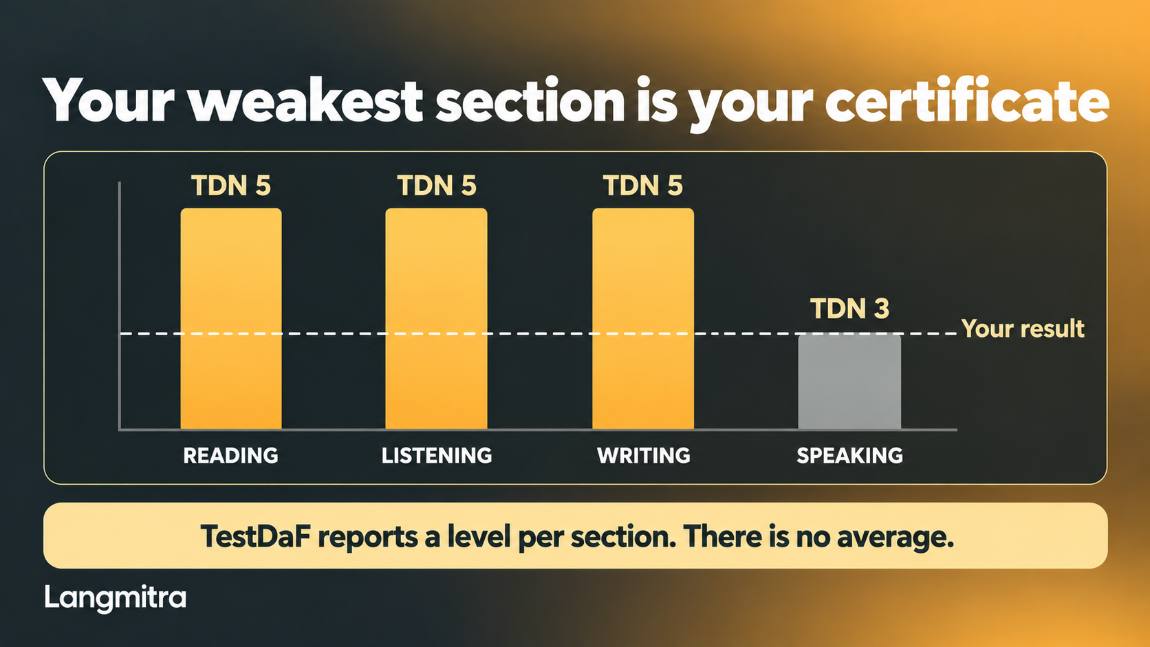
TestDaF does not pass or fail you. Each of the four sections is reported separately as TDN 3, TDN 4 or TDN 5, and anything below the bottom level is reported as being under TDN 3.
| TDN level | Roughly | What it tends to mean for admission |
|---|---|---|
| TDN 5 | C1 | Required by some competitive programmes |
| TDN 4 | Upper B2 to C1 | The standard requirement at most German universities, in all four sections |
| TDN 3 | B2 | Accepted by some programmes, often with conditions |
Because the levels are per section, your weakest section is your result. A candidate with TDN 5 in reading, listening and writing and TDN 3 in speaking does not have a TDN 4 certificate. They have an admissions problem, and no averaging rescues them. This is the same structural trap the DELE two-block rule sets, and it catches people for the same reason: preparation naturally gravitates to the sections that are already strongest.
There is one mechanism that softens it, and it is not widely known. For the digital test, results from several sittings within a six-month window can be combined into a single certificate taking your best result in each section. If speaking is the section holding you back, that changes the calculation: a second sitting does not have to repeat your good sections, it only has to beat the weak one.
Using a thin supply well
Work through the sample tasks before you book. They are free, they are public, and they tell you which sections are going to be the problem. Discovering that in the portal with four weeks left is worse.
Watch the speaking tutorials before you attempt speaking. All seven. Speaking into a computer with no interlocutor is the part candidates most reliably misjudge, and the format is learnable in an evening.
Save one portal model test for the final fortnight. Two tests taken in the same week measure nothing. Two tests separated by six weeks of study give you a trend and a decision about whether to sit.
Time the writing properly. Written academic German under a clock is a different skill from written academic German, and it is the one most self-studiers never rehearse. Our guide to writing in a foreign language covers why rewriting the same piece after correction does more than producing new ones.
Do not re-sit a paper you have already marked. Once you know the answers, the score is flattering and useless.
When the practice says you are not ready
Practice material measures; it does not teach. If the gaps are grammatical, our guides to German cases and der/die/das and German word order cover the two areas that cost the most marks in written production, and the common beginner mistakes guide covers what examiners see most often.
If you are still choosing between the German exams, start with which German certificate to choose or the DSH, TestDaF, Goethe and telc comparison. For how TDN 4 lines up against DSH-2 and the CEFR levels, see German levels explained. For the test itself, the TestDaF preparation guide covers format and strategy.
And for the honest timescale: the FSI language difficulty ranking puts German in Category II at roughly 900 class hours to professional working proficiency. TDN 4 sits near the top of that. A model test that goes badly in month five is a reading of month five.
If you want to see how much more generous other boards are, the contrast is stark: the Goethe-Institut publishes three or four complete papers per level free, and TOPIK releases a full paper every year.
Frequently asked questions
Are there free TestDaF practice tests?
Yes, but not openly. Two complete model tests are free in the participant portal, which only registered candidates can access. Publicly available without registering are the official sample tasks with audio, transcripts and solutions, plus video tutorials for every section.
Where can I download a TestDaF Modellsatz?
Complete model tests for the paper-based TestDaF are downloadable from the official site with their listening audio. The digital test's two model tests are in the participant portal rather than on the open site.
How many official TestDaF practice tests exist?
Two complete model tests for the digital test, plus the paper-based model tests and the public sample tasks. It is a much thinner supply than Goethe or TOPIK offer, which is why paid preparation materials are more commonly needed for this exam.
What is a good TestDaF score?
TDN 4 in all four sections is the standard requirement at most German universities. TDN 5 is asked for by some competitive programmes, and TDN 3 is accepted by some with conditions.
Can I pass TestDaF with a low score in one section?
There is no overall pass. Each section is reported separately, so a single section at TDN 3 leaves you with TDN 3 for that section whatever the others say. For the digital test, results from several sittings within six months can be combined to take your best result in each section.
Is the paper-based TestDaF still available?
Yes. Both formats exist, each with its own preparation material. The model tests for the paper-based version are the ones published openly on the official site.
Do I need to pay for TestDaF preparation material?
Not necessarily, but the free supply is thin enough that many candidates do. Deutsch-Uni Online runs courses built on the test format, and Klett publishes preparation titles with model tasks and an online simulation.