
Writing is the only one of the four skills where you control the clock. You can stop mid-sentence, look something up, try three versions and keep the best one — and that is precisely why most learners either avoid it or do it badly. Avoided, because it feels slow and exposing. Done badly, because the unlimited time gets spent on vocabulary lookups rather than on the thing writing is uniquely good for, which is finding out exactly where your knowledge of the language runs out.
The short version: write little and often, write to a deadline, get a small number of errors corrected rather than all of them, and rewrite the same piece at least once. Everything below is the reasoning behind those four instructions, and the evidence for the one of them that most teaching advice gets backwards.
Writing makes your gaps visible in a way reading never does
When you read, you understand the sentence and move on. You do not find out whether you could have produced it. Comprehension runs on far less grammar than production does, which is why learners routinely understand a paragraph containing a structure they could not write to save their lives.
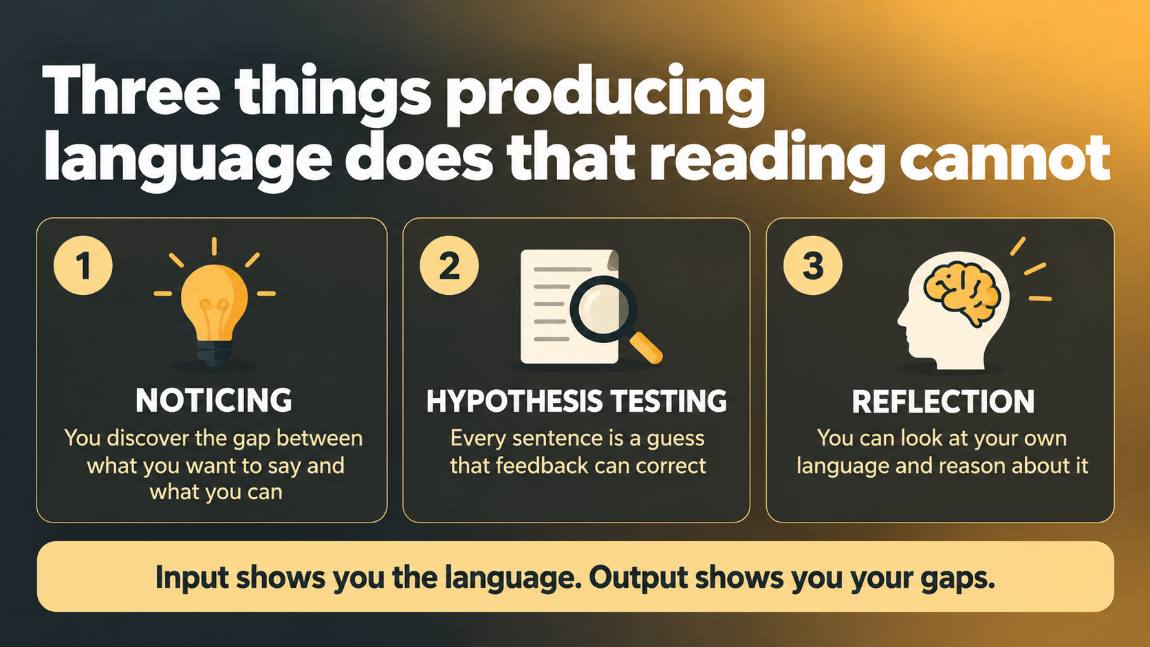
Writing removes that cushion. The moment you have to commit to a tense, a case ending, a particle or a preposition, you discover whether you actually know it or whether you have been recognising it. Merrill Swain's argument, made in the 1980s and still the clearest statement of why production matters, is that output does three things input cannot: it forces you to notice the hole in what you can say, it lets you test a guess and see what happens, and it gives you something concrete to think and talk about afterwards.
That third function is the one learners underuse. A paragraph you wrote is a record of your interlanguage on a specific day. It can be examined. A conversation you had cannot.
The counter-argument deserves a hearing, because it comes from Stephen Krashen and he has never conceded the point: learners produce very little language relative to how much they take in, some people reach high proficiency with almost no output, and being made to produce raises anxiety, which he argues interferes with acquisition. He is right that output alone builds nothing. The sensible reading is that writing is a diagnostic and a consolidator, not an engine. It does not replace reading and listening. It tells you what your reading and listening have and have not given you.
What the correction research actually found
Here is where most advice goes wrong, including advice from people who should know better.
The received wisdom is that correcting a small number of targeted error types works and correcting everything does not. A 2020 meta-analysis in TESL-EJ pooled 35 studies of written corrective feedback and found something more qualified than that.
| Comparison | Effect size (Hedges's g) | Statistically significant difference |
|---|---|---|
| Written corrective feedback overall, immediate post-test | 0.59 | — |
| Focused feedback | 0.63 | No (p = 0.305) |
| Unfocused feedback | 0.45 | Same comparison |
| Direct correction | 0.76 | No (p = 0.570) |
| Indirect correction | 0.63 | Same comparison |
| Overall, delayed post-test (23 studies, two weeks or more later) | 0.57 | — |
Three things follow, and they are not the usual three.
Correction works. A moderate effect that barely decays after two weeks or more is a real result, and it settles an argument that ran for twenty years over whether correcting written errors does anything at all.
The focused-versus-unfocused distinction is weaker than it is usually sold as. Focused feedback did come out ahead, but the gap was not statistically significant. If someone tells you that marking every error is useless, they are overstating a trend into a finding.
Direct correction helps more immediately; indirect correction may hold better. Being given the right form produced the larger immediate effect. Being shown that there is an error and left to fix it yourself produced the larger delayed effect, though again not significantly so. The practical compromise is to be told the answer for things you have never seen, and to be made to find it yourself for things you have.
What none of this tells you is how to get corrected when nobody is correcting you.
Correcting yourself, usefully
Self-correction has a known failure mode: you reread your own writing and your brain supplies what you meant rather than what you wrote. Three things defeat that.
Leave it overnight. Not a productivity platitude — a specific mechanism. The memory of the intended sentence fades faster than the sentence on the page, and once it has faded you are reading as a reader rather than as the author.
Read it aloud. Prosody catches what the eye skips. Word-order errors in German, dropped particles in Japanese and missing articles in English are all far more audible than visible.
Hunt one error type at a time. Read the whole piece checking only verb endings. Then read it again checking only agreement. Then only prepositions. Four narrow passes catch more than one general pass, because a general pass is really four passes done at a quarter of the attention each.
Then do the thing almost nobody does: keep the list. Over a dozen pieces, your errors turn out not to be random. Most learners have somewhere between three and six recurring mistakes that account for the large majority of what goes wrong, and the list identifies them in a way no amount of general study will.
Write to a constraint, not to a word count
"Write 500 words in Spanish today" produces 500 words of whatever you already find easy. Constraints produce the uncomfortable parts.
Set the piece in the past, and you cannot avoid the past tense system. Write a complaint and you need polite registers, conditionals and hedging. Write instructions and you need imperatives and sequencing. Summarise something you read and you need reported speech. Argue against a position you hold and you need concession structures, which are where most intermediate learners discover their writing has no joints.
Fifteen minutes to a timer, every day, beats ninety minutes on a Sunday. Writing is slow for everyone in a second language, and the fluency part — getting words out without stalling — only develops under time pressure. Without the clock you are practising composition. With it, you are also practising retrieval.
Rewrite the same piece, at least once
This is the highest-return habit in the whole list and the one almost universally skipped.
Writing something once tells you what you can produce under pressure. Rewriting it after correction is where the correction actually lands, because you have to re-make the same decisions with the error pointed out. A correction you read and nodded at has changed nothing. A correction you had to apply yourself, in context, has at least had a chance.
A workable cycle: write it cold to a timer, leave it a day, self-correct in narrow passes, get it corrected by a person or a tool if you can, then rewrite the whole thing from scratch rather than patching the original. Rewriting from scratch matters, because patching lets you avoid every structure you got wrong the first time.
When the writing exposes something bigger
Sometimes a piece goes badly because you had fifteen minutes and a dull topic. Sometimes it goes badly because a chunk of the grammar is not there yet, and no amount of writing practice will install it. Writing diagnoses; it does not teach.
If the gaps are in Spanish verbs, our guides to the subjunctive and to ser versus estar cover what costs the most marks in written production. For German, cases and der/die/das and word order are the two that wreck otherwise good sentences. For Japanese, the wa and ga particles are the perennial one.
And if what your writing lacks is not accuracy but appropriateness — sentences that are correct and still land wrong — that is a separate problem with a separate fix, covered in why fluent learners sound rude.
For exam writing specifically, where the task is narrower and the marking criteria are published, see the IELTS Task 2 essay templates. Exam writing rewards a drilled structure in a way that real writing does not, and it is worth treating as its own skill rather than as a sample of your general ability.
Frequently asked questions
How often should I write in my target language?
Short and daily beats long and weekly. Fifteen minutes to a timer, most days, develops the retrieval speed that writing fluency depends on. One long session a week develops composition but leaves you just as slow.
Should I translate from my first language or write directly?
Write directly, even though the result is simpler. Translating keeps you composing in your first language and converting, which trains the wrong process and tends to produce sentences that are grammatical and unidiomatic.
Does correcting my errors actually help?
Yes. A meta-analysis of 35 studies found a moderate effect on written accuracy that largely held up two weeks or more later. The long-running argument that correction does nothing is not supported.
Should I be corrected on everything or just a few error types?
Either works better than nothing. Targeted feedback on a small set of errors came out slightly ahead in the research, but the difference was not statistically significant, so the common claim that marking everything is useless overstates the evidence.
Is it better to be given the correct form or just told there is an error?
Being given the form helps more immediately; being made to find it yourself appears to hold up better over time, though the difference was not significant. A reasonable compromise is to be told the answer for structures you have never met, and to be left to work it out for structures you have studied.
How do I get writing corrected if I do not have a teacher?
Self-correct in narrow passes a day later, checking one error type at a time, and keep a running list of what recurs. Language exchange partners will correct writing more willingly than speech, because it is easier to mark text than to interrupt a conversation.
Why do I write much worse than I speak?
Usually you do not. Speech hides errors that writing records, and listeners repair what they hear without telling you. Writing is the first time many learners see their actual accuracy rather than the conversational version of it.