
You studied French for five years at school and cannot order a coffee. You were conversational in Spanish during a year abroad and now the words will not come. It feels like the whole thing drained away, and that feeling is the main reason people never go back.
The research says something more encouraging. Most of what you think you lost is still there — you have lost fast access to it, not the knowledge itself. And the loss is not a slow slide into nothing. It falls steeply, then it stops.
The shape of forgetting
The best-known work here is Harold Bahrick's, who tested 773 people who had studied Spanish and then not used it — some for up to fifty years. The pattern he found was not a steady decline.
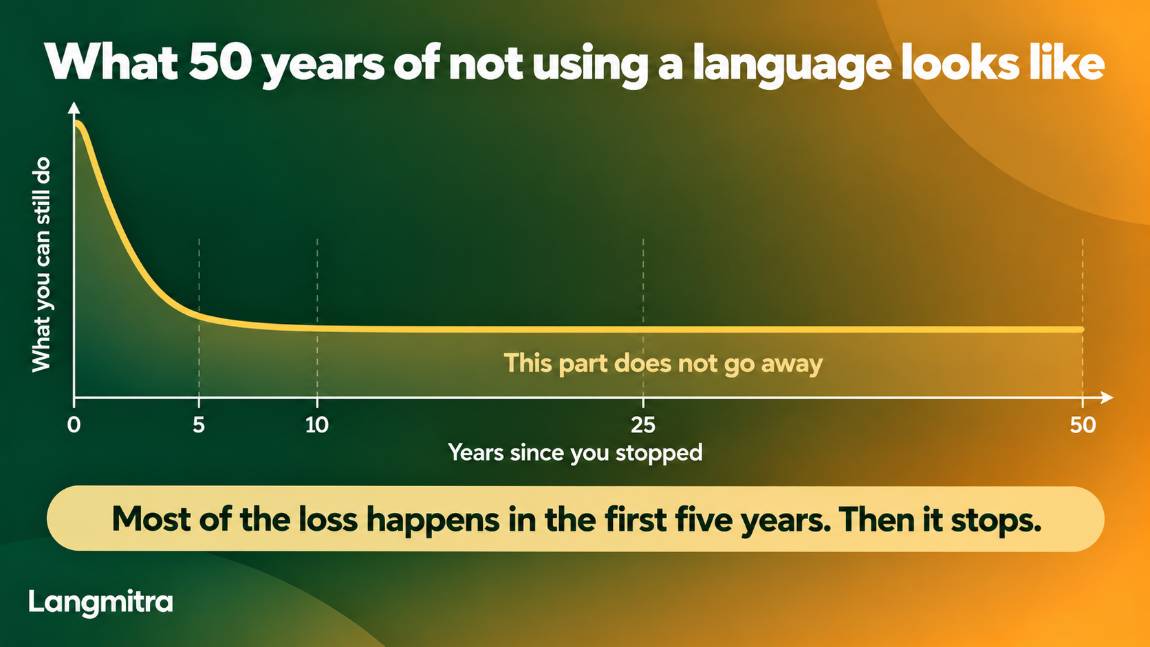
Losses were concentrated in roughly the first five years. After that, performance was remarkably stable across the following decades. Bahrick called what survived the permastore: knowledge that, once it reaches a certain level, appears to resist decay more or less indefinitely.
Other researchers have found variations on this — some report an initial plateau before any loss begins, which may reflect how proficient their participants were to start with. The literature is genuinely mixed on the timing. What is consistent is the shape: fast early loss, then a long flat floor, rather than decline all the way down.
The practical consequence is large. If you stopped ten years ago, you have almost certainly already lost whatever you were going to lose. Another decade of neglect will cost you much less than the first five years did.
What goes, and what stays
Attrition is not uniform. It takes specific things in a fairly reliable order.
Production goes before comprehension. This is the most consistent finding in the field, and it explains the particular misery of returning to a language: you can follow the conversation perfectly and cannot contribute to it. Receptive knowledge is comparatively stable. You are not back at zero — you are holding an asymmetric version of what you had.
Retrieval speed goes first of all. Fluency declines before anything structural, and mostly because word-finding slows. Speech gets slower, pauses get longer and more frequent, and you start reaching for the other language to fill gaps. The word is not gone; the path to it has gone quiet.
Then morphology and syntax. Verb tenses and agreement start to wobble after the lexical slowdown, not before it.
Rare and irregular things go before common and regular ones. Low-frequency items, marked forms and the features furthest from your native language are the most vulnerable. The core of the language is the most robust part of it.
How far you got matters more than how long you have been away
The strongest predictor of what survives is the level you reached before you stopped. Researchers describe a critical threshold: get past it and a large portion of what you know becomes close to permanent. Fall short of it and much more is at risk.
This reframes a decision many learners face. If you are at A2 and life is about to get busy, the highest-value thing you can do is push to a solid B1 before you pause, rather than maintaining A2 indefinitely. Reaching the threshold is what makes the knowledge cheap to keep.
It also explains why a year abroad at twenty leaves more behind than three years of school lessons, even though the school lessons took longer.
Maintenance costs less than you think
Because the floor is high and the loss is front-loaded, maintaining a language is far cheaper than acquiring one.
Protect comprehension first and cheaply. Fifteen minutes of listening or reading a few times a week keeps receptive knowledge in good condition. It is low effort and it is also the half that survives best anyway, so you are reinforcing strength.
Protect production deliberately, because it decays first. This is the part that actually needs scheduling. Speaking aloud to yourself for ten minutes a week does more for retention than an hour of passive listening, because retrieval is the thing that is slipping. Our solo speaking routine works as a maintenance regime as well as a learning one.
Accept maintenance is not progress. A maintenance schedule holds a level; it does not raise one. Expecting it to improve you leads to abandoning it in disappointment.
Rotate rather than stack. If you have more than one language, alternating months works better than trying to maintain all of them weekly — see how many languages you can learn at once.
Coming back after years away
Expect the first week to be misleading. Returning learners consistently underestimate what they retain because they test themselves by trying to speak, which is the skill that decayed most. Read something first. You will be surprised.
Relearning is much faster than learning. Recovering a language you once had is not the same project as acquiring one from scratch, and treating it as if it were — starting again at absolute-beginner materials — wastes the asymmetry. Start at the level your comprehension suggests, not your speaking.
Give retrieval time to warm up. Much of what feels lost in week one is back by week four without anything having been relearned at all. The paths are still there; they have gone quiet, and traffic reopens them.
If the gap feels discouraging, the same measurement problem described in the intermediate plateau applies here: the thing you can feel (fluent speech) is the thing that decayed, while the thing you cannot easily feel (recognition, structure, sound system) is largely intact.
Frequently asked questions
Do you really forget a language you do not use?
Partly. Production and retrieval speed decline noticeably, while comprehension stays relatively stable. The knowledge is mostly still there; fast access to it is what goes.
How fast does language attrition happen?
Research points to most of the loss occurring in roughly the first five years, after which performance is strikingly stable — Bahrick found this across participants who had not used Spanish for up to fifty years.
Why can I understand but not speak?
Because productive skills decay faster than receptive ones. This is the most consistent finding in attrition research, and it is why returning learners badly underestimate what they still have.
How much practice does it take to maintain a language?
Far less than to acquire one. A few short sessions a week will hold comprehension; production needs deliberate speaking practice because it decays first.
Is it faster to relearn a language than to learn one?
Yes, substantially. You are reactivating existing knowledge rather than building it, which is why starting again from beginner materials is usually the wrong move.
Should I reach a higher level before taking a break?
If you can, yes. The level you reach before stopping is the strongest predictor of what survives, and passing a certain threshold appears to make a large portion of the knowledge close to permanent.