
Yes — and by a margin that is unusually large for a field where most interventions move the needle barely at all. The best-known synthesis of the evidence found that learners who were taught grammar explicitly outperformed those left to absorb it, on the features they were taught, by roughly twice as much.
That is the honest headline. The honest second sentence is that the result is narrower than it sounds, and that most of what learners actually do under the name "studying grammar" is not the thing that was measured.
The case against, which is not stupid
The position that grammar study is a waste of time has a serious version, and it belongs to Stephen Krashen. Language, on his account, is acquired through understanding messages, not through learning rules. Conscious knowledge of grammar can only ever serve as a monitor — a slow editor you apply to speech when you have time, know the rule and are thinking about form, which in real conversation is almost never.
The evidence he points at is real. Children acquire a first language to complete mastery without a single explanation. Plenty of immigrants reach high fluency having never opened a grammar book. And nearly everyone has met the learner who can recite the conditional paradigm and freezes solid when asked to use it.
Anyone who has studied a language seriously has also met the opposite: the learner with years of exposure and fossilised errors that never resolve, because nothing in the input ever forced them to notice the difference.
What the research found
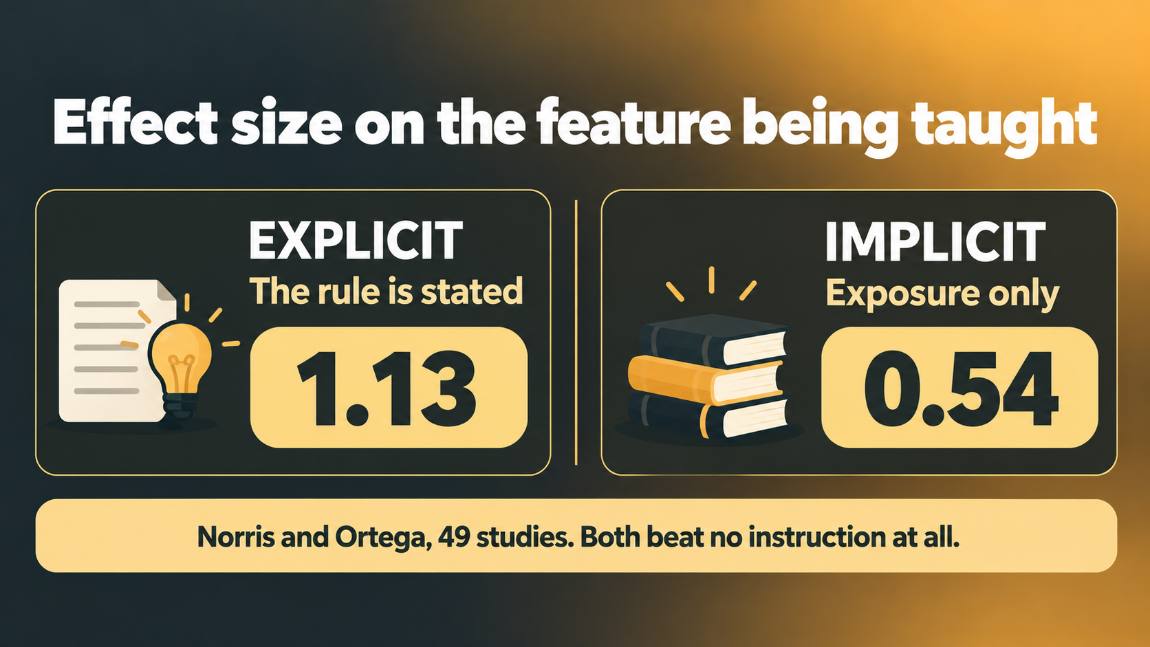
In 2000, John Norris and Lourdes Ortega pooled 49 experimental studies of second language instruction published between 1980 and 1998. The results:
| Type of instruction | Average effect size (d) |
|---|---|
| Focused instruction of any kind | 0.96 |
| Explicit instruction — the rule is stated and the form pointed out | 1.13 |
| Implicit instruction — exposure, input flooding, no explanation | 0.54 |
In a field where an effect size of 0.4 counts as worth having, 1.13 is enormous. Both kinds of instruction beat nothing. Explicit instruction beat implicit by roughly two to one.
The other finding matters just as much and gets quoted less. Instruction organised around a grammar target — a lesson about the subjunctive — and instruction that stays communicative and addresses grammar when it comes up produced broadly equivalent large effects. The two-week grammar unit is not the thing doing the work. The attention to the form is.
The caveat the numbers hide
Norris and Ortega flagged this themselves, and anyone citing their headline figure without it is misleading you.
Most of the studies measured their outcomes with discrete-point tests — fill in the gap, choose the correct form, judge whether the sentence is grammatical. Those tests measure exactly the kind of knowledge explicit teaching produces. On freer, more communicative measures the explicit advantage shrank, though it did not disappear.
Two further limits: the interventions were mostly short, and the post-tests mostly immediate, so the research says little about what survives a year. And the single strongest predictor of whether a learner did well was whether they were tested on the form in the way they had practised it.
The defensible conclusion is therefore narrower than "grammar study works". It is this: deliberate attention to a specific form reliably improves your command of that form, most strongly when you are later asked to use it the way you practised it. That is a genuinely useful finding. It is not a licence to spend a year on textbooks.
Which means some grammar study is close to worthless
The research supports attention to form. It does not support most of what learners do.
Reading a grammar explanation and nodding is not studying grammar — it is reading. The gap between understanding a rule and applying it under time pressure is the whole difficulty, and comprehension does nothing to close it.
Learning terminology is not studying grammar either. Being able to name the dative does not help you produce it. Some learners find the labels useful as filing, and others find them a second language to learn on top of the first; neither effect is the thing that was measured.
Completing exercises you cannot get wrong is the most comfortable and least productive version. A gap-fill where the page is headed The Subjunctive has already told you the answer. The whole skill is deciding that this sentence needs the subjunctive, and a labelled exercise removes exactly that step.
What does resemble the research: taking one form, producing it yourself in sentences you had to decide the content of, getting told when you got it wrong, and meeting it again days later rather than forty times in one sitting. Which is to say grammar study works best when it looks less like studying and more like testing yourself — and, since production is where the gap shows up, it is closely tied to writing practice.
How much, and when
A workable allocation for most learners is somewhere around a fifth of study time on grammar and the rest on input and production. Grammar is a corrective, not a diet.
The point in the process matters more than the proportion. Grammar study pays best when it resolves confusion you already have. A learner who has met the Spanish subjunctive a dozen times in reading and sensed that something is going on has somewhere to put the explanation. A learner who meets the same explanation in week two has nothing to attach it to and will forget it, which is why so much early grammar study feels like it evaporates. It does evaporate.
The practical rule: when something in the language keeps confusing you, go and study it. When nothing is confusing you, read and listen more, and wait for the language to raise the question.
A reasonable exception is a structure so frequent that you cannot read a paragraph without it. Basic word order, the present tense, the case system in a language that has one: those are worth front-loading, because the confusion they would otherwise cause is continuous.
Where to start, by language
Grammar guides earn their keep when they target the specific thing that is going wrong. For Spanish, the subjunctive and ser versus estar account for a large share of intermediate errors. For German, cases and der/die/das and word order, with the beginner mistakes guide covering what examiners see most. For Japanese, the wa and ga particles are the long-running one.
And for the grammar that is not grammar — sentences that are perfectly correct and still land badly — see why fluent learners sound rude. No amount of paradigm drilling fixes that one, because it is not an accuracy problem.
For how long the whole road takes, the FSI language difficulty ranking is the realistic baseline.
Frequently asked questions
Does studying grammar actually help you learn a language?
Yes, for the specific features you study. A synthesis of 49 studies found focused instruction produced large gains, with explicit instruction roughly twice as effective as leaving learners to absorb the form from exposure.
Is explicit grammar teaching better than just getting exposure?
On the evidence, yes, though both beat nothing. Explicit instruction averaged an effect size of 1.13 against 0.54 for implicit. The caveat is that most of the tests used favoured the kind of knowledge explicit teaching produces.
How much of my study time should be grammar?
Around a fifth is a reasonable working figure for most learners. Grammar corrects and sharpens; input and production are what build the language.
Should I study grammar as a complete beginner?
Study the structures you cannot avoid — basic word order, the present tense, the case system if your language has one. Leave the rest until the language has raised the question, because explanations given before you have met the problem rarely stick.
Do I need to learn grammar terminology?
No. Naming the dative does not help you produce it. The labels are a filing system, useful to some learners and an extra burden to others, and they are not what the research measured.
Why can I explain the rule and still get it wrong when speaking?
Because knowing a rule and applying it in real time are different abilities. Conscious knowledge needs time, attention and the awareness that this is the moment to apply it — conditions that rarely hold mid-conversation. Closing that gap takes repeated production, not more explanation.
Are grammar exercises worth doing?
Only if you can get them wrong. An exercise headed with the name of the structure has already made the decision that is the actual skill. Exercises that mix structures, or that make you produce rather than select, are much closer to the thing being tested.