
Italian is welcoming to beginners: spelling is relatively consistent, the alphabet is familiar to English speakers, and useful phrases become pronounceable quickly. The challenge comes later, when articles, gender, prepositions and verb forms begin interacting. A good roadmap helps you enjoy the easy wins without ignoring the structures that create confident speech.
This guide takes you from your first ciao to independent conversation. The stages use CEFR levels because they describe what you can do, not merely how many lessons you have completed.
Before you begin: choose a concrete goal
“Learn Italian” is too broad. Choose a first destination: hold a ten-minute family conversation, travel independently, pass an A2 exam, understand a podcast, or reach B1 for work or study. Your goal decides which vocabulary and situations deserve the most practice.
At five focused hours per week, many learners can reach a useful A2 level in six to nine months and B1 in roughly a year to eighteen months. These are planning ranges, not promises. Your previous language experience, conversation access and consistency matter more than the calendar.
Stage 1: pronunciation and survival Italian
Spend your first two weeks learning the sound system alongside basic phrases. Italian spelling is predictable once you understand a few patterns:
- c before e or i sounds like “ch” in ciao; ch keeps a hard sound as in che.
- g before e or i can sound like the “j” in “job”; gh stays hard.
- gn resembles the sound in “canyon,” while gli needs dedicated listening practice.
- Double consonants matter: pala and palla are not pronounced identically.
- Keep vowels clear. English-style vowel reduction can make familiar words harder to understand.
Learn greetings, courtesy phrases, numbers, time, directions and repair phrases such as Può ripetere? (Can you repeat?) and Non ho capito (I didn't understand).
Stage 2: build an A1 foundation
At A1, aim to introduce yourself, order food, ask simple questions and understand slow, predictable speech. Build around high-frequency verbs: essere (to be), avere (to have), fare (to do/make), andare (to go), volere (to want), potere (can) and dovere (must).
Learn nouns with their articles, not alone. Memorize la casa, not just casa; il problema, not just problema. The article carries information about gender and sound pattern.
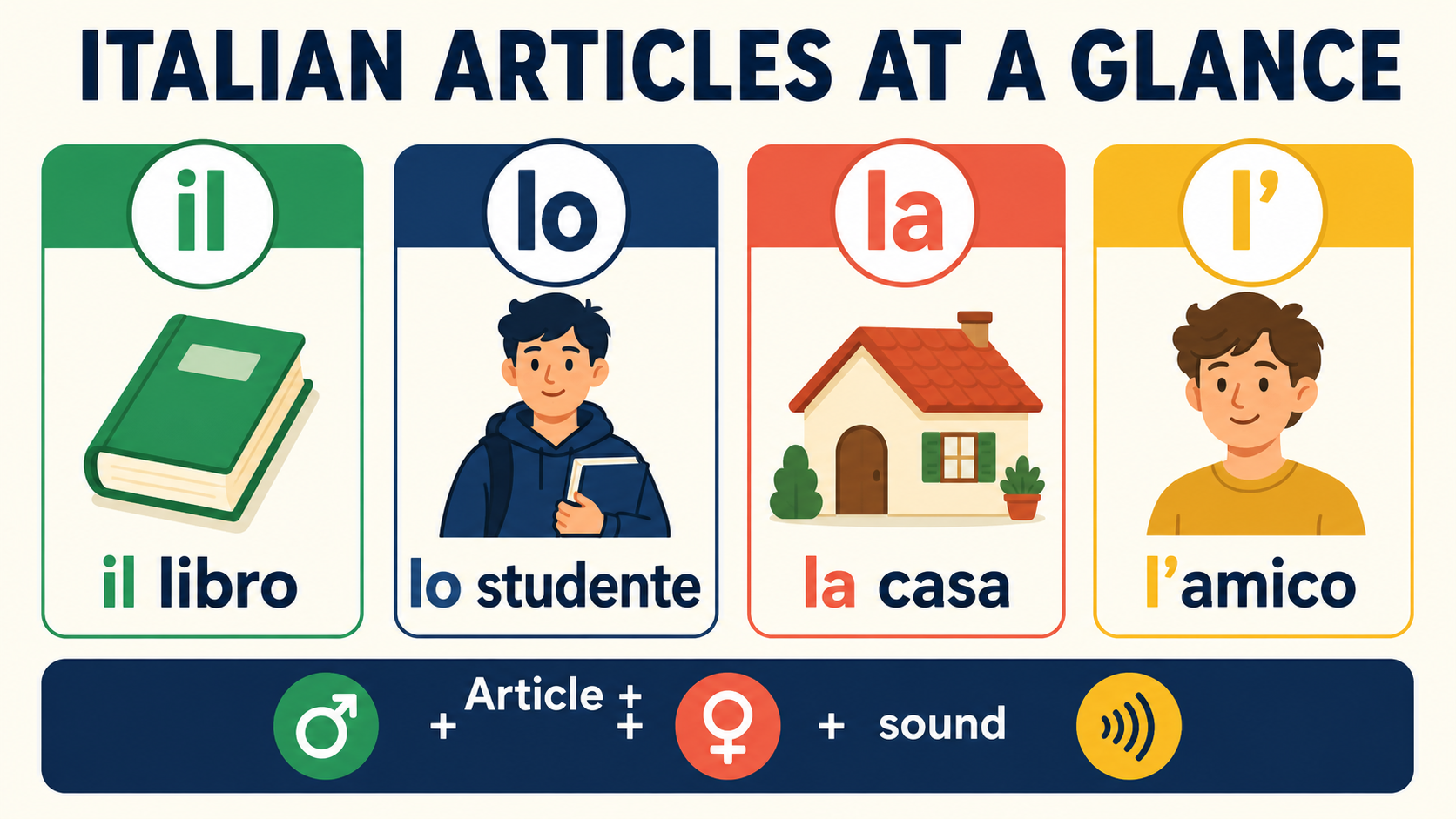
The first challenging bit: articles and gender
Italian has several forms of “the.” Masculine singular nouns commonly use il, but use lo before s + consonant, z, ps, gn and some other clusters: lo studente, lo zaino. Both masculine and feminine nouns use l' before a vowel: l'amico, l'amica. Feminine singular nouns otherwise usually take la.
Plural forms add another layer: i libri, gli studenti, le case. Instead of memorizing an abstract chart once, notice and say complete noun phrases in every lesson.
Stage 3: reach A2 everyday Italian
At A2, expand into routine life: shopping, transport, health, hobbies, family and work. Learn the present tense well, then add the passato prossimo for completed past events: Ho mangiato (I ate) and Sono arrivata/arrivato (I arrived).
Notice that some past forms use avere and others use essere. With essere, the participle agrees with the subject. Do not try to master every exception immediately; collect verbs in meaningful examples.
This is also the time to learn combined prepositions such as del, alla and nel. Read them as units in context rather than translating each piece every time.
Stage 4: cross the B1 bridge
B1 means you can handle most travel situations, describe experiences, explain opinions and follow the main points of clear speech. The biggest shift is moving from rehearsed exchanges to connected language.
Add the imperfect tense for background, habits and ongoing past situations: Quando ero piccolo, vivevo a Roma. Contrast it with completed events in the passato prossimo. Begin using direct and indirect object pronouns—lo, la, li, le, gli, le—in short, frequent patterns.
Speak every week. Prepare a story, tell it without reading, receive corrections and tell it again. Repeated storytelling is one of the fastest ways to make grammar usable.
Stage 5: build B2 confidence
At B2, you should discuss abstract topics, understand standard media and interact without placing constant strain on your partner. Expand connectors such as tuttavia, inoltre and nonostante. Learn the present subjunctive through common triggers—opinions, doubt, emotion and necessity—rather than as an isolated table.
Read longer articles, follow one podcast series and write 150–250 words weekly. Ask a teacher or exchange partner to identify recurring errors. Advanced progress comes from refining patterns you already use, not endlessly collecting beginner resources.
A weekly study plan that works
- Two sessions: structured grammar and sentence building.
- Three short sessions: spaced vocabulary review using complete phrases.
- Three sessions: listening with a transcript, including one shadowing practice.
- One session: live conversation or a recorded monologue.
- One enjoyable activity: music, cooking video, football commentary or a series in Italian.
A 30-minute weekday routine can outperform a long weekend session because frequent contact reduces forgetting. Use our guide on how long it takes to learn a language to set a realistic timeline.
Vocabulary: learn phrases, not lonely words
Store avere bisogno di (to need), not only bisogno. Save dipende da (it depends on), not only dipendere. Phrase-based learning teaches the preposition and word order at the same time.
Build small topic collections linked to your life: 30 phrases for your work, 30 for your family and 30 for your interests. Personal relevance makes retrieval easier.
Interesting features that make Italian memorable
Italian can drop subject pronouns because verb endings often reveal who is acting: Parlo italiano already means “I speak Italian.” Word order can also shift for emphasis. Hand gestures are culturally meaningful, but they are not a substitute for vocabulary and vary by context.
Italy also has rich regional languages and varieties. Standard Italian is the best shared starting point; regional pronunciation and expressions can become part of your learning once you know where you will live, travel or connect with family.
Common beginner traps
- Pronouncing Italian through English spelling habits.
- Memorizing nouns without an article.
- Learning every tense before holding simple conversations.
- Translating word for word and ignoring fixed expressions.
- Waiting to speak until you feel “ready.”
- Using five apps but finishing no coherent course.
Choose one structured course, one listening source and one place to speak. Our language learning app comparison can help you select tools without building an overcrowded system.
Frequently asked questions
Is Italian easy to learn?
For English speakers, Italian is generally more approachable than languages with unfamiliar scripts or very different grammar. Its verb system, gender and pronouns still require sustained practice.
Can I learn Italian in three months?
You can build survival skills and a solid A1 foundation in three consistent months. Comfortable independent conversation usually takes longer.
Should I learn grammar or start speaking?
Do both. Learn one small grammar pattern, hear it in context and use it in speech the same week.
Do I need to roll my r?
A clear approximation is enough to be understood. Practise gradually, but do not let one sound delay your speaking.
Your first seven days
Learn Italian sound rules, greetings and ten high-frequency verbs. Create 20 personal sentences, listen to the same short dialogue daily and record a one-minute introduction on day seven. Your first goal is not perfection—it is a repeatable system that keeps Italian present in your week.