
It's the first question every aspiring language learner asks — and the answer is frustratingly honest: it depends. But "it depends" isn't helpful when you're trying to plan your year, so let's break it down with real timelines based on research, proficiency standards, and what thousands of learners actually experience.
The US Foreign Service Institute (FSI) has spent decades tracking how long it takes English speakers to reach professional proficiency in different languages. Their data, combined with modern research on self-directed learning, gives us the most reliable estimates available.
The FSI Framework: Languages by Difficulty
The FSI groups languages into four categories based on how different they are from English. This isn't about one language being "harder" in some abstract sense — it's about how much new ground an English speaker needs to cover.
Category I (600-750 hours): Spanish, French, Italian, Portuguese, Dutch, Norwegian, Swedish, Danish, Romanian. These languages share vocabulary, grammar structures, or both with English. Spanish and French are the fastest for most learners.
Category II (900 hours): German, Indonesian, Malay, Swahili. Slightly more complex grammar or less shared vocabulary, but still relatively accessible.
Category III (1,100 hours): Hindi, Russian, Thai, Vietnamese, Turkish, Polish, Czech, Greek, Hebrew, Icelandic. Different writing systems, grammar structures, or tonal systems add significant learning time.
Category IV (2,200 hours): Japanese, Korean, Mandarin Chinese, Cantonese, Arabic. These require learning entirely new writing systems (often multiple), fundamentally different grammar, and in some cases tonal pronunciation. Japanese is consistently rated the hardest for English speakers due to its three writing systems.
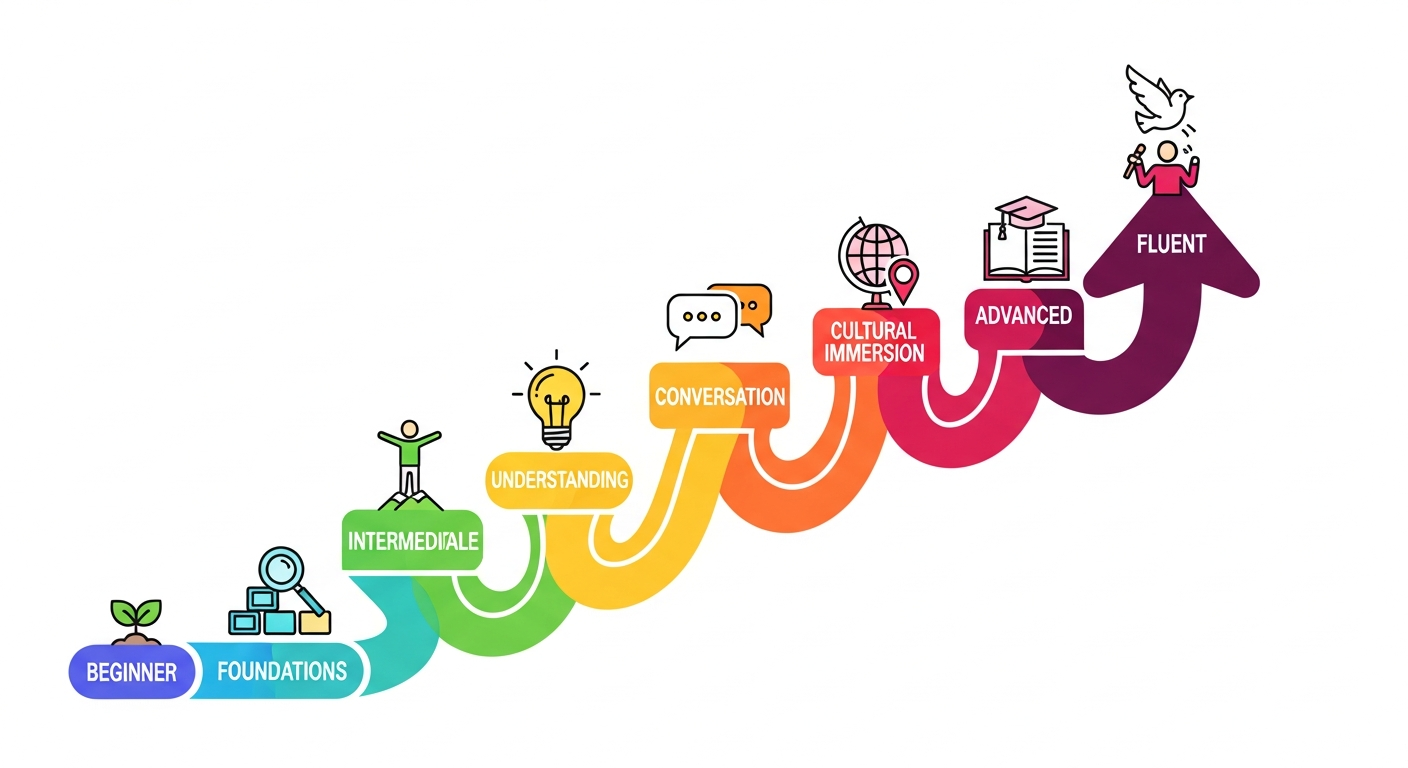
How Long to Learn Spanish
Spanish is consistently the fastest major language for English speakers to learn. The FSI estimates 600-750 hours to reach professional working proficiency (B2-C1 level).
What this looks like in practice:
Casual learner (30 min/day): Basic conversational ability in 6-8 months. Comfortable travel conversations in 12-14 months. Professional proficiency in 3-4 years.
Dedicated learner (1-2 hours/day): Ordering food and basic small talk in 2-3 months. Following TV shows with occasional subtitle checks in 6-8 months. Professional proficiency in 12-18 months.
Intensive learner (3+ hours/day or immersion): Conversational within 3-4 months. Near-fluent in 8-12 months.
Why Spanish is fast: roughly 30-40% of English words have Spanish cognates (hospital/hospital, information/información, perfect/perfecto). The grammar is relatively predictable, pronunciation is phonetic, and there's massive amounts of practice content available.
How Long to Learn Japanese
Japanese is the marathon of language learning. The FSI estimates 2,200 hours — nearly four times longer than Spanish.
What this looks like in practice:
Casual learner (30 min/day): Hiragana and katakana mastered in 1-2 months. Basic greetings and survival phrases in 4-6 months. JLPT N5 level (very basic) in 8-12 months. Comfortable conversation: 3-5 years. Professional proficiency: 6-8+ years.
Dedicated learner (1-2 hours/day): Both kana systems in 2-4 weeks. JLPT N4 (basic conversation) in 6-10 months. JLPT N3 (intermediate) in 12-18 months. JLPT N2 (professional) in 2-3 years.
Intensive learner (3+ hours/day or immersion): JLPT N3 in 8-12 months. JLPT N2 in 18-24 months. Near-fluency in 3-4 years.
Why Japanese takes long: you need to learn three writing systems (hiragana, katakana, and roughly 2,000 kanji characters), honorific speech levels, particles that don't exist in English, and subject-object-verb word order. The payoff is enormous — Japan has the world's third-largest economy and a culture that deeply rewards Japanese speakers.
How Long to Learn Korean
Korean falls in the same FSI category as Japanese (2,200 hours), but many learners find it slightly faster in practice because Hangul is dramatically easier to learn than kanji.
What this looks like in practice:
Casual learner (30 min/day): Hangul reading in 1-2 weeks. Basic phrases in 2-3 months. TOPIK Level 1-2 in 6-12 months. Comfortable conversation: 2-4 years. Professional proficiency: 4-6 years.
Dedicated learner (1-2 hours/day): Hangul in a weekend. TOPIK Level 2 in 4-6 months. TOPIK Level 3-4 (intermediate-advanced) in 12-18 months. Near-fluent in 2-3 years.
Intensive learner (3+ hours/day or immersion): TOPIK Level 3 in 6-8 months. TOPIK Level 5 in 18-24 months.
The K-pop advantage: fans who consume Korean media regularly often progress 30-40% faster through beginner levels because they've already built passive vocabulary and pronunciation intuition.
How Long to Learn German
German sits at 900 FSI hours — harder than Spanish but much easier than Asian languages for English speakers. English is a Germanic language, so you share deep structural roots.
Casual learner (30 min/day): A1 level in 3-4 months. B1 (intermediate) in 12-18 months. B2 (upper-intermediate, needed for many jobs) in 2-3 years.
Dedicated learner (1-2 hours/day): A2 in 3-4 months. B1 in 6-8 months. B2 in 12-16 months.
The grammar curve: German grammar (cases, gendered nouns, separable verbs) feels steep at the start but becomes predictable once you internalize the patterns. Many learners describe a "click" moment around the B1 level where German grammar suddenly makes sense.
How Long to Learn French
French is another Category I language at 600-750 FSI hours. It's slightly slower than Spanish for most English speakers due to pronunciation complexity and more irregular verbs.
Casual learner (30 min/day): Basic conversation in 6-9 months. B1 level in 14-18 months. B2 in 2.5-3.5 years.
Dedicated learner (1-2 hours/day): A2 in 2-3 months. B1 in 6-8 months. B2 in 12-16 months.
French vocabulary advantage: an estimated 45% of English words have French origins, making reading comprehension surprisingly fast. The challenge is pronunciation — French has nasal vowels, silent letters, and liaison rules that take time to master.
What Actually Determines Your Speed
FSI hours assume full-time classroom instruction with homework. Your actual timeline depends on five factors that matter more than raw talent:
1. Consistency over intensity. Fifteen minutes daily beats three hours on Saturday. Your brain builds neural pathways through regular repetition, not cramming. Missing days resets progress more than short sessions advance it.
2. Quality of input. Consuming content you genuinely enjoy in your target language (shows, music, podcasts, social media) dramatically accelerates progress compared to textbook-only study.
3. Speaking practice. Languages learned passively (reading and listening only) plateau at intermediate levels. Regular speaking practice — even 15 minutes with a language partner — unlocks fluency.
4. Languages you already know. If you speak Spanish, Portuguese and Italian become significantly faster. If you know Japanese kanji, Chinese reading becomes much more accessible. Each language makes the next one easier.
5. Living environment. Immersion (living where the language is spoken) typically doubles or triples learning speed. But "immersion at home" through media, language partners, and changing your phone language can capture 30-50% of that benefit.
The Honest Truth About "Fluency"
Most people use "fluent" to mean "can have a comfortable conversation without struggling." By that practical definition, here's the reality check for a dedicated learner studying 1 hour per day:
Spanish/French/Italian: 8-14 months to conversational. 18-24 months to comfortable fluency.
German: 10-16 months to conversational. 20-30 months to comfortable fluency.
Japanese/Korean/Mandarin: 18-30 months to basic conversational. 3-5 years to comfortable fluency.
These numbers aren't meant to discourage you — they're meant to help you set realistic expectations so you don't quit at month three thinking you're failing. You're not. Language learning is a long game, and every hour invested compounds.
The best language to learn is the one you're most motivated to stick with. Passion for Korean dramas will get you farther than a logical argument for Spanish, because passion keeps you studying when motivation fades.
Ready to start? Langmitra's AI-powered platform creates personalized study plans for any language, adjusting to your pace and interests. Whether you're targeting Spanish in 6 months or Japanese over 3 years, we'll help you build the right daily habit.