
If you have searched for the easiest or hardest languages to learn, you have probably seen a chart that places Spanish in Category I, German in Category II, Russian in Category III, and Japanese in Category IV. These groupings are usually called the FSI language categories because they are based on training schedules associated with the U.S. Foreign Service Institute.
The chart is useful—but it is often misunderstood. It does not predict exactly how long you will need. It was built around intensive professional training for English-speaking U.S. government personnel, not casual app study, one weekly class, or every learner background.
This guide explains what the FSI categories mean, what the familiar hour estimates do and do not measure, and how to convert them into a realistic personal study plan. For the complete language-by-language list, see Langmitra’s FSI ranking of the easiest and hardest languages.
The short answer: what are the FSI language categories?
FSI-style difficulty groupings estimate the relative training time an English-speaking learner may need to reach professional working proficiency. The widely circulated schedule is commonly summarized like this:
- Category I: approximately 24–30 weeks or 600–750 class hours
- Category II: approximately 36 weeks or 900 class hours
- Category III: approximately 44 weeks or 1,100 class hours
- Category IV: approximately 88 weeks or 2,200 class hours
These are not “time to fluency” guarantees. They are intensive-course benchmarks associated with a demanding professional goal. The U.S. Department of State defines level 3 proficiency as the ability to participate effectively in most formal and informal conversations on practical, social, and professional subjects. That is considerably more demanding than ordering food, holding a friendly conversation, or finishing an A2 course.
What proficiency level do the estimates target?
The most important detail is the finish line. The estimates are generally discussed in relation to minimum professional proficiency, often represented as level 3 on the Interagency Language Roundtable scale.
At level 3, a learner should be able to discuss professional topics with sufficient vocabulary and structural accuracy, understand standard speech, and read ordinary professional material. The State Department’s official proficiency definitions describe level 3 as effective participation in most formal and informal conversations—not native-like mastery.
For an everyday learner, more useful milestones may be:
- A1: basic introductions, simple questions, and survival phrases
- A2: common daily tasks and predictable conversations
- B1: independent travel, routine social interaction, and familiar topics
- B2: detailed conversation, work or university discussions, and greater spontaneity
- C1: flexible, precise language use in demanding academic or professional settings
You therefore do not need to complete the full FSI-style schedule before the language becomes useful. A learner can often start enjoying podcasts, conversations, travel, and beginner reading much earlier.
Category I: languages closest to English
Category I contains languages that usually offer English speakers the fastest route to professional proficiency. Frequently cited examples include Spanish, French, Italian, Portuguese, Dutch, Norwegian, Swedish, Danish, and Romanian.
They are not equally easy in every skill. French spelling and pronunciation may slow listening progress. Danish pronunciation can be difficult even when the grammar feels accessible. Portuguese has unfamiliar vowel sounds. What these languages share is a meaningful amount of vocabulary, grammatical structure, or writing-system familiarity with English.
What 600–750 hours might look like for you
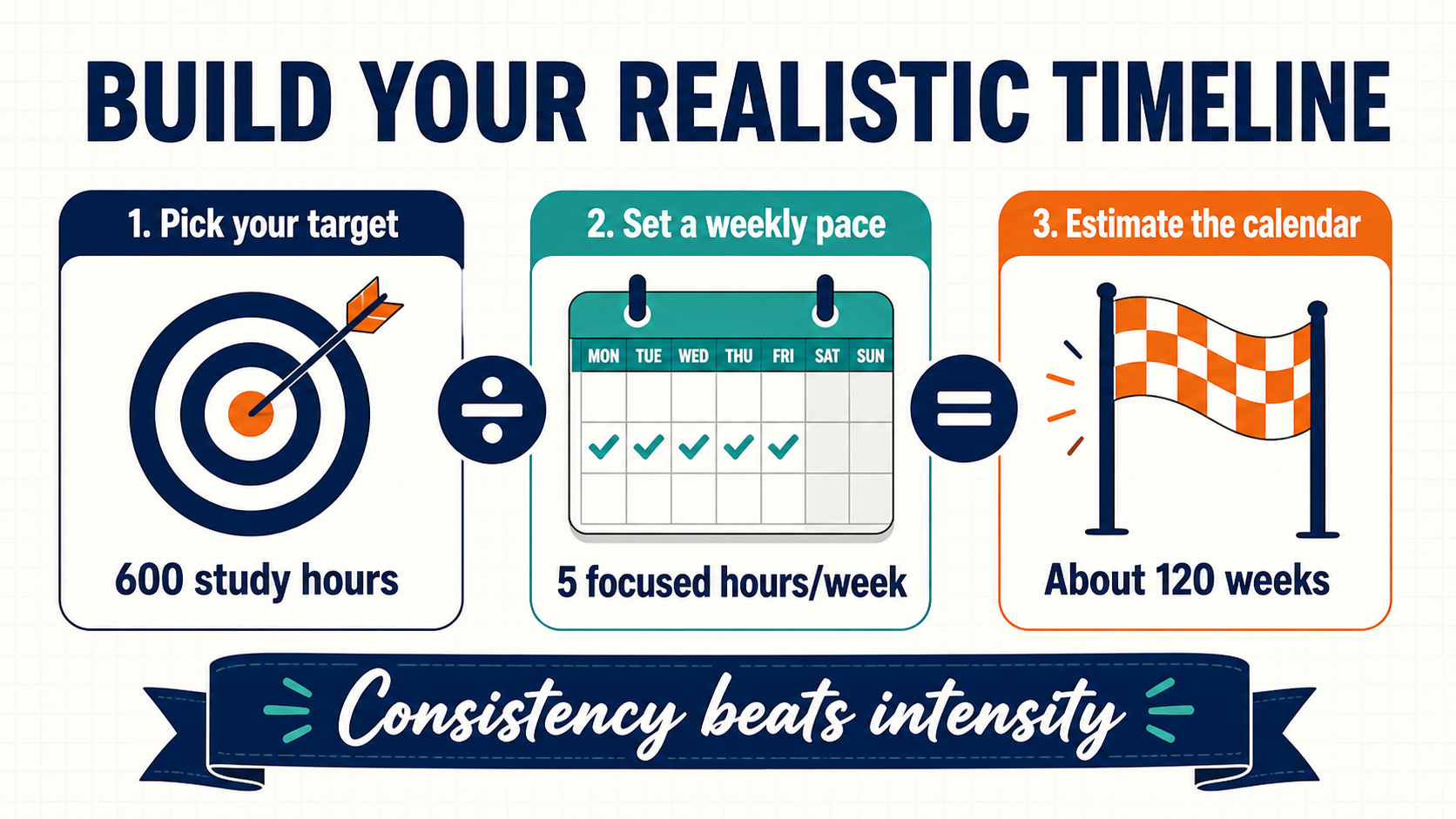
If you study five focused hours per week, 600 hours equals about 120 weeks—more than two years. At ten hours per week, it is about 60 weeks. A full-time intensive learner can accumulate those hours much faster.
That difference explains why online claims such as “learn Spanish in 24 weeks” can mislead. Twenty-four weeks is plausible only when the weekly study load resembles an intensive program. For a busy learner, the better question is not “How many months?” but “How many high-quality hours can I sustain every week?”
Category II: familiar roots with added complexity
German is commonly placed in the next group. English and German share many linguistic roots, so vocabulary such as Haus/house, Wasser/water, and Name/name provides an early advantage. German also adds four cases, three grammatical genders, adjective endings, and word-order rules that demand more structured practice.
The result is a language that can feel easy at the beginning and substantially harder around A2–B1. Learners who rely only on recognition often plateau; learners who practise cases, sentence structure, listening, and speaking together tend to progress more steadily.
If German is your target, use the German language proficiency roadmap to divide the journey into CEFR milestones rather than treating 900 hours as one intimidating block.
Category III: significant structural distance
The next group includes many languages with grammar, sound systems, or scripts that differ substantially from English. Russian, Hindi, Turkish, Thai, Vietnamese, Polish, and Hebrew are often discussed in this range.
The difficulty may come from different sources:
- Russian and Polish use extensive case systems.
- Hindi uses postpositions and a different script, although Devanagari is systematic.
- Turkish builds meaning through long, regular chains of suffixes.
- Thai and Vietnamese require careful tone perception.
- Hebrew uses a right-to-left script and root-based word formation.
“Distant from English” does not mean “illogical.” Turkish grammar is highly regular. Hindi spelling is more predictable than English spelling. A different system often feels difficult because it is unfamiliar, not because it is chaotic.
Category IV: the longest professional-training schedules
Arabic, Japanese, Korean, Mandarin Chinese, and Cantonese are commonly placed in the longest-training group for English speakers. These languages combine several sources of distance: writing systems, sound distinctions, grammar, honorifics, tones, or major differences between formal and everyday varieties.
Each also contains easier elements:
- Japanese pronunciation has a relatively small sound inventory.
- Mandarin grammar does not require verb conjugation by person.
- Korean Hangul can be learned quickly even though advanced grammar takes years.
- Arabic roots help learners recognise related words once the system becomes familiar.
A category describes the complete journey to a high professional level. It does not tell you how quickly you can learn a script, finish a beginner course, or hold your first useful conversation. For Japanese, for example, the JLPT pathway from N5 to N1 gives more actionable short-term goals.
Why the popular FSI chart is not a personal stopwatch
Your first language changes the calculation
The categories are English-centric. A Hindi speaker may already understand grammatical gender, flexible word order, and concepts that feel unfamiliar to a monolingual English speaker. A Spanish speaker will recognise large amounts of Portuguese or Italian vocabulary. A Korean speaker may find Japanese sentence structure more intuitive.
Your full language background—not just your strongest language—matters.
Training intensity changes calendar time
Six hundred hours completed in six months is not the same learning experience as six hundred hours spread across four years. Intensive study creates frequent retrieval and continuity. Slower schedules can still work, but they require deliberate review so knowledge does not decay between sessions.
Study quality matters as much as study quantity
An hour of active listening, speaking, correction, and recall is not equivalent to an hour of passive video watching. Useful study hours usually include a clear task, full attention, retrieval from memory, and feedback.
Motivation changes persistence
A so-called hard language connected to family, work, music, travel, or identity may be easier to sustain than an “easy” language you do not care about. Difficulty predicts the likely amount of work; motivation predicts whether you will keep doing it.
Professional proficiency may not be your goal
You may need travel conversation, reading ability, an exam score, workplace vocabulary, or access to entertainment. Define the outcome first. The appropriate study plan for TOPIK I, Goethe B1, JLPT N5, or conversational Spanish is much shorter and more specific than a plan for professional level 3.
How to turn an FSI estimate into a realistic plan
Step 1: choose a concrete target
Replace “be fluent” with a measurable result: complete A1, pass Goethe B1, score TOPIK level 2, understand a beginner podcast, or hold a 15-minute conversation.
Step 2: calculate sustainable weekly hours
Track the time you can repeat for six months, not the maximum you can survive for one enthusiastic week. Five consistent hours usually beat a 20-hour burst followed by a long break.
Step 3: split the week across skills
A balanced beginner plan could include:
- 30% structured lessons and grammar
- 25% comprehensible listening
- 20% vocabulary retrieval
- 15% speaking or pronunciation
- 10% reading and writing
Adjust the proportions for your exam or practical goal. A speaking interview requires more live production; a reading exam requires more timed reading.
Step 4: measure outputs, not streaks
Track what you can do: introduce yourself without notes, understand a two-minute clip, write 100 words, or pass a mock-test section. App streaks can support consistency, but performance shows progress.
Step 5: review every four weeks
If progress is slower than expected, change the method before assuming you lack talent. Increase retrieval, shorten passive activities, add feedback, or reduce the number of resources you are juggling.
For a broader planning method, read how long it really takes to learn a language.
A note on sources and responsible use
The Foreign Service Institute is the U.S. Department of State’s training institution and runs proficiency-based language and culture programs. Current State Department policy documents confirm FSI’s role and the professional S-3/R-3 objective for relevant personnel. However, the familiar public category-and-hours chart is often reproduced without its original context.
Use it as a comparative planning tool, not an official promise about your personal completion date. When accuracy matters, distinguish between current State Department language-training policy, official proficiency definitions, and secondary charts summarising historical training schedules.
Frequently asked questions
Is the FSI ranking accurate for every learner?
No. It is most useful as a relative comparison for English-speaking learners pursuing a high professional level. Your native languages, target level, weekly intensity, prior experience, and study method can change the timeline substantially.
Does Category I mean I can become fluent in 24 weeks?
Not through ordinary part-time study. The week estimates assume an intensive training schedule. Convert the hours into your actual weekly study capacity for a more realistic calendar.
Is German a Category I or Category II language?
German is commonly shown in the next tier after the easiest Romance and Germanic languages because its case system, gender, endings, and word order add complexity despite its relationship to English.
Why are Japanese, Korean, Arabic, and Chinese in the longest category?
They combine major differences in writing, grammar, sound, register, or vocabulary. The exact challenge differs by language, and each has beginner-friendly features too.
Which language should I choose if time is limited?
Choose the language that best matches your real goal and motivation. If two options are equally valuable, the closer language may deliver usable results sooner. Compare individual languages in the complete FSI difficulty ranking.
Build your plan around milestones, not a category
FSI categories are best used as a map of relative distance. They can help you budget effort, but they cannot measure your motivation, background, teacher, environment, or goal.
Choose one useful milestone, calculate a sustainable weekly schedule, and review your real performance every month. Langmitra’s structured courses and proficiency roadmaps can help you turn a broad hour estimate into daily listening, vocabulary, grammar, and speaking practice.