
If you have been hunting for the official DELE model exams and finding dead ends, you are not doing it wrong. As of October 2026 the Instituto Cervantes has moved its exam site from examenes.cervantes.es to cervantes.org, and the old model-exam addresses — the ones every blog, forum and study guide links to — now redirect to a general DELE page that hosts no practice material at all.
We checked. The direct PDF links return a redirect rather than a file. So does the preparation page at examenes.cervantes.es, which is the address the Instituto Cervantes' own regional websites were still linking to when this was written. The Centro Virtual Cervantes DELE page returns a 404. The only downloadable manual now on the official DELE page is for the CCSE, the citizenship test, which is a different exam entirely.
This guide covers what that means in practice, the legitimate routes that still work, and — because it is what the model exams were really for — the exact structure and pass rule for every level, so you can build a realistic mock from material you can get hold of.
What has actually changed
A website migration, not an exam change. Nothing about the DELE itself has been altered: the levels, the pruebas, the timings and the pass rule are all as they were. What has gone missing is the free library of model exams the Instituto Cervantes had published for years.
Whether they return at a new address, and when, is not something anyone outside the Instituto can tell you. Treat any link you find to the old addresses as broken until you have clicked it yourself.
The practical consequence: any DELE preparation article that hands you a list of examenes.cervantes.es download links — and most of them do — was written before this and has not been checked since. That includes some very well-known ones.
What still works
Your exam centre. This is the route most people skip and the one most likely to work. Centres hold the official model exams as part of their teaching material and routinely give them to registered candidates. Ask the centre where you are booked, or your nearest one if you have not booked yet.
The Instituto Cervantes directly. The migration is recent and the new site is still filling in. Their contact channels can tell you where the models have gone, which is more reliable than guessing at URL patterns.
Published preparation books. Series such as Las claves del nuevo DELE and El Cronómetro are built around full mock exams with audio and marking guidance, they are written to the current format, and they are not going anywhere because of a website migration. For C1 and C2 in particular, where free material was always thin, these were the better option even before the links broke.
Your level's exam guide. The Instituto Cervantes publishes a guía del examen describing each level's structure and assessment criteria. These are separate documents from the model exams and are the thing to look for first on the new site.
What we would not recommend: the many sites currently offering "free official DELE model exam" downloads. Some are hosting copies of the Instituto's own PDFs without permission, some are serving old editions as though they were current, and you have no way to tell which from the download page. If you use one, check it against the format table below before trusting a single timing.
The structure, by level
This is what a model exam would have told you, and it has not changed. The DELE groups its pruebas into two blocks. Each block is scored out of 50 and you need 30 in each. There is no overall total that can rescue a weak block, and the result is simply apto or no apto.
| Level | Group 1 | Group 2 |
|---|---|---|
| A1 | Reading 45 min; Writing 25 min | Listening 20 min; Speaking 15 min |
| A2 | Reading 60 min; Writing 50 min | Listening 40 min; Speaking 15 min |
| B1 | Reading 70 min; Writing 60 min | Listening 40 min; Speaking 15 min |
| B2 | Reading 70 min; Writing 80 min | Listening 40 min; Speaking 20 min |
| C1 | Reading and use of language 90 min; integrated listening and writing 80 min | Listening and use of language 50 min; integrated reading and speaking 20 min, after 20 min preparation |
C2 works differently: three tests rather than two groups — use of language with reading and listening (105 min), integrated listening, reading and writing (150 min), and integrated reading and speaking (20 min after 30 minutes' preparation). You need 20 in each of the three.
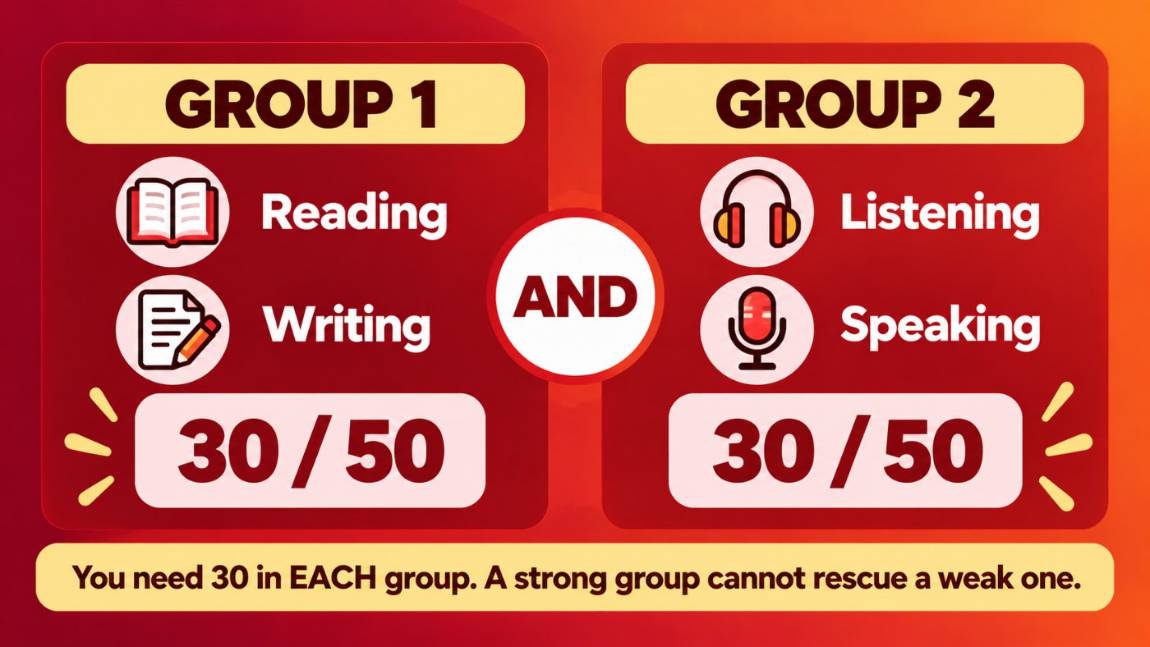
The two-block rule is the one that catches people. A candidate with excellent reading and writing and weak listening does not pass by averaging. Group 2 has to clear 30 on its own. Because listening and speaking sit together in that block at every level up to C1, the two skills most learners neglect are precisely the two that share a pass threshold.
Note also what C1 does: it stops testing skills in isolation and starts combining them. You listen and then write about what you heard; you read and then speak about what you read. A C1 candidate who has only ever practised single skills in isolation is preparing for an exam that no longer exists at that level.
Building a mock without the official papers
Time the blocks, not the pruebas. Group 1 at B2 is 150 minutes of continuous written work. That endurance is a real part of what is being tested, and it is the easiest thing to replicate without any official material at all.
Use authentic audio once. Listening is the half of Group 2 you can practise with anything — a podcast, a radio news bulletin, an interview. The discipline that matters is not the source, it is playing it once and answering from that.
Write to the clock and to the criteria. The guía del examen for your level lists what the writing is marked on. Writing a B2 task in 80 minutes while actually watching the clock is worth more than three untimed attempts.
Rehearse speaking with the preparation time. Every level gives you preparation minutes before the oral, and at C1 and C2 those minutes are substantial and structured. Candidates who have never used them under pressure arrive with notes they cannot read back.
If the mock says you are not ready
Practice material diagnoses; it does not teach. For Spanish learners at B1 and B2 the recurring gap is the verb system — our guides to the subjunctive and to ser versus estar cover the two areas that cost the most marks in written production.
If you are still deciding which Spanish certificate to sit, the DELE versus SIELE comparison covers the choice and the SIELE exam guide covers the alternative in detail — worth a look here, because SIELE is computer-based, returns results in three weeks and cannot be failed, which makes it a far better diagnostic than a DELE sitting if what you actually want is to know where you stand.
For how the levels map to study time, the Spanish proficiency roadmap and the FSI language difficulty ranking are the places to start: Spanish is a Category I language at roughly 600 to 750 class hours to professional working proficiency, and B2 sits comfortably inside that.
We have written the same guide for three other exams, and the contrast is instructive: TOPIK releases one full paper a year free with audio and answer keys, DELF publishes sample papers with the real examiner marking grids, and the Goethe-Institut gives away three or four complete papers per level. Among the major exam boards, the DELE is currently the outlier.
Frequently asked questions
Are the official DELE model exams still available?
Not at the addresses they used to be. The Instituto Cervantes migrated its exam site and the old model-exam URLs now redirect to a general DELE page with no practice material. Ask your exam centre, which holds the official models as teaching material.
Why do all the download links I find not work?
Because almost every guide linking to them was written before the migration and has not been rechecked. The links were correct when published.
What is the DELE pass mark?
Each of the two groups of pruebas is scored out of 50 and you need 30 in each. There is no overall average — a strong group cannot carry a weak one. The result is apto or no apto. C2 uses three tests and needs 20 in each.
Which pruebas are in which group?
Group 1 is reading and writing; Group 2 is listening and speaking, at every level up to C1. At C1 the pruebas combine skills, so Group 1 is the reading-plus-writing tasks and Group 2 the listening-plus-speaking tasks.
Can I prepare without official model exams?
Yes, though it takes more discipline. Time the blocks rather than individual pruebas, use authentic Spanish audio played once, write to the clock against the published assessment criteria, and rehearse the oral with the real preparation time. A published preparation book will give you full mocks if you want them.
Does the DELE expire?
No. A DELE diploma is valid for life. The SIELE, its computer-based sibling, expires after five years.