
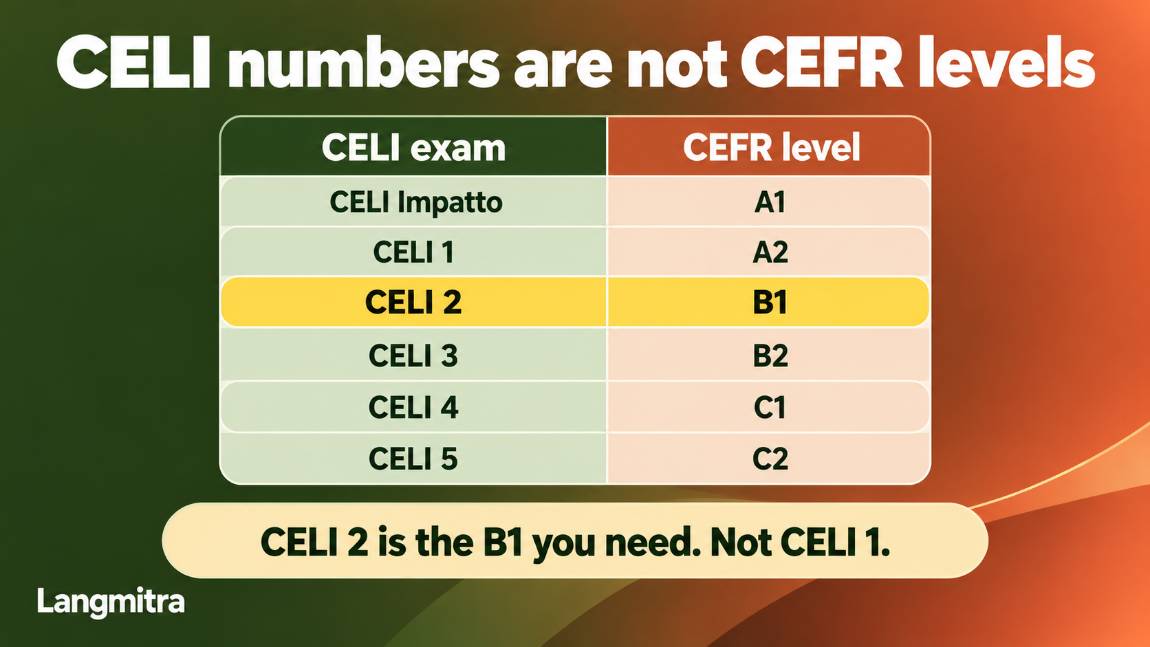
Four institutions certify Italian as a foreign language, and between them they issue five certificates that the Italian state recognises. The one trap that catches people before they have even booked: CELI's level numbers are not CEFR levels. CELI 2 is B1, not A2. Candidates who need B1 and book CELI 1 have bought the wrong exam.
Who certifies Italian
| Body | Certificate | Notes |
|---|---|---|
| Università per Stranieri di Siena | CILS | The most widely recognised internationally; five tested abilities |
| Università per Stranieri di Perugia | CELI and DILS-PG | CELI uses its own numbering; DILS-PG is aimed at immigrants |
| Società Dante Alighieri | PLIDA | Widest network of centres worldwide through Dante Alighieri committees |
| Università Roma Tre | IT | Smaller, fewer centres |
All four are recognised by the Italian Ministry of Foreign Affairs, and all of them test reading, listening, writing and speaking. They are not interchangeable in format, but they are interchangeable in recognition — no institution treats one as inherently superior.
The numbering trap
CILS names its levels after the CEFR directly — CILS A1 through CILS C2, with the older names CILS Uno (B1), Due (B2), Tre (C1) and Quattro (C2) still in circulation. PLIDA likewise uses A1 to C2.
CELI does not. Its ladder runs Impatto, then 1 to 5, and the offset means every number is one step lower than it looks. If a requirement says B1, you need CELI 2.
How the exams differ in structure
CILS tests five abilities separately: listening, reading, communication structures (grammar and vocabulary), writing and speaking. Each is scored on its own, out of 100 points total at B1 and above. The separate grammar component is the distinguishing feature — CILS is the most explicitly grammatical of the four.
CELI combines a written part and an oral part. At CELI 2 the written booklet runs two hours covering reading and writing, a second booklet of 20 minutes covers listening, and the oral runs 10 to 12 minutes. Scoring totals 160: the written part is out of 120 and the oral out of 40. To pass you need at least 72 in the written part, at least 22 in the oral, and 94 overall. Grades run A at 138 to 160, B at 115 to 137, C at 94 to 114, with D and E below.
The capitalisation rule is the difference that should decide your choice. On standard CELI, a part you have passed can be carried for one year — two sessions — so failing one component does not mean resitting everything. CILS allows this on its standard exams too. The citizenship variants are where it stops, and that is covered below.
The citizenship B1, and why it is its own exam
Italy requires B1 Italian for citizenship applications based on residency or marriage. Several bodies run a dedicated citizenship version, and it is not simply the standard B1 with a different label.
CILS B1 Cittadinanza has four tests rather than five, each worth 12 points for a maximum of 48. There is no standalone communication-structures paper; grammar is folded into a combined "reading and grammar reflection" test. Listening is two tasks in 30 minutes, reading and grammar two tasks in 40 minutes, writing a single text of 80 to 120 words in 40 minutes, and speaking is an individual recorded oral opening with a short personal introduction.
Critically, CILS B1 Cittadinanza does not allow capitalisation. You must reach the threshold in every ability, and failing any one means resitting the entire exam. On standard CELI you could have kept your passed components for a year. That single rule is the strongest argument for choosing a CELI citizenship exam over the CILS one if you are at all unsure of one skill.
CELI 2 i cittadinanza runs 2 hours 30 minutes across four equally weighted parts: reading 40 points, writing 47 converted to 40, listening 40, speaking 40. You need at least 72 of 120 in the written part and 92 of 160 overall.
One honest caveat on that last exam: published criteria sheets show the oral minimum on both a 20-point and a doubled 40-point scale, and the two readings give different thresholds. Confirm with your centre which applies before relying on a number.
On the wider requirement: citizenship rules change, exemptions exist (for example for applicants who completed schooling in Italian in Italy), and the requirement does not apply in the same way to every route. Nothing here is immigration advice — confirm the current rule with the Prefecture or consulate handling your application before booking anything.
Choosing between them
Take CILS if you want the most internationally portable certificate, or if you are heading for an Italian university — CILS B2 in particular is widely accepted in place of the universities' own language assessment.
Take CELI if you want the capitalisation safety net, or if your nearest centre offers it. Just book the right number.
Take PLIDA if access is the deciding factor. The Dante Alighieri network is the broadest, and in many countries it is simply the closest exam centre.
Take the dedicated citizenship version rather than the standard B1 if citizenship is your only purpose. It is shorter and usually cheaper. But read the capitalisation rule first — for a candidate with one weak skill, the standard exam's carry-over can be worth more than the shorter paper.
Before you book
Confirm the level against CEFR, not the exam's own name. This is the CELI numbering problem, and it is the single most common and most expensive mistake.
Check session frequency. CILS traditionally runs two main sessions a year, in June and December, with additional citizenship sittings. If you miss one, the wait is long.
Ask whether your centre offers the citizenship variant. Not every centre runs every version.
Learning the Italian underneath
A certificate is a measurement, not a method. If you are earlier in the journey, our beginner's roadmap for Italian covers the first year, and Spanish versus French may be useful if you are still choosing between Romance languages.
For how long B1 actually takes: the FSI language difficulty ranking places Italian in Category I, roughly 600 to 750 class hours to professional working proficiency for an English speaker. B1 sits well short of that — it is a realistic target inside a year of consistent study, which is worth knowing if a citizenship timeline is involved.
For how other exam boards handle their levels and practice material, see our guides to the Goethe-Zertifikat, DELF, DELE and SIELE.
Frequently asked questions
What is the difference between CILS, CELI and PLIDA?
Different issuing bodies with different formats, equal official recognition. CILS (Siena) scores five abilities including a separate grammar paper, CELI (Perugia) combines written and oral parts and uses its own level numbering, and PLIDA (Dante Alighieri) has the widest centre network.
Is CELI 1 the same as B1?
No. CELI 1 is A2. CELI 2 is B1. The numbering runs one step below the CEFR level it corresponds to, starting with CELI Impatto at A1.
Which Italian certificate is accepted for citizenship?
B1 from any of the recognised bodies — CILS, CELI, DILS-PG, PLIDA or IT. Confirm current requirements with the Prefecture or consulate handling your application, as rules and exemptions change.
What is the difference between CILS B1 and CILS B1 Cittadinanza?
The citizenship version has four tests instead of five, worth 12 points each, with grammar folded into the reading test rather than tested separately. It also does not allow capitalisation, so failing one ability means resitting the whole exam.
Can I keep a passed section if I fail another?
On standard CELI, yes — a passed part carries for one year, covering two sessions. On CILS B1 Cittadinanza, no.
Which exam is easiest?
None of them is meaningfully easier at the same CEFR level; they are calibrated to the same framework. Choose on format and logistics: CILS if you want a separate grammar paper and international portability, CELI if the carry-over rule matters to you, PLIDA if centre access decides it.