
Many language learners can understand a lesson yet freeze when a real person starts speaking. The problem is often not missing grammar. It is the gap between recognizing language and producing it at natural speed. Shadowing is one of the most direct ways to close that gap.
In shadowing, you listen to a short piece of speech and repeat it almost immediately, following the speaker's rhythm, stress and melody. You are not simply memorizing sentences. You are training your ear, mouth and attention to work together.
What is the shadowing method?
Imagine walking one step behind someone: you follow the same path, but with a small delay. Language shadowing works the same way. Play a recording and begin speaking roughly half a second behind the speaker. Try to preserve the sentence as a complete sound pattern instead of pronouncing each word separately.
Shadowing differs from ordinary listen-and-repeat practice. In listen-and-repeat, the audio stops before you speak. In shadowing, the recording continues. That pressure forces you to process connected speech in real time.
What shadowing actually improves
- Listening: you begin noticing contractions, reduced sounds and word boundaries.
- Pronunciation: your mouth rehearses unfamiliar sound combinations repeatedly.
- Rhythm and intonation: you copy the musical structure that makes speech sound natural.
- Speaking speed: common phrases become easier to retrieve as complete chunks.
- Confidence: regular recording makes your real progress audible.
Shadowing is not a complete language course. It does not replace vocabulary study, conversation, reading or grammar. It is a focused workout for turning language you partly know into language you can hear and say.
Choose the right audio
The best clip is short, clear and only slightly above your current level. Beginners should use 20–40 seconds; intermediate learners can use one or two minutes. A transcript is extremely helpful. Choose one speaker at first and avoid films with background music, overlapping dialogue or heavy slang.
A useful test is simple: after reading the transcript, can you understand at least 80 percent of the clip? If not, the material is probably too difficult for pronunciation practice. Easier audio practiced deeply beats difficult audio repeated badly.
The five-stage shadowing process
1. Preview for meaning
Read the transcript once. Look up only words that block the central meaning. Mark pauses, surprising stress and linked sounds. Do not turn the session into a 30-minute vocabulary hunt.
2. Listen without speaking
Play the clip two or three times. Tap the rhythm or notice where the speaker speeds up and slows down. Your goal is to hear the shape of the message.
3. Shadow with the transcript
Speak quietly behind the recording while reading. If you lose the speaker, rejoin at the next phrase instead of stopping every time. Accuracy matters, but maintaining the flow matters too.
4. Shadow without the transcript
Now look away. Copy the sound, emotion and timing. This reveals which parts you genuinely hear and which parts you were only reading.
5. Record and compare
Record one final attempt. Compare a single feature at a time: Was the sentence stress similar? Did you pause in the same places? Were final sounds clear? Pick one correction for tomorrow.
A practical 20-minute routine
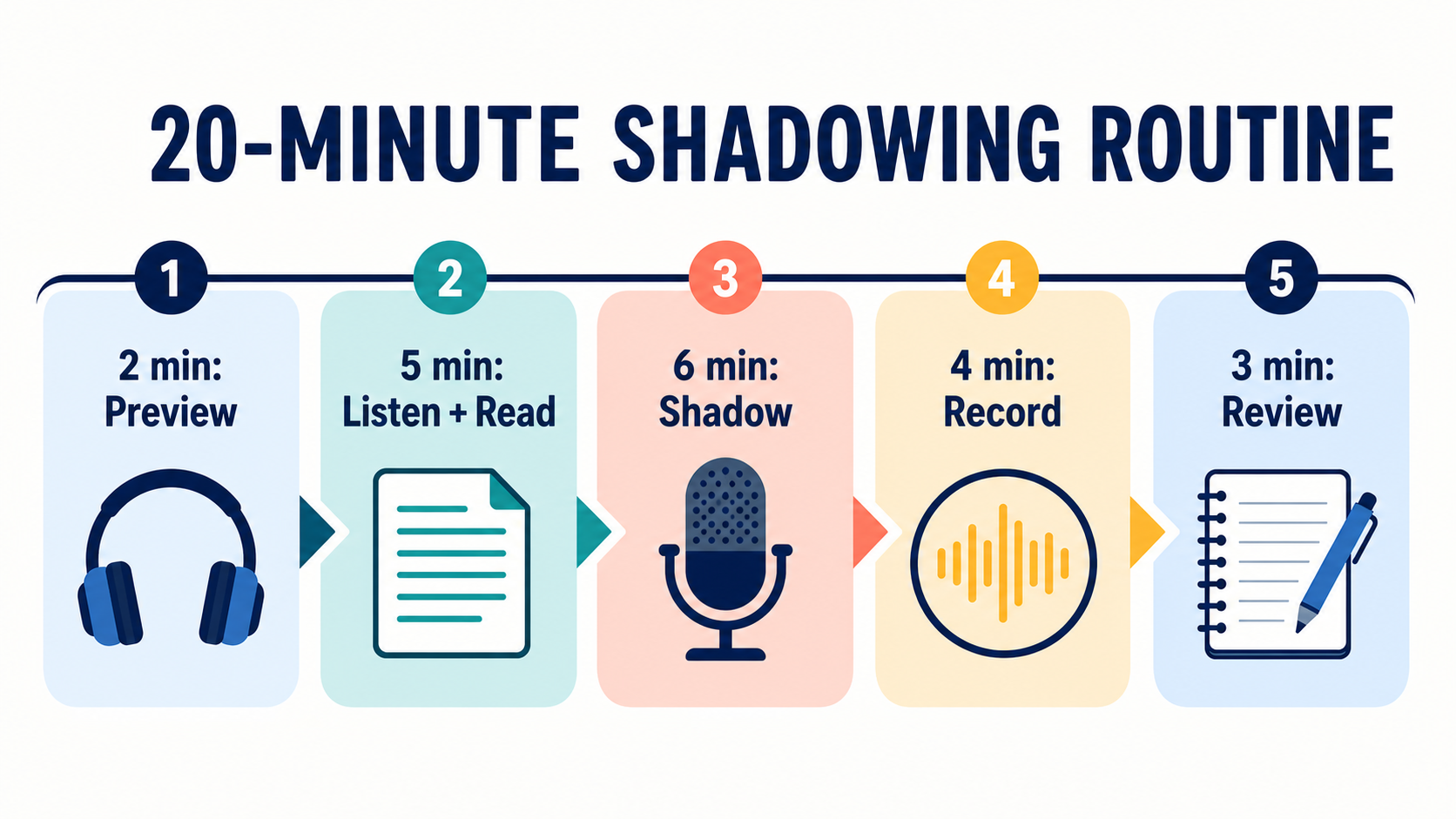
Spend two minutes previewing, five listening while reading, six shadowing, four recording and three reviewing. Use the same clip for three to five days. Repetition may feel less exciting than constantly changing material, but it is where coordination improves.
Five focused sessions per week are enough. Track the clips you finish, not a vague number of hours. After four weeks, replay your first recording beside your latest one.
How beginners should adapt shadowing
True simultaneous shadowing can overwhelm a new learner. Start with pause shadowing: listen to one phrase, pause, imitate, then replay. Next use chorusing, speaking at the same time as the recording while reading. Only then move to a small delay.
For languages with a new writing system, learn the basic script first. Romanization can help briefly, but relying on it for months often creates pronunciation habits that are hard to remove.
Common mistakes
- Using audio that is too hard: you end up mumbling rather than learning.
- Chasing an accent: aim for intelligibility and rhythm, not a new identity.
- Practising silently: shadowing is physical; your mouth must do the work.
- Never recording: memory is a poor judge of pronunciation.
- Repeating errors: slow the clip, isolate the phrase and rebuild it accurately.
- Changing clips daily: depth produces more improvement than novelty.
How to use shadowing for different languages
In French, pay attention to linking and disappearing sounds. In Spanish or Italian, copy clean vowels and syllable rhythm. In German, watch word stress and consonant endings. In Japanese, listen for mora timing and pitch movement; in Korean, focus on sound changes between syllables. The method stays the same, but the feature you monitor should match the language.
How to measure progress
Do not ask only, “Do I sound native?” Use measurable questions: Can I stay with the full clip? Do I catch words without the transcript? Is my recording easier to understand? Can I reuse two phrases in conversation? A simple monthly recording gives better evidence than daily self-criticism.
Combine this routine with a realistic study timeline using our FSI language categories guide, and use authentic material from our guide to the best multilingual podcasts. If you are building a complete system, see how to actually learn a language and compare language exchange apps for real conversation practice.
Frequently asked questions
How long should I shadow each day?
Ten to twenty focused minutes is enough for most learners. Stop when accuracy collapses; tired repetition can reinforce mistakes.
Can shadowing improve fluency?
It improves automaticity, rhythm and access to useful phrases. Fluency also requires unscripted conversation, so use shadowing as preparation rather than a substitute.
Should I use subtitles?
Use a transcript during early passes, then remove it. Target-language text is better than translated subtitles because it connects sounds to the words you are learning.
Do I need to copy a native speaker?
Use a clear, proficient model whose speech suits your goals. The quality and comprehensibility of the recording matter more than the speaker's passport.
Start today
Choose one clear 30-second clip, save its transcript and record your first attempt. Repeat it for three days. The method looks simple because it is simple—but careful repetition can change how quickly spoken language moves from your ears to your voice.