
Moving to Germany requires navigating a maze of visa types, and nearly all of them have one thing in common: you need to prove your German language ability. But which certificate do you need? The answer depends entirely on your visa category, your profession, and where you're coming from.
This guide cuts through the bureaucratic confusion and tells you exactly which German language certificate you need for each visa type in 2026.
Why German Certificates Matter for Visas
German immigration law ties language requirements directly to visa categories. The logic is straightforward: Germany wants immigrants who can integrate into society, and language is the primary tool for integration. Different visa types require different levels because the integration expectations differ.
A student visa has lower requirements because you'll learn more German while studying. A permanent residence visa has higher requirements because you're expected to participate fully in German society. Professional visas vary based on whether your job requires German-language interaction.
The certificates aren't interchangeable — German authorities accept specific exams from specific providers. Using the wrong certificate, even if it shows the right level, can delay or derail your application.
The CEFR Framework: Understanding Levels
All German language requirements reference the Common European Framework of Reference (CEFR). The levels you'll encounter in visa applications are:
A1 (Beginner): Can understand and use basic everyday expressions. Can introduce yourself and ask simple personal questions. Required for: spouse/family reunion visas.
A2 (Elementary): Can communicate in simple, routine tasks. Can describe your background and immediate environment. Required for: some work visas, settlement permit prerequisites.
B1 (Intermediate): Can deal with most situations while traveling in Germany. Can produce simple connected text on familiar topics. Required for: permanent settlement permit, citizenship, some professional visas.
B2 (Upper Intermediate): Can interact with native speakers fluently. Can produce detailed text on a wide range of subjects. Required for: healthcare professions, teaching, some regulated professions.
C1 (Advanced): Can use German flexibly for social, academic, and professional purposes. Required for: university admission (in some cases), medical licensing, certain specialized professions.
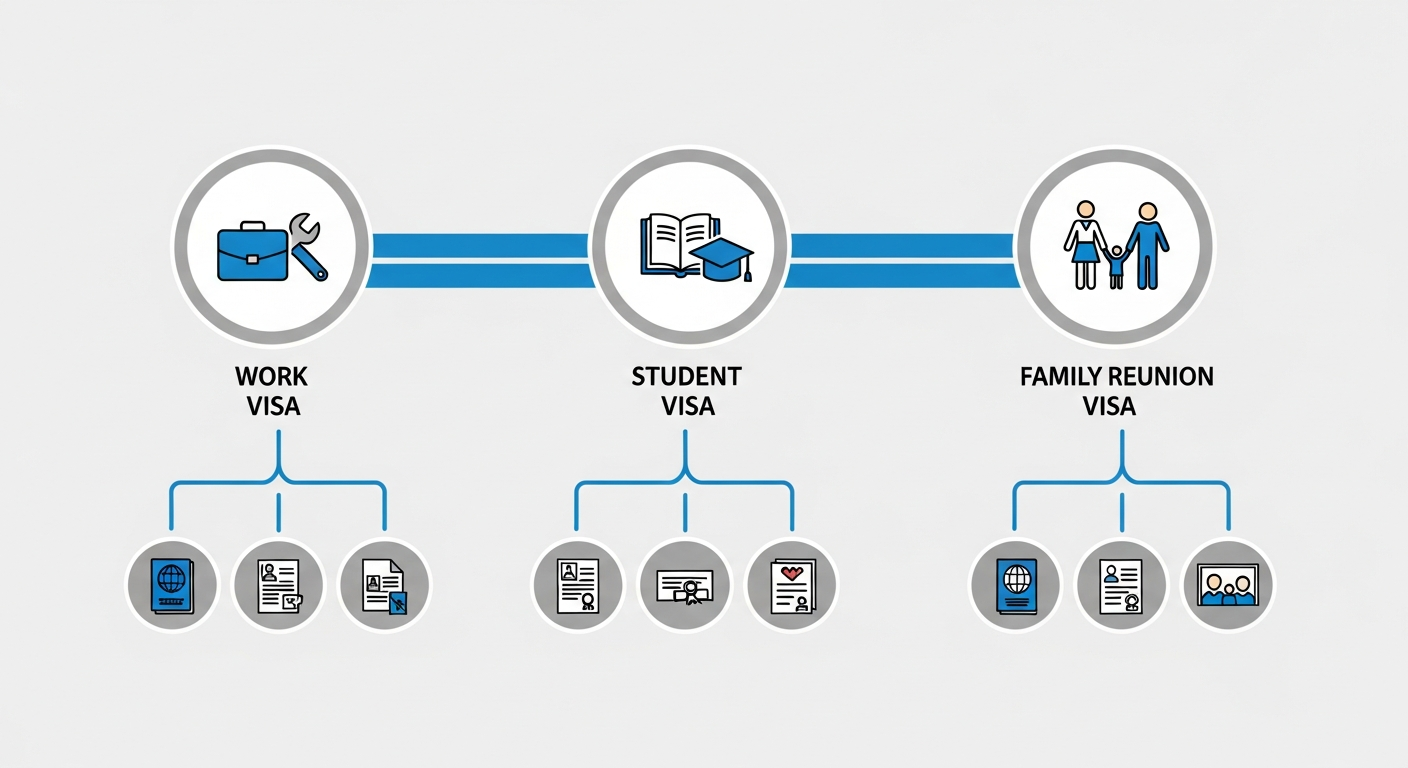
Visa Type: Family Reunion (Spouse Visa)
Required level: A1 (basic)
Accepted certificates: Goethe-Zertifikat A1: Start Deutsch 1, telc Deutsch A1, ÖSD Zertifikat A1
This is the most common visa-related language requirement. If you're joining your spouse in Germany, you must prove basic German ability before the visa is issued. The A1 requirement applies to spouses of German citizens and spouses of non-EU residents with a settlement permit.
Exceptions: Citizens of the US, Canada, Australia, Japan, South Korea, Israel, and other privileged nations are exempt from the A1 requirement for spouse visas. EU/EEA citizens are also exempt. Additionally, if you hold a university degree or your spouse holds an EU Blue Card, the requirement may be waived.
Practical tip: The Goethe-Zertifikat A1 is the most widely accepted and recognized. If you're unsure which to take, choose Goethe — no embassy will question it.
Visa Type: Student Visa
Required level: B1-C1 (varies by program)
Accepted certificates: TestDaF (TDN 4 in all sections for full admission), DSH-2 or DSH-3, Goethe-Zertifikat C1 or C2, telc Deutsch C1 Hochschule
For German-taught degree programs, universities set their own language requirements, but most require TestDaF TDN 4 or DSH-2. Some preparatory courses (Studienkolleg) accept B1 or B2 for enrollment.
For English-taught programs: Language requirements are much lower or non-existent for the German component. Some universities accept A2 or B1 for English-taught Master's programs, while others have no German requirement at all. You'll still benefit from having German for daily life.
The student visa itself doesn't technically require a specific German level — it's the university admission that does. But you'll need to show university admission (which requires the language certificate) to get the visa.
Visa Type: Work Visa (Skilled Worker / Fachkräfteeinwanderung)
Required level: Varies (A1-B2 depending on profession)
Accepted certificates: Goethe-Zertifikat (any level), telc (any level), ÖSD (any level), TestDaF
The 2020 Skilled Immigration Act (Fachkräfteeinwanderungsgesetz), updated in 2024, created more flexible pathways for skilled workers. Language requirements depend on your specific situation:
IT professionals: Often no formal German requirement if the company language is English. Some employers accept A1 or A2 as sufficient.
Engineers and technical professionals: Typically B1-B2, though requirements vary by employer and region.
Healthcare workers (nurses, doctors): B2 minimum, often B2-C1 depending on the state (Bundesland). Medical licensing (Approbation) requires C1 in most states.
Skilled trades: Usually B1, as direct communication with clients and colleagues is essential.
The EU Blue Card for highly qualified workers has reduced language requirements — often A1 is sufficient at the time of visa application, with higher levels expected within a set timeframe after arrival.

Visa Type: Permanent Settlement Permit (Niederlassungserlaubnis)
Required level: B1
Accepted certificates: Goethe-Zertifikat B1, telc Deutsch B1, ÖSD Zertifikat B1, DTZ (Deutsch-Test für Zuwanderer) at B1 level
After living in Germany for five years on a temporary residence permit, you can apply for permanent settlement. The B1 requirement is mandatory, along with other conditions like financial stability and pension contributions.
Integration course completion can satisfy this requirement. If you complete the government-mandated integration course (Integrationskurs) and pass the final DTZ exam at B1 level, this counts as your language proof.
EU Blue Card holders can apply for permanent settlement after 21 months if they have B1 German, or after 33 months with A1 German.
Visa Type: German Citizenship (Einbürgerung)
Required level: B1 (standard) or B2 (for reduced residency requirement)
Accepted certificates: Goethe-Zertifikat B1/B2, telc Deutsch B1/B2, DTZ at B1, ÖSD Zertifikat B1/B2
Citizenship normally requires 8 years of legal residence plus B1 German. However, with B2 or higher and special integration achievements, the residency requirement can be reduced to 6 years — and in exceptional cases, even 5 years.
You also need to pass the citizenship test (Einbürgerungstest), which covers German politics, history, and society. This test is in German, so your language skills need to be functional enough to understand and answer 33 multiple-choice questions.
Which Certificate Provider Should You Choose?
Goethe-Institut: The gold standard. Accepted everywhere, no questions asked. Available worldwide through Goethe-Institut centers. More expensive but the safest choice for visa purposes.
telc: Widely accepted and often cheaper than Goethe. The telc Deutsch C1 Hochschule is specifically designed for university admission. Good option if there's a test center near you.
TestDaF: The standard for university admission. Administered at TestDaF centers worldwide. Not typically used for immigration purposes outside of university admission.
ÖSD (Austrian German Diploma): Accepted by German authorities for visa purposes. Can be a good option if ÖSD test centers are more accessible in your country.
DSH: Only available in Germany, administered by universities. Used exclusively for university admission. You'd typically take this after arriving on a student visa or during a preparatory course.
Common Mistakes to Avoid
Taking the wrong certificate. Some language schools offer their own certificates that are not recognized by German authorities. Only certificates from Goethe, telc, ÖSD, TestDaF, and DSH are accepted for visa purposes. Ask your embassy specifically which certificates they accept before taking any exam.
Letting your certificate expire. Most German language certificates don't technically expire, but some visa authorities prefer certificates less than two years old. For university admission, some institutions require certificates issued within the last two years. Check the specific requirement before submitting an old certificate.
Assuming English is enough. Even in international companies, German immigration authorities require German language proof for most visa categories. Don't assume your excellent English will substitute for the German requirement.
Not checking state-specific requirements. Germany's federal system means requirements can vary by Bundesland. Healthcare licensing requirements, for example, differ between Bavaria and Berlin. Always verify with the specific authority in your destination state.
Planning Your Timeline
If you're starting from zero German, here's a realistic timeline to reach each level:
A1 takes 2-3 months of regular study (8-10 weeks of an intensive course or 3-4 months of evening classes). A2 takes an additional 2-3 months after A1. B1 takes 6-9 months total from zero. B2 takes 9-14 months total from zero. C1 takes 14-20 months total from zero.
For visa applications, start your language preparation as early as possible. Don't wait until you've found a job or received a university offer — the language certificate often takes longer to obtain than the visa itself.
For a detailed comparison of all German language certificates and which to choose for your specific situation, see our German Certifications Compared guide.