
France remains one of the world's most visited countries, drawing over 90 million tourists annually to its iconic cities, sun-drenched countryside, and world-class cuisine. While many people in French tourist areas speak some English, knowing even basic French phrases transforms your travel experience. Locals genuinely appreciate the effort, service becomes warmer, and you can venture beyond tourist zones with confidence.
This guide covers the essential French phrases you'll actually need — organized by real travel situations so you can find what you need quickly.
Pronunciation Quick Start
Before diving into phrases, here are four pronunciation rules that will instantly make your French more understandable.
Final consonants are usually silent. The word "Paris" is pronounced "pa-REE" (not "pa-RISS"). Words ending in s, t, d, x, and p almost always drop the final sound. The major exception is words ending in c, r, f, and l (think "CaReFuL" as a memory trick).
The nasal vowels are French's most distinctive sounds. When you see "an/en," "on," or "in/un," the vowel is pronounced through the nose without fully closing into the n sound. Practice by saying "on" but stopping before your tongue touches the roof of your mouth.
The French "r" is produced in the back of the throat, almost like a gentle gargle. Don't try to roll it like Spanish — it's closer to the sound you make when clearing your throat softly.
Stress always falls on the last syllable of a phrase. Unlike English, which stresses different syllables in different words, French has a predictable rhythm that makes it sound smooth and flowing.
Greetings and Polite Basics
These are non-negotiable. Using them consistently is the single biggest factor in how French people respond to you.
"Bonjour" (bohn-ZHOOR) means good day and is the universal greeting until evening. Use it when entering any shop, restaurant, or interaction. "Bonsoir" (bohn-SWAHR) takes over in the evening. Simply walking into a bakery and saying "Bonjour" before placing your order completely changes the dynamic.
"S'il vous plaît" (seel voo PLEH) means please and should accompany virtually every request. "Merci" (mair-SEE) is thank you, and "merci beaucoup" (mair-SEE boh-KOO) means thank you very much. "De rien" (duh ree-EN) means you're welcome.
"Excusez-moi" (ex-koo-zay-MWAH) is excuse me, used to get someone's attention or apologize for bumping into them. "Pardon" (par-DOHN) works similarly and is slightly more casual.
"Au revoir" (oh ruh-VWAHR) means goodbye. "Bonne journée" (bun zhoor-NAY) means have a good day and is a warm way to end an interaction.
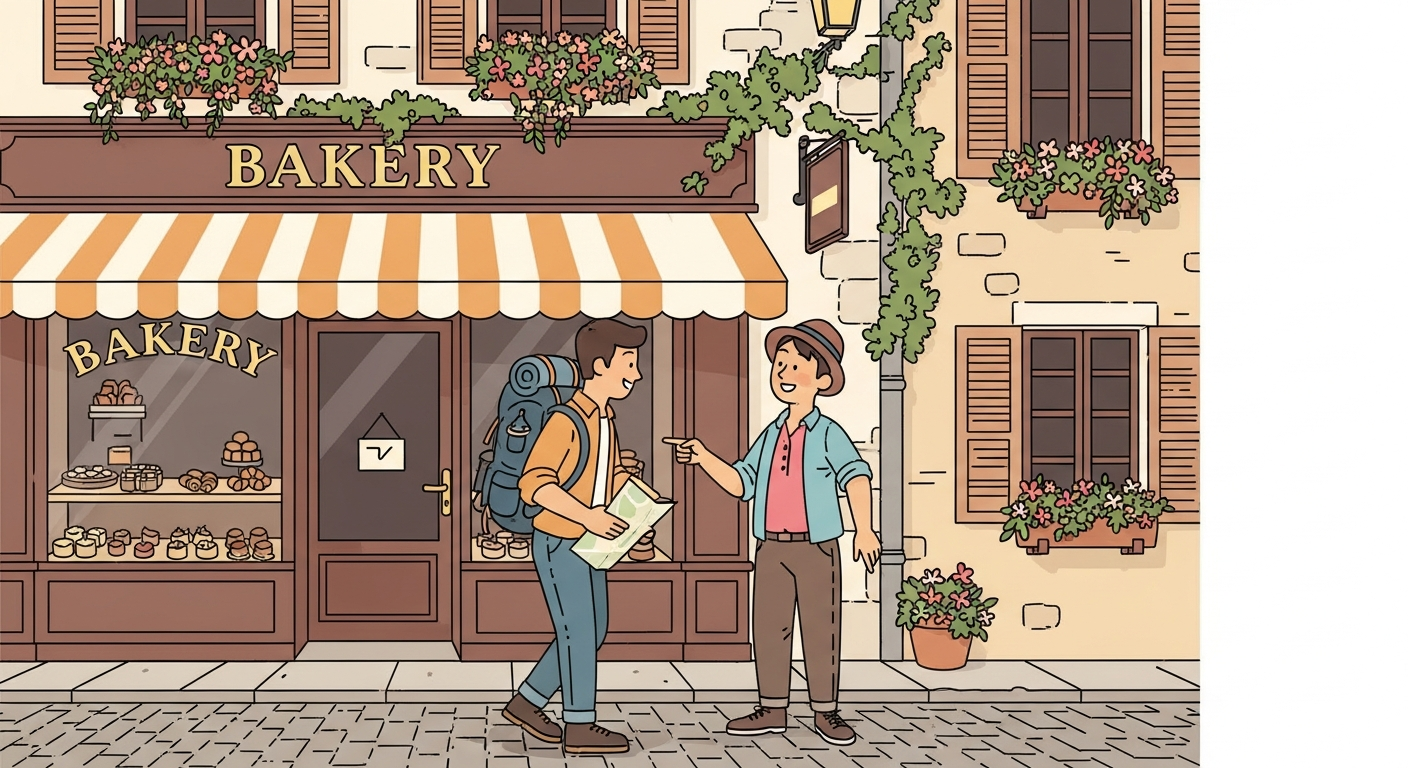
Getting Around: Directions and Transportation
Asking for help navigating is one of the most common needs for travelers.
"Où est…?" (oo EH) means where is…? Combine it with your destination: "Où est la gare?" (where is the train station?), "Où est le métro?" (where is the metro?), "Où est la pharmacie?" (where is the pharmacy?). For asking about restrooms: "Où sont les toilettes?" (oo sohn lay twa-LET).
"Je cherche…" (zhuh SHAIRSH) means I'm looking for… This works when you're lost or searching for a specific place: "Je cherche le musée d'Orsay" (I'm looking for the Orsay Museum).
"À gauche" (ah GOHSH) means to the left. "À droite" (ah DRWAHT) means to the right. "Tout droit" (too DRWAH) means straight ahead. "C'est loin?" (say LWAHN) means is it far? "C'est près d'ici?" (say PREH dee-SEE) means is it near here?
For public transportation: "Un billet, s'il vous plaît" (uhn bee-YAY) means one ticket, please. "Un aller simple" (uhn ah-LAY SAHM-pluh) is a one-way ticket. "Un aller-retour" (uhn ah-LAY ruh-TOOR) is a round trip. "À quelle heure part le train pour…?" (ah kel UHR par luh TRAHN poor) means what time does the train leave for…?
For taxis and rideshares: "Pouvez-vous m'emmener à…?" (poo-vay VOO mam-NAY ah) means can you take me to…? "Combien ça coûte?" (kohm-bee-EN sah KOOT) means how much does it cost? "Arrêtez ici, s'il vous plaît" (ah-reh-TAY ee-SEE) means stop here, please.
At Restaurants and Cafés
Dining is sacred in France, and the right phrases make the experience so much better.
"Une table pour deux, s'il vous plaît" (oon TAH-bluh poor DUH) means a table for two, please. "La carte, s'il vous plaît" (lah KART) asks for the menu. "Qu'est-ce que vous recommandez?" (kess-kuh voo ruh-koh-mahn-DAY) means what do you recommend? — a question that French servers love answering.
Ordering: "Je voudrais…" (zhuh voo-DREH) means I would like… This is the polite way to order anything. "Je vais prendre…" (zhuh VAY PRAHN-druh) means I'll have… For drinks: "Un café" (uhn kah-FAY) is an espresso (the default in France), "un café crème" (uhn kah-FAY KREHM) is coffee with steamed milk, "un verre de vin rouge/blanc" (uhn vehr duh VAHN roozh/blahn) is a glass of red/white wine, "une carafe d'eau" (oon kah-RAHF DOH) is a carafe of tap water (free in France — always ask for this instead of buying bottled).
Dietary needs: "Je suis végétarien/végétarienne" (zhuh SWEE vay-zhay-tah-ree-EN) means I'm vegetarian. "Je suis allergique à…" (zhuh SWEE ah-lair-ZHEEK ah) means I'm allergic to… Common allergens: "les noix" (nuts), "le gluten" (gluten), "les produits laitiers" (dairy).
Finishing up: "L'addition, s'il vous plaît" (lah-dee-see-OHN) means the check, please. In France, the waiter won't bring the bill until you ask — lingering at your table is expected and welcome. Tipping is not obligatory (service is included in prices), but leaving a euro or two for good service is appreciated.
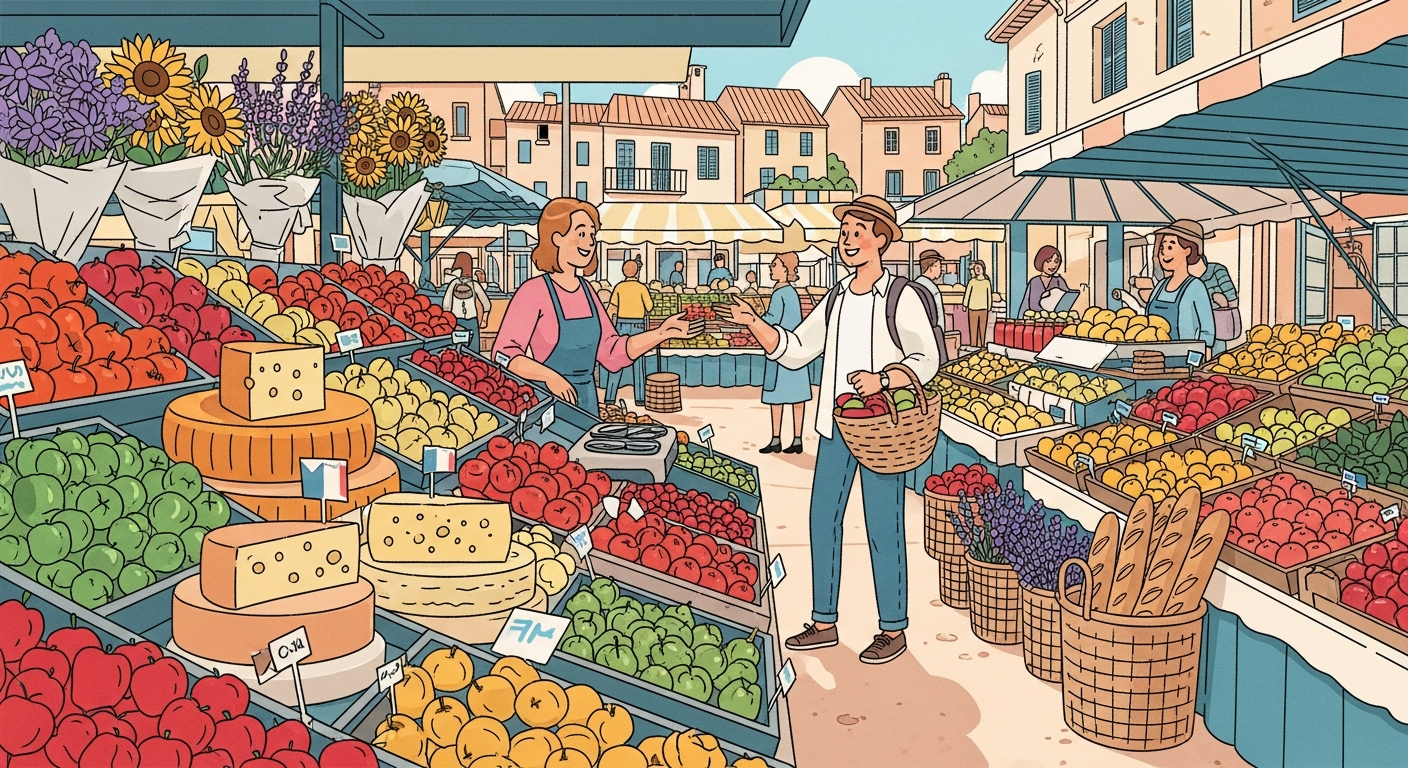
Shopping and Markets
At shops and markets: "Je regarde" (zhuh ruh-GARD) means I'm just looking — useful when a shop assistant approaches. "Combien ça coûte?" (kohm-bee-EN sah KOOT) means how much is this? "C'est trop cher" (say TROH SHAIR) means it's too expensive (useful at flea markets where haggling is acceptable).
"Est-ce que vous avez…?" (ess-kuh voo zah-VAY) means do you have…? "Quelle taille?" (kel TIE-yuh) means what size? "Je peux essayer?" (zhuh PUH eh-say-YAY) means can I try it on?
At bakeries and food shops (where you'll likely visit daily): "Une baguette, s'il vous plaît" — the essential French phrase. "Deux croissants" (duh kwah-SAHN). "Un pain au chocolat" (uhn PAHN oh shoh-koh-LAH). Point at pastries and say "Je voudrais celui-là" (I'd like that one) or "celui-ci" (this one).
Emergency and Essential Phrases
These are the phrases you hope you won't need but should definitely know.
"Aidez-moi!" (ay-day-MWAH) means help me! "Appelez la police" (ah-play lah poh-LEES) means call the police. "J'ai besoin d'un médecin" (zhay buh-ZWAHN duhn mayd-SAHN) means I need a doctor. "Où est l'hôpital le plus proche?" (oo eh low-pee-TAL luh plew PROHSH) means where is the nearest hospital?
"Je ne comprends pas" (zhuh nuh kohm-PRAHN pah) means I don't understand. "Parlez-vous anglais?" (par-lay VOO ahn-GLEH) means do you speak English? — use this as a backup, not an opener. Always try French first. "Pouvez-vous parler plus lentement?" (poo-vay VOO par-LAY plew lahnt-MAHN) means can you speak more slowly?
"Je suis perdu/perdue" (zhuh SWEE pair-DOO) means I'm lost. "Mon passeport a été volé" (mohn pass-POR ah ay-TAY voh-LAY) means my passport was stolen. "Où est l'ambassade?" (oo eh lahm-bah-SAHD) means where is the embassy?
Cultural Tips That Make a Difference
Beyond phrases, a few cultural habits will significantly improve your interactions in France.
Always greet before asking anything. Walking up to someone and immediately asking for directions in any language is considered rude. Start with "Bonjour" or "Excusez-moi" and pause for acknowledgment before continuing.
Attempt French first, even if your pronunciation is terrible. A genuine "Bonjour, est-ce que vous parlez anglais?" shows respect and almost always gets a warmer response than leading with English.
Say "au revoir" when leaving any shop, even if you didn't buy anything. This small courtesy is deeply ingrained in French social norms.
Learn numbers 1-20 at minimum. You'll need them for prices, addresses, times, and ordering. The French number system gets quirky above 69 (seventy is "soixante-dix" — literally sixty-ten), but you can always fall back on showing your phone screen for larger numbers.
Practice Before You Go
Spend even 15 minutes a day for two weeks before your trip practicing these phrases. Use YouTube pronunciation videos to hear the sounds, record yourself and compare, and practice the phrases that match your specific trip plans.
For a deeper dive into French language learning, check out our guide to the DALF C1/C2 advanced French certification if you're serious about French, or explore our best language learning apps for 2026 for tools that can help you prepare. And if you're deciding between multiple languages for your travels, our easiest languages to learn guide can help you plan your next linguistic adventure.
Bon voyage!