
You don't need to be fluent in Korean to have an incredible trip to South Korea. But knowing the right 50 phrases makes the difference between a tourist experience and a real connection with the places and people you encounter.
This isn't a random list of textbook Korean. These are the phrases you'll actually use — organized by the situations you'll find yourself in, from landing at Incheon Airport to ordering your last bowl of bibimbap.
All phrases use the polite speech level (해요체), which is appropriate for virtually every travel situation.
Survival Basics
These five phrases will get you through 80% of daily interactions:
안녕하세요 (annyeonghaseyo) — Hello. Use this everywhere: entering shops, greeting hotel staff, meeting people. Accompanied by a slight bow (just a head nod, not a deep bow).
감사합니다 (gamsahamnida) — Thank you. The formal version that works in every situation. You can also use the slightly softer 고마워요 (gomawoyo) in casual settings.
죄송합니다 (joesonghamnida) — I'm sorry / Excuse me. Use when bumping into someone, getting attention, or apologizing. For getting past someone in a crowd, 잠시만요 (jamsimanyo, "just a moment") also works.
네 (ne) — Yes. Also used to acknowledge that you're listening, similar to "uh-huh."
아니요 (aniyo) — No. Polite form. You'll use this less than you think — Korean culture tends to avoid direct refusal.
At the Airport and Transportation
택시 타는 곳이 어디예요? (taeksi taneun gosi eodiyeyo?) — Where is the taxi stand?
이 주소로 가 주세요 (i jusoro ga juseyo) — Please go to this address. Show your phone with the address in Korean — most taxi drivers don't read English addresses well.
얼마예요? (eolmayeyo?) — How much is it? This is your most-used shopping and transportation phrase.
카드 돼요? (kadeu dwaeyo?) — Can I pay by card? Korea is extremely card-friendly. Most places accept both credit cards and Korean mobile payment apps. Cash is rarely needed outside traditional markets.
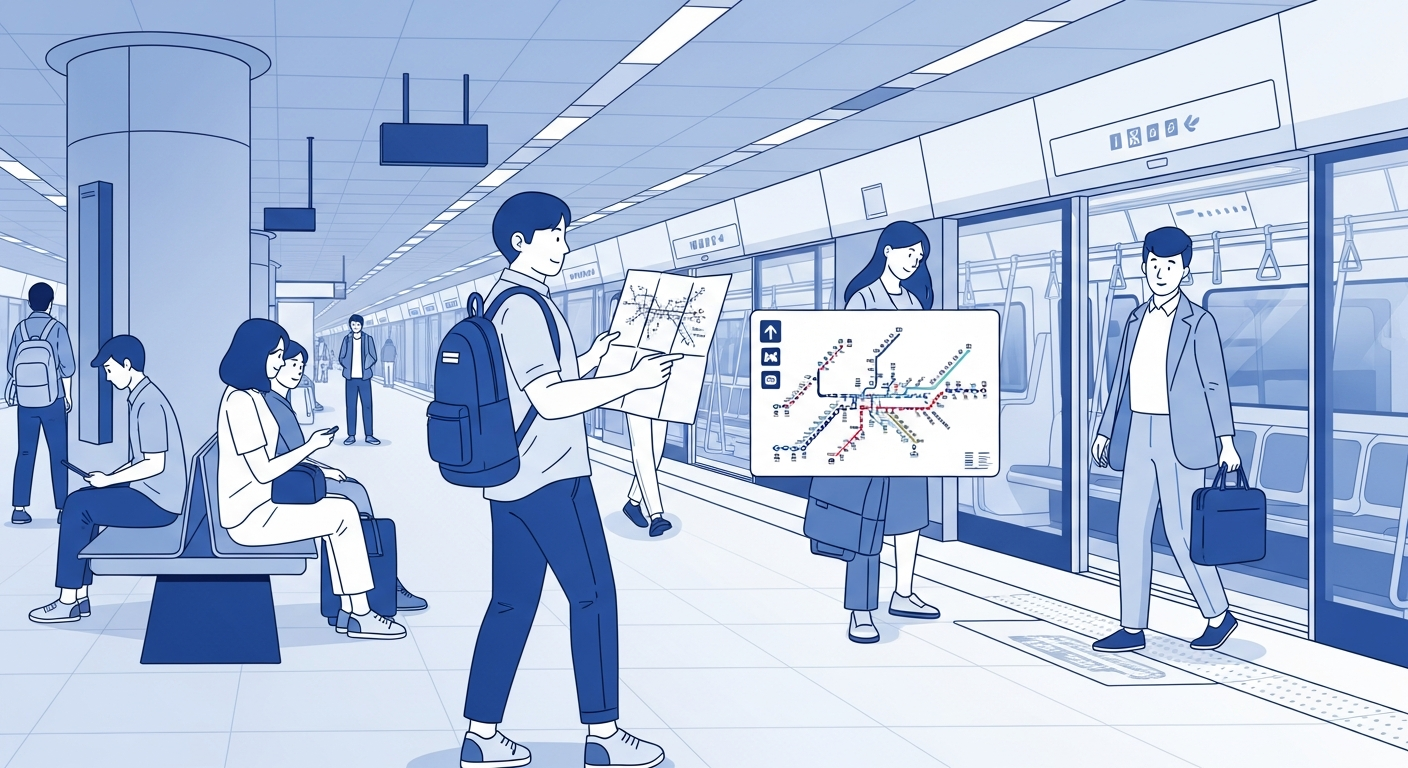
지하철역이 어디예요? (jihacheol-yeogi eodiyeyo?) — Where is the subway station? Seoul's subway system is excellent and signs are in Korean and English, but this phrase helps when you're walking around and can't find the entrance.
Ordering Food
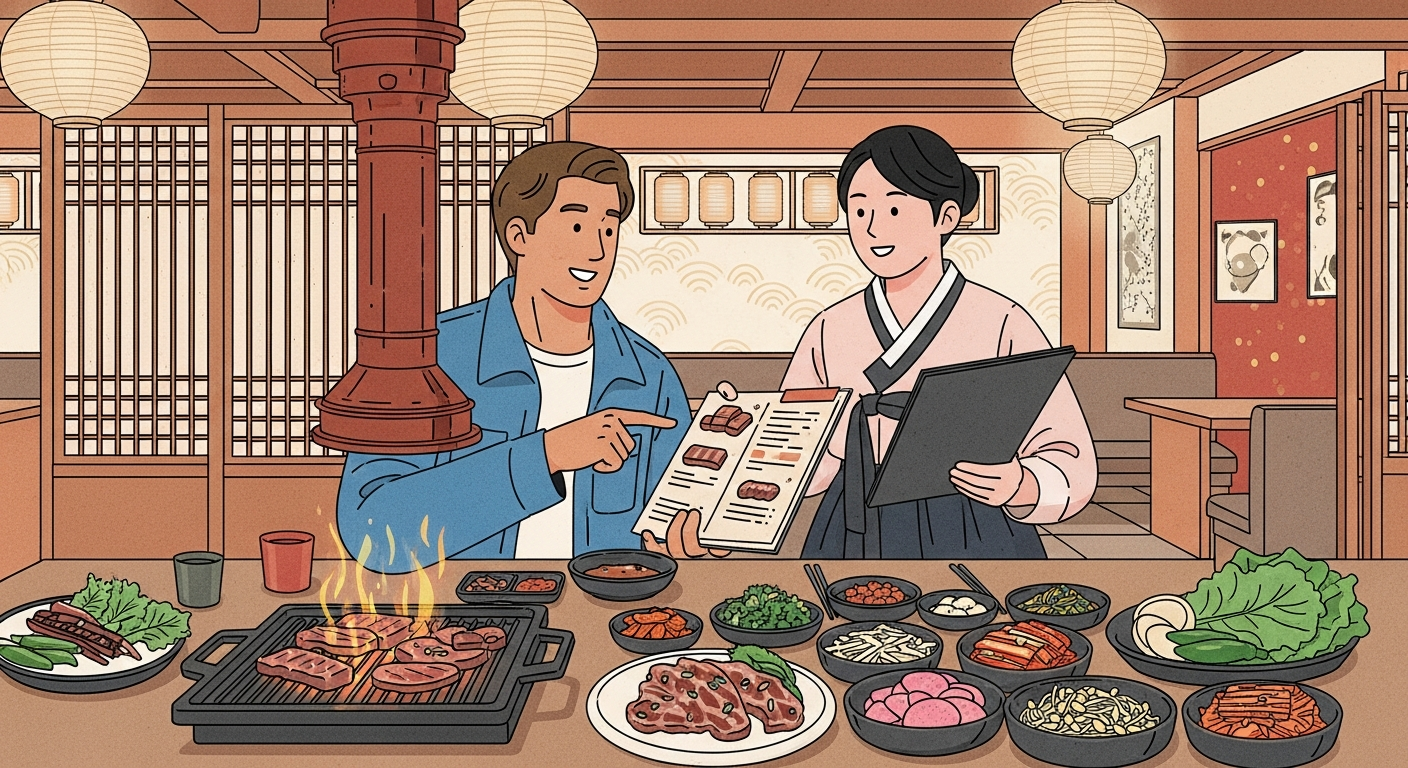
Korean food culture is one of the highlights of any trip. These phrases turn you from a confused tourist pointing at pictures into someone who can actually communicate with restaurant staff.
메뉴판 주세요 (menyu-pan juseyo) — Please give me the menu.
추천 메뉴가 뭐예요? (chucheon menyuga mwoyeyo?) — What do you recommend? This is gold. Korean restaurant owners love recommending their best dishes, and you'll often get something better than what you would have picked yourself.
이거 주세요 (igeo juseyo) — Please give me this one. Point at the menu or at someone else's dish. Simple and effective.
이거 두 개 주세요 (igeo du gae juseyo) — Two of these, please. For counting: 하나 (hana, one), 둘 (dul, two), 셋 (set, three), 넷 (net, four), 다섯 (daseot, five).
덜 맵게 해 주세요 (deol maepge hae juseyo) — Please make it less spicy. Essential for travelers who aren't used to Korean spice levels. Many Korean dishes come in adjustable spice levels.
안 맵게 해 주세요 (an maepge hae juseyo) — Please make it not spicy at all.
물 주세요 (mul juseyo) — Water, please. Water is usually free in Korean restaurants, but you might need to ask.
계산이요 (gyesaniyo) — Check, please. In many Korean restaurants, you pay at the counter when leaving rather than at the table.
맛있어요! (masisseoyo!) — It's delicious! Saying this to the cook or server will earn you genuine smiles. Koreans take great pride in their food.
배불러요 (baebulleoyo) — I'm full. Useful when your Korean host keeps trying to feed you more (this will happen).
Shopping and Markets
이거 얼마예요? (igeo eolmayeyo?) — How much is this?
너무 비싸요 (neomu bissayo) — It's too expensive. Acceptable to use at traditional markets where bargaining is expected. Do not use this in regular stores.
깎아 주세요 (kkakka juseyo) — Please give me a discount. Works at Namdaemun Market, Dongdaemun Market, and other traditional markets. Not appropriate at department stores or chain shops.
카드 돼요? (kadeu dwaeyo?) — Can I pay by card? (Worth repeating — you'll use this constantly.)
봉투 주세요 (bongtu juseyo) — Please give me a bag. Korea charges for plastic bags at most stores, but the fee is minimal.
영수증 주세요 (yeongsujeung juseyo) — Please give me a receipt. Important for tax-free shopping if you're spending over the minimum threshold.
Getting Around
여기가 어디예요? (yeogiga eodiyeyo?) — Where is this place? Show your phone with the location.
길을 잃었어요 (gireul ireosseoyo) — I'm lost. Koreans are generally very helpful to lost tourists. Many younger Koreans speak some English and will go out of their way to help.
걸어서 갈 수 있어요? (georeoseo gal su isseoyo?) — Can I walk there?
얼마나 걸려요? (eolmana geollyeoyo?) — How long does it take?
화장실이 어디예요? (hwajangsiri eodiyeyo?) — Where is the restroom? Korea has abundant public restrooms, especially in subway stations, but they're not always easy to find in buildings.
Wi-Fi 있어요? (waipai isseoyo?) — Do you have Wi-Fi? Korea has excellent connectivity, but the password might not be obvious.
Emergencies and Health
도와주세요 (dowajuseyo) — Please help me. For genuine emergencies.
병원이 어디예요? (byeongwoni eodiyeyo?) — Where is the hospital?
약국이 어디예요? (yakgugi eodiyeyo?) — Where is the pharmacy? Korean pharmacies are everywhere and pharmacists can often recommend over-the-counter remedies.
알레르기가 있어요 (allereugi-ga isseoyo) — I have allergies. Follow with the allergen: 땅콩 (ttangkong, peanuts), 우유 (uyu, milk), 해산물 (haesanmul, seafood), 밀 (mil, wheat).
경찰서가 어디예요? (gyeongchalseo-ga eodiyeyo?) — Where is the police station? Korea is very safe, but good to know just in case.
Social Phrases That Win Hearts
한국어 잘 못해요 (hangugeo jal motaeyo) — I don't speak Korean well. Koreans will immediately appreciate that you're trying and often switch to whatever shared language works best.
한국어로 뭐예요? (hangugeoro mwoyeyo?) — What is this in Korean? Point at something and ask. People love teaching you Korean words.
사진 찍어 주세요 (sajin jjigeo juseyo) — Please take my photo.
같이 사진 찍어도 돼요? (gachi sajin jjigeodo dwaeyo?) — Can we take a photo together? Useful when you want a photo with someone.
잘 먹겠습니다 (jal meokgesseumnida) — Said before eating, literally "I will eat well." This shows respect to the person who prepared or is paying for the food. Koreans say this before every meal.
잘 먹었습니다 (jal meogeosseumnida) — Said after eating, literally "I ate well." The complement to the phrase above.
건배! (geonbae!) — Cheers! Used when drinking. Korean drinking culture is social and these moments of shared cheers build connections fast.
Pronunciation Tips for Travel
Korean pronunciation doesn't need to be perfect for travel — Koreans are used to foreigners attempting Korean and are very forgiving. But a few tips that help:
The double consonants (ㄲ, ㄸ, ㅃ, ㅆ, ㅉ) require tensing your throat. Think of the difference between "sky" (tense s) and "sigh" (relaxed s). The first consonant in "sky" is closer to what Korean double consonants sound like.
The vowel ㅓ (eo) is the trickiest for English speakers. It's not "oh" and it's not "uh" — it's in between. Listen to any Korean drama character say 어 (eo, which means "yeah" in casual speech) and imitate the sound.
When in doubt, speak slightly slower and enunciate clearly. Speed is less important than clear pronunciation.
For a deeper dive into Korean pronunciation and the alphabet, check out our guide to learning Hangul in a weekend.